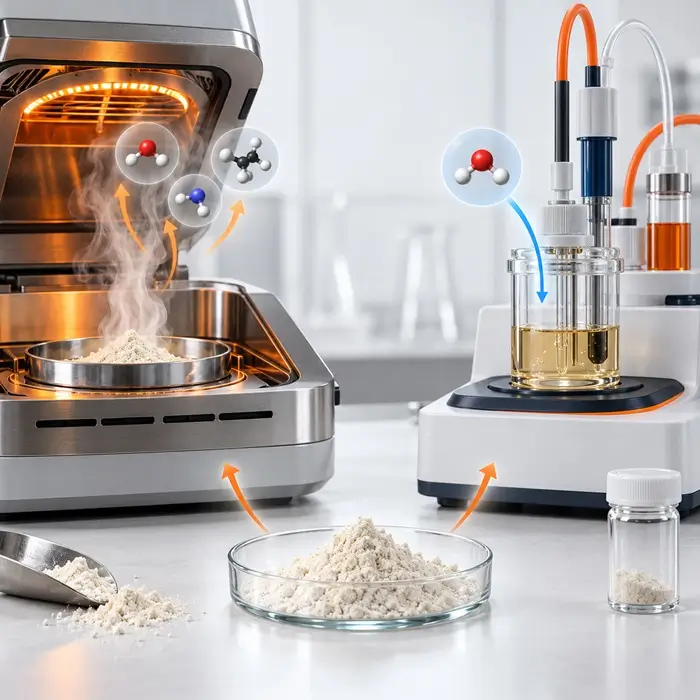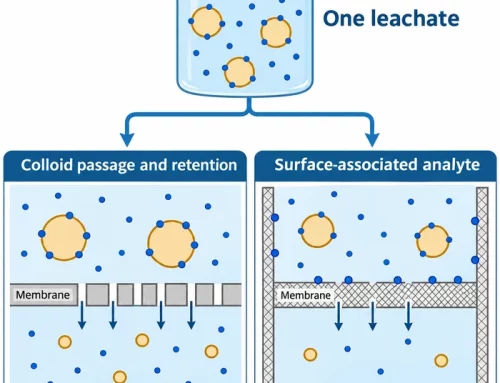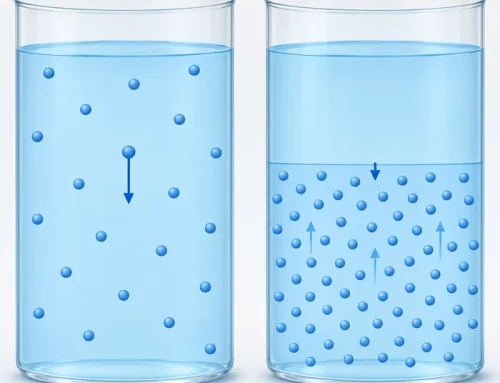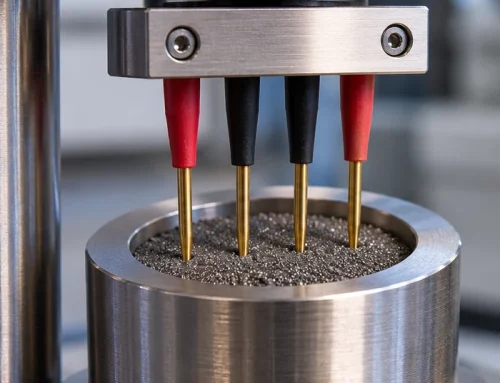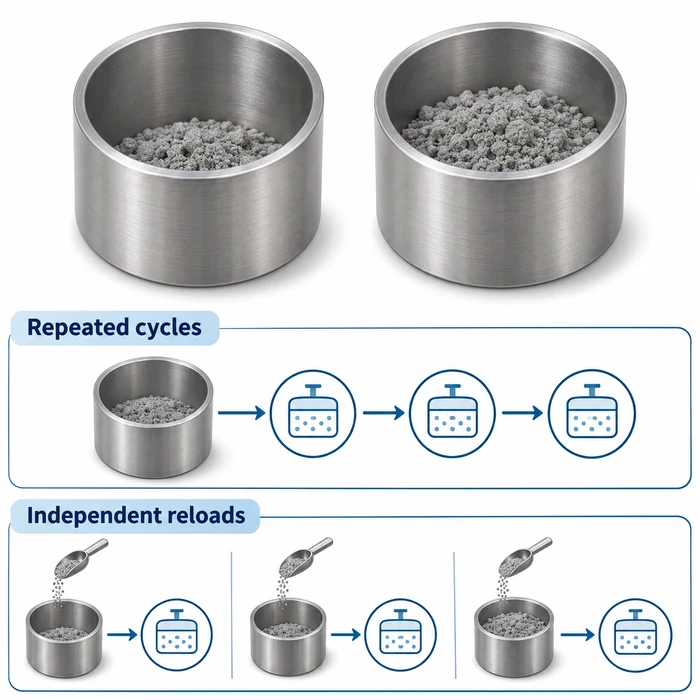
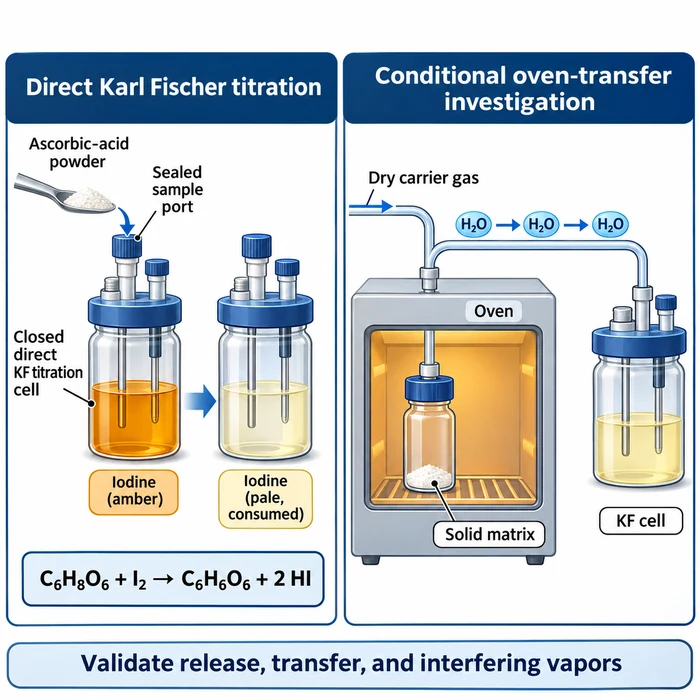
Direct contact permits ascorbic acid to consume iodine. Oven transfer separates the sample from the cell, but requires validation of water release and exclusion of interfering vapors.
An unexpectedly high direct Karl Fischer result for an ascorbic-acid powder raises a specific question: how much iodine consumption represents water? A repeatable endpoint can still include a repeatable chemical interference.
Consider a proposed investigation using representative aliquots from one homogenized lot, with matched storage, closure, and exposure records. Direct contact and an alternative preparation can differ, but the aliquots should share the same sample history. The decision is whether the direct result is suitable for reporting as water content.
Why Can the Result Read High?
Karl Fischer analysis relates iodine consumption to water through the KF reaction. Ascorbic acid provides another iodine-consuming route: oxidation to dehydroascorbic acid. Metrohm documents the following reaction in its section on reducing-agent interference.
C₆H₈O₆ + I₂ → C₆H₆O₆ + 2 HI
The equation contains no water product. It consumes one mole of iodine per mole of ascorbic acid, which the source identifies as simulating one mole of water. Ascorbic acid’s molar mass (176.12 g/mol) relative to water’s (18.015 g/mol) puts complete oxidation at roughly 10.23% apparent water for the pure compound; this is reaction stoichiometry, not a measured interference, and should not be subtracted from a powder result. The contribution actually reached in a working method depends on reagent exposure and reaction conditions.
Compare Direct KF Against Blanks and Repeats
First inspect weighing, exposure, reagent formulation, solvent, extraction time, endpoint, blank correction, and reporting basis. Establish whether the disagreement exceeds applicable method precision and uncertainty. Changed handling can change actual water content, while incomplete extraction can oppose a positive interference.
Repeat direct KF under controlled preparation conditions alongside reagent and preparation blanks, and resolve unstable controls before interpreting sample differences. Stable blanks and a repeatable direct-KF result establish a usable comparison, but neither establishes specificity: water-spike recovery tests whether the method recovers added water without ruling out ascorbic acid’s own iodine consumption, and sample-mass linearity cannot separate water from an interference that scales with sample mass the same way.
Keep chemically generated water as a separate mechanism when formulation ingredients make it plausible. The PTI explanation of LOD–KF disagreement describes bicarbonate-related water generation; that chemistry should not be assigned to ascorbic acid’s displayed oxidation reaction.
Can Oven Transfer or Pre-Oxidation Discriminate?
Two prepared alternatives can help separate the interference from water. Metrohm’s monograph describes dissolving the sample in methanol and titrating it against methanolic iodine solution to pre-oxidize ascorbic acid before the water determination. Measure a matched blank with the same amounts of methanol and iodine reagent, and account for the water they introduce. Sigma-Aldrich guidance lists oven transfer as a second option, provided the matrix does not vaporize and decomposition products do not interfere; neither source gives a validated operating condition. Either comparison can mislead in both directions: incomplete release, transfer, or pre-oxidation can read falsely low, while decomposition products or other interfering volatiles can read falsely high.
Use the Moisture and Environmental Response guidance to frame either comparison. For matched aliquots, document temperature or reaction time and handling, then screen a range rather than assume one condition is safe. Ascorbic acid’s reported melting and decomposition point is approximately 190 °C to 192 °C, so treat any chosen condition as product-specific, not universal. A stabilized oven-release signal does not establish complete water recovery. Where decomposition is plausible, evolved-gas analysis can detect accompanying decomposition products, but it cannot by itself establish whether the detected water was present as moisture or formed during heating.
Once a procedure’s recovery and specificity checks are satisfied, compare controlled repeats against direct KF. A lower comparison result supports investigating direct interference, though agreement between two methods does not by itself prove either is accurate. If recovery, specificity, or interfering vapors remain unresolved, the comparison cannot separate the contributions reliably.
Make the Reporting Decision
Reporting follows four checks. First, confirm the suspect direct-KF result and rule out procedural or blank-related causes. Second, investigate the ascorbic-acid redox contribution using pre-oxidation, oven transfer, or another evaluated alternative. Third, evaluate water recovery, specificity, and any thermal interference from that comparison. Fourth, if a procedure is sufficiently supported, report its validated quantity, mass basis, and uncertainty; otherwise, document the unresolved method limitation and continue the investigation rather than applying an assumed redox correction.
Technical Basis / Sources
- Bruttel, Peter, and Regina Schlink. Water Determination by Karl Fischer Titration. Metrohm Ltd., February 2006. Publication 8.108.5089.
- Felgner, Andrea. “Coulometric Water Determination According to Karl Fischer: Reagents and examples of applications.” Analytix, Issue 1, 2013, pp. 21–23. Sigma-Aldrich.
- National Oceanic and Atmospheric Administration (NOAA), Office of Response and Restoration. “L-Ascorbic Acid.” CAMEO Chemicals Chemical Datasheet. Physical-property value sourced from NTP (1992).