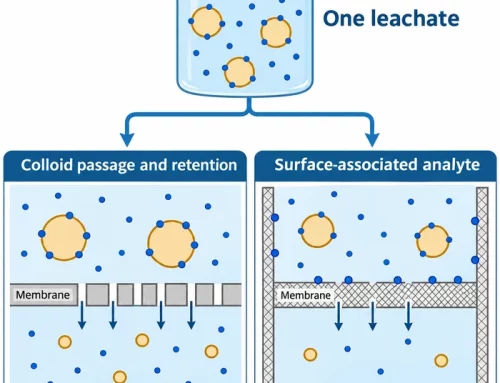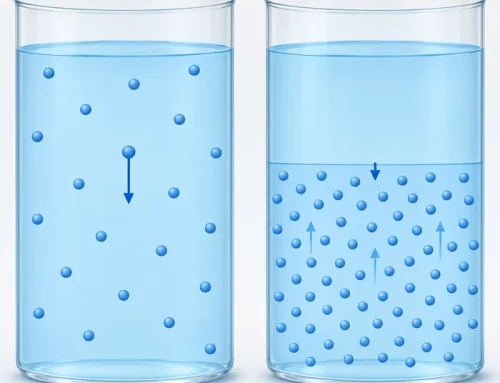
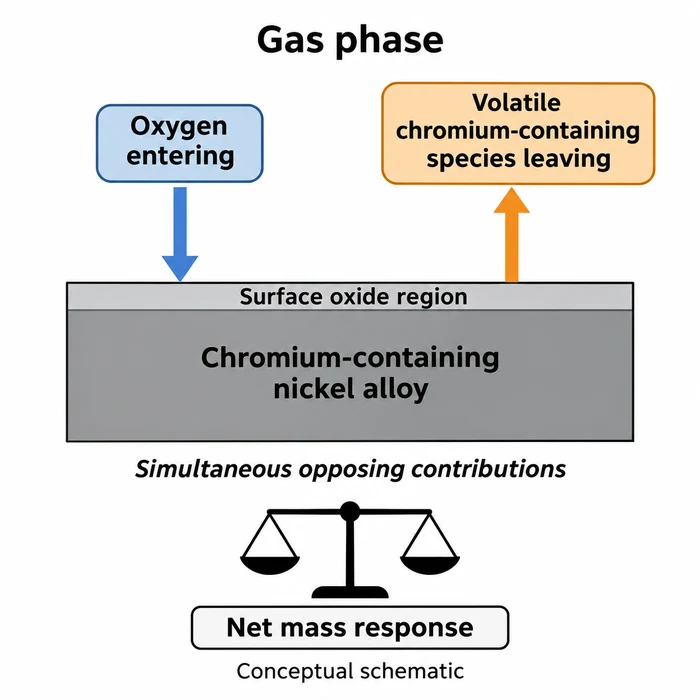
Conceptual opposing mass contributions during oxidation. Arrow sizes are schematic and do not represent measured rates.
A powder gains little mass during heating in an oxidizing atmosphere, while an inert run loses mass. It is tempting to subtract the traces and call the difference oxygen uptake. That calculation needs a chemical assumption: the material must release the same mass under both atmospheres. Changing atmosphere can change the release pathway itself.
A Documented Powder Case and Supporting Evidence
Zissel and colleagues used argon as the reference atmosphere while debinding binder jetted 17-4 PH stainless steel powder at 300 °C for two hours. Debinding in argon removed only about 34% of the binder, while debinding in atmospheres containing 3-20 vol% oxygen removed nearly all of it; the powder also picked up 1,734-1,820 ppm oxygen under those oxidizing conditions [2]. Changing the atmosphere therefore changed both how much binder left the compact and how much oxygen the powder gained, so equivalent release under different atmospheres cannot be assumed.
As a brief secondary illustration, Zhang and colleagues recorded a net mass gain of only about 0.048 mg/cm² for bulk Inconel 625 after 2500 h at 850 °C in humidified air, attributing this low figure to volatilization loss alongside diffusion-controlled oxide accumulation [1]. That result is bulk-coupon weighing rather than powder TGA, but it supports the same point: a small net mass change can combine a larger uptake with a larger loss.
Why subtraction leaves an unresolved term
Δm_air − Δm_inert = (Uair − Uinert) − (Rair − Rinert)
Here U is the mass entering the specimen and R the mass leaving it, both positive and expressed over the same interval per unit initial powder mass. Assigning the difference to oxygen uptake in air requires negligible uptake during the inert run, equivalent release under both atmospheres, and oxygen accounting for the incoming mass in air. For an oxygen-sensitive powder, check residual oxygen under the actual purge conditions rather than assuming the nominal gas is inert. An empty-crucible blank characterizes the instrument response but cannot reveal whether the specimen oxidized.
Choose the measurement that resolves the ambiguity
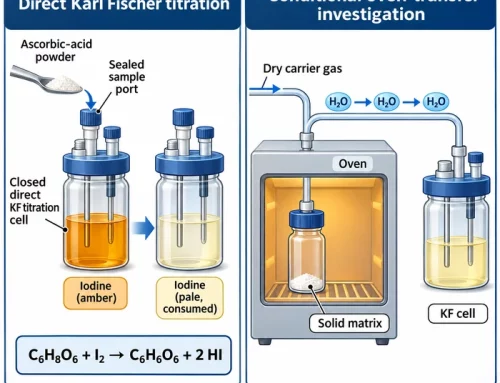
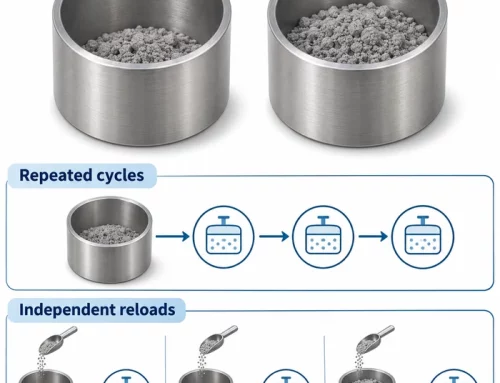
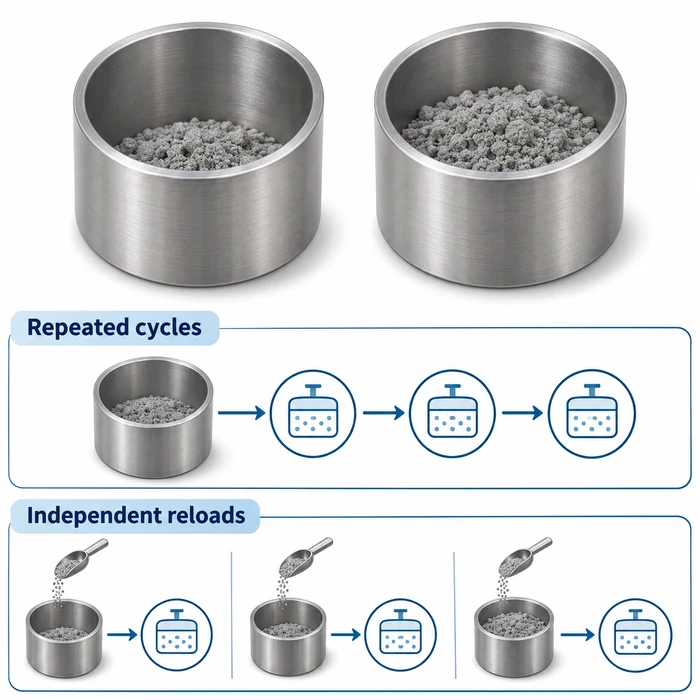
Is the trace difference resolved? Start with representative aliquots sharing storage, conditioning, and thermal history, and match loading, crucible, and temperature-time program between the air and inert runs. Document the actual gas composition and flow, since atmosphere is the intended variable but can also change decomposition pathways, not only oxygen uptake; PTI’s thermal measurement selection guidance explains why loading and gas access belong in this comparison. If simultaneous DSC shows a pronounced exotherm, inspect the available specimen-temperature record before treating the two events as temperature-matched. Check whether the air-minus-inert difference, over the interval being interpreted, exceeds applicable repeatability and measurement uncertainty, using replicate runs, atmosphere-specific blanks, a common interval, and the same initial-mass basis. If the difference falls within measurement uncertainty, the traces cannot establish a difference in net mass change over that interval. Uptake and release could still offset each other.
Did binder-derived carbon leave differently? TGA-FTIR or TGA-MS can identify carbon-containing evolved gases, provided transfer delay and calibration for quantitative claims are accounted for. A more direct comparison is the carbon remaining in specimens recovered at the interval boundaries under each atmosphere, expressed per unit initial powder mass rather than as a residue percentage, since oxidation changes that denominator. Oxygen from the purge gas can appear in evolved CO2, so its full molecular mass cannot automatically be assigned to loss of the original powder.
What oxygen quantity can be reported? If the quantity of interest is oxygen retained in the solid, compare oxygen inventories in matched specimens recovered before and after the interval, with controlled cooling and handling to avoid further oxidation. This retained-oxygen change is not gross oxygen uptake if oxygen can also leave in volatile products, such as CO2 formed from binder carbon. Phase analysis, such as powder X-ray diffraction, is useful when the oxide’s identity matters rather than only its mass.
Greater carbon loss in air establishes that more carbon left the specimen over that interval. Identifying its source or reaction pathway requires additional evidence. If total release is independently shown to be greater in air, uptake during the inert run is negligible, and oxygen accounts for the incoming mass in air, subtraction underestimates gross oxygen uptake. Report a numerical value only for the quantity the measurements support.
Technical Basis / Sources
- Zhang, K., Hong, J.-E., and Steinberger-Wilckens, R. (2018). Effect of Alloy Composition on the Oxidation Behaviour and Cr Evaporation of High-Cr Steels for SOFC Cathode Air Preheaters. Proceedings of the 13th European SOFC & SOE Forum, paper A0807.
- Zissel, K., Bernardo, E., Forêt, P., and Hryha, E. (2025). Impact of oxygen content on debinding of binder jetted 17-4 PH stainless steel: Part I – Debinding. Powder Metallurgy, 68(1), 3–15.