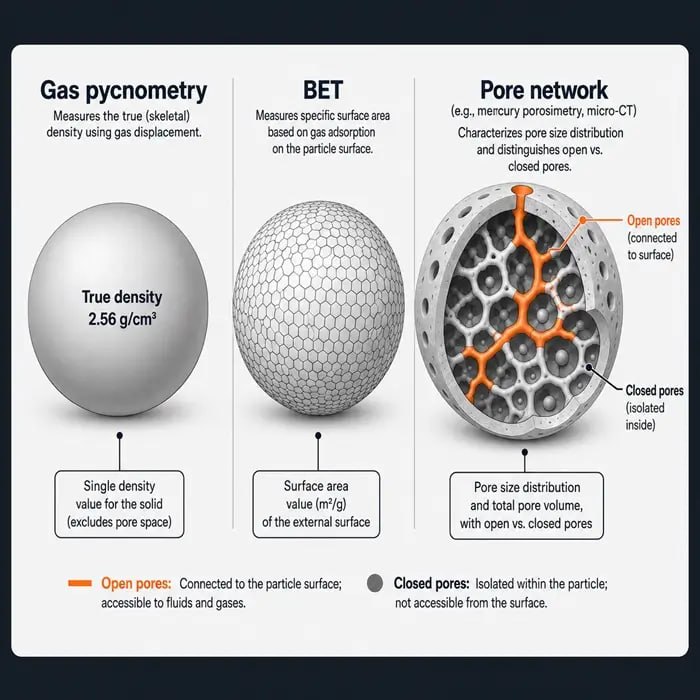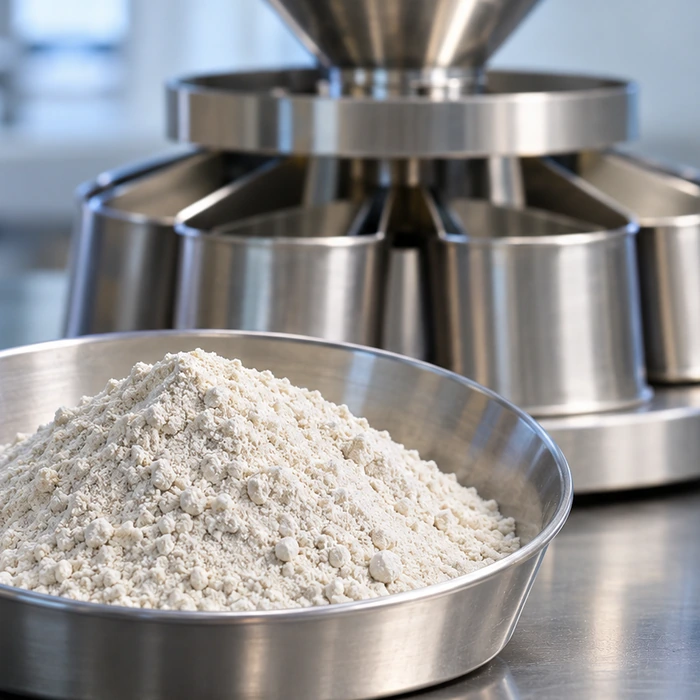
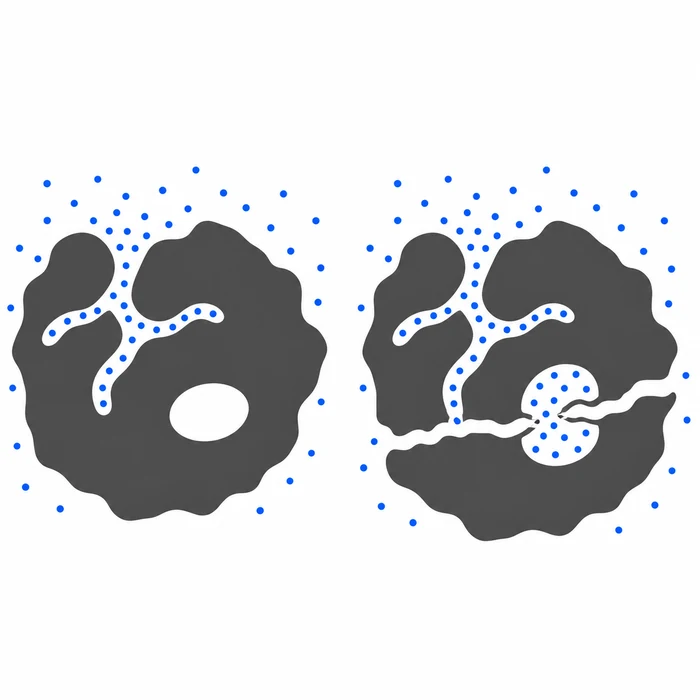
Crushing can expose previously inaccessible pore space, reducing the volume displaced by the sample. Conceptual illustration without measured dimensions.
An intact porous sample returns a lower helium density than a crushed portion from the same parent material. The immediate decision is whether this represents changed pore accessibility or a difference introduced during preparation and measurement. Shared origin helps, but comparable composition, conditioning, and measurement performance still need checking.
Why opening pores raises the reported density
Gas pycnometry measures the volume that the test gas cannot occupy. Helium-accessible pores are excluded from that volume; inaccessible pores remain included. Crushing can connect an enclosed cavity to the particle exterior. Helium then enters space previously counted as displaced volume, so measured skeletal volume decreases. With comparable mass and material state, calculated density increases.
ρ = m / Vs
Here, m is measured mass in grams and Vs is skeletal volume in cubic centimeters, giving ρ in g/cm³. The pore-opening interpretation appears explicitly in ISO/DIS 12154, a 2012 draft standard. The distinction between skeletal and envelope volume explains why gas density should not be treated as independent of all porosity.
Establish the difference before explaining it
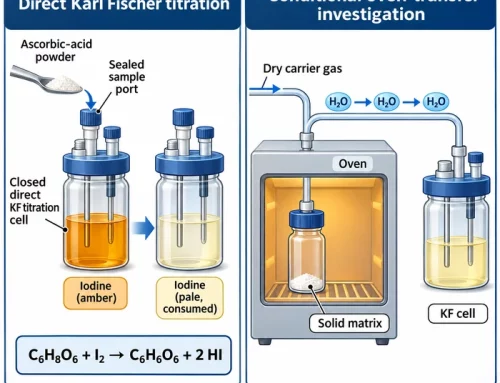
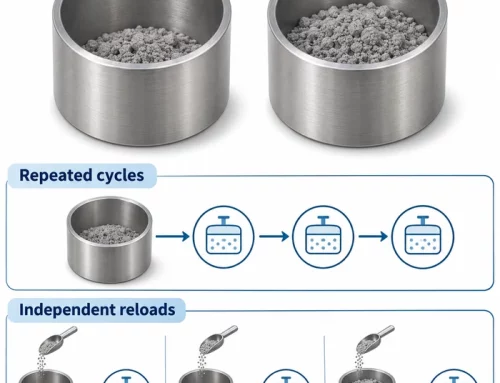
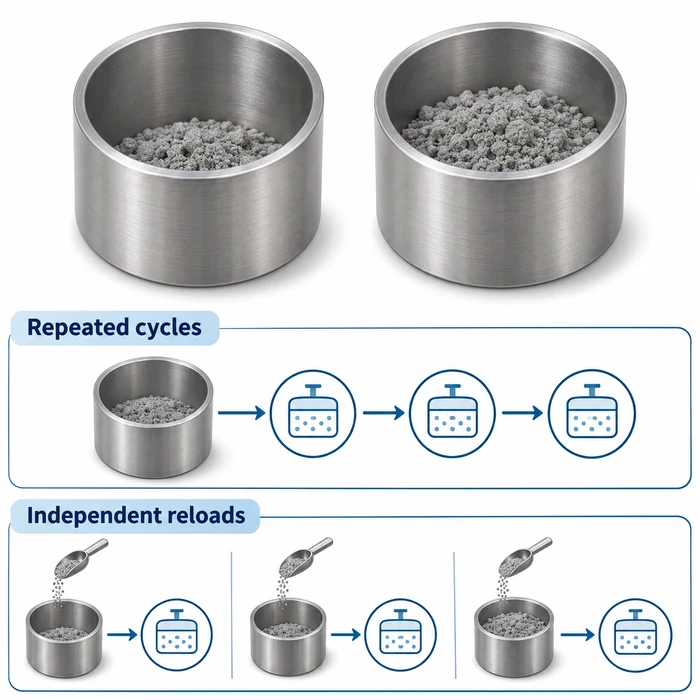
Compare the observed difference with your laboratory’s precision and uncertainty evidence for comparable materials and cell loading. Repeated instrument cycles describe behavior within a run; they do not capture all variation from preparation and reloading. If relevant repeatability is unknown, establish it before interpreting a small difference. A manufacturer specification alone does not describe your complete preparation route.
Next inspect mass records, conditioning schedules, storage and transfer intervals, loading, temperature stability, and individual-cycle results. Nguyen and colleagues showed that activation affected skeletal density in the porous materials they examined; loading and thermostability also mattered. Cycle trends can therefore guide an investigation, although they do not uniquely identify its cause.
Separate conditioning from crushing
Conditioning can produce a substantial density change without crushing. Micromeritics Application Note 192 reports average densities of 2.0321 g/cm³ before external pretreatment and 2.5118 g/cm³ afterward for zeolite 13x. Treatment comprised 90 °C for one hour followed by 350 °C for eight hours. Both samples used a 1 cm³ AccuPyc II 1345 with the same instrument parameters. This material-specific example illustrates why a density increase alone cannot diagnose pore opening; its heating schedule is not a general preparation recommendation.
For a proposed diagnostic comparison, split representative portions from one parent sample and document their shared history. Keep one intact and crush the other. Apply the same material-appropriate conditioning and handling sequence, record recovered mass, and use consistent validated measurement settings and suitable loading. These controls address sample-state and measurement differences that could otherwise accompany crushing.
Use the repeat to choose the next action
Compare independently prepared or reloaded results against the established variation. A persistent increase supports a crushing-associated change consistent with greater helium accessibility. If the difference diminishes after matched conditioning, conditioning contributed. Both effects can coexist. If results remain unstable, resolve preparation or measurement variability before estimating inaccessible pore volume.
Record the supported interpretation and standardize the preparation state used for future comparisons. No current PTI calculator separates pore opening from conditioning for this discrepancy, so the useful next output is a repeatable paired result with documented sample state and uncertainty.
Technical Basis / Sources
- International Organization for Standardization. 2012. Determination of density by volumetric displacement — Skeleton density by gas pycnometry. ISO/DIS 12154, Draft International Standard.
- Nguyen, Huong Giang T.; Horn, Jarod C.; Bleakney, Matthew; Siderius, Daniel W.; Espinal, Laura. 2019. Understanding Material Characteristics Through Signature Traits from Helium Pycnometry. Langmuir 35(6):2115–2122. doi:10.1021/acs.langmuir.8b03731. NIST-hosted manuscript.
- Micromeritics Instrument Corp. Sample Preparation for Gas Pycnometry. AccuPyc II Application Note 192. Publication year not verified.