Powder property
Crystallinity
Crystal structure, amorphous content, and polymorphic form change how a powder performs
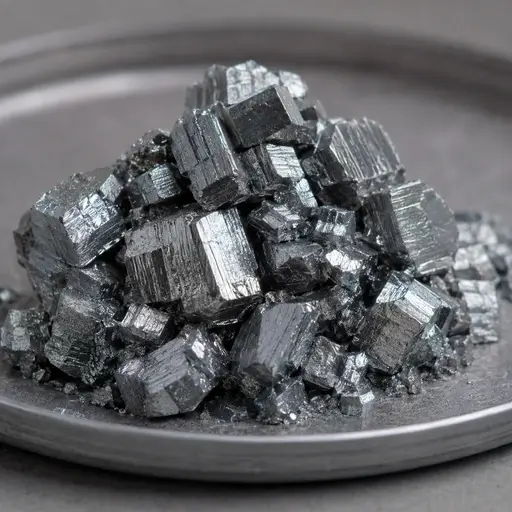
Crystallinity describes the extent and form of ordered solid structure within a material. Crystalline fraction, amorphous content, polymorphic form, crystal defects, and thermal history can change stability, solubility, mechanical response, and processing behavior even when chemical composition is unchanged.
Powder property
Crystallinity
Crystal structure, amorphous content,
and polymorphic form change how a powder performs
Crystallinity describes the extent and form of ordered solid structure within a material.
Crystalline fraction, amorphous content, polymorphic form, crystal defects, and thermal
history can change stability, solubility, mechanical response, and processing behavior
even when chemical composition is unchanged.




Core concept
Crystallinity describes order, not simply material quality
A crystalline solid has repeating structural order, while an amorphous region lacks long-range order. Real powders may contain several crystalline phases, polymorphs, defects, solvates, hydrates, and amorphous material at the same time. A higher crystalline fraction is not automatically better. The required state depends on whether the process needs stability, dissolution, reactivity, deformation, or a controlled transformation. Interpret phase identity and fraction together with preparation and history. Milling, drying, heating, pressure, moisture, and storage can alter the solid state after the original material specification was established.
What controls it
Six groups of variables govern crystallinity
Solid-state behavior reflects how the material formed and every thermal, mechanical, and environmental condition it experienced afterward.
States and interpretation
Similar chemistry can conceal different solid states
Use complementary methods when phase identity, fraction, and transformation behavior all matter.
| Material state | Typical indication | Interpretation risk | Useful confirmation |
|---|---|---|---|
| Predominantly crystalline | Defined diffraction peaks and reproducible thermal events | Minor amorphous content or a second phase may remain undetected | PXRD with calibrated quantification and DSC |
| Partly amorphous | Diffuse scattering with reduced or broadened crystalline peaks | Small domains and disorder can resemble amorphous content | PXRD, DSC, and moisture-dependent analysis |
| Polymorphic mixture | More than one crystalline fingerprint or transition | Peak overlap can obscure a minor form | Reference patterns, controlled preparation, and thermal microscopy |
| Process-transformed | Difference between incoming and post-process samples | Sampling or preparation may create the apparent change | Paired samples under identical analytical conditions |
How to measure it
Choose measurements by the solid-state question
No single method fully resolves phase identity, amorphous fraction, thermal transitions, and environmental stability.
Where it matters
Crystallinity becomes a stability and transformation constraint
Solid-state changes matter where energy, solvent, pressure, moisture, or time can move the material into another structural state.
Go deeper
Three practical routes into crystalline structure
Explore how crystalline frameworks form, how processing changes their energetic state, and why phase history affects performance.

Need the measurement, not just the guidance?
If the remaining uncertainty concerns crystalline phase identity, amorphous content, polymorphic conversion, thermal history, or storage stability, select the measurement around the material state and process decision. PowderTechnology.info can help define the test sequence, sample conditions, and interpretation route. For laboratory support, explore our Delft Solids Solutions partner page or visit Delft Solids Solutions directly.