Troubleshooting

Moisture and environmental sensitivity

Moisture content, water activity, dew point, and conditioning history answer different questions
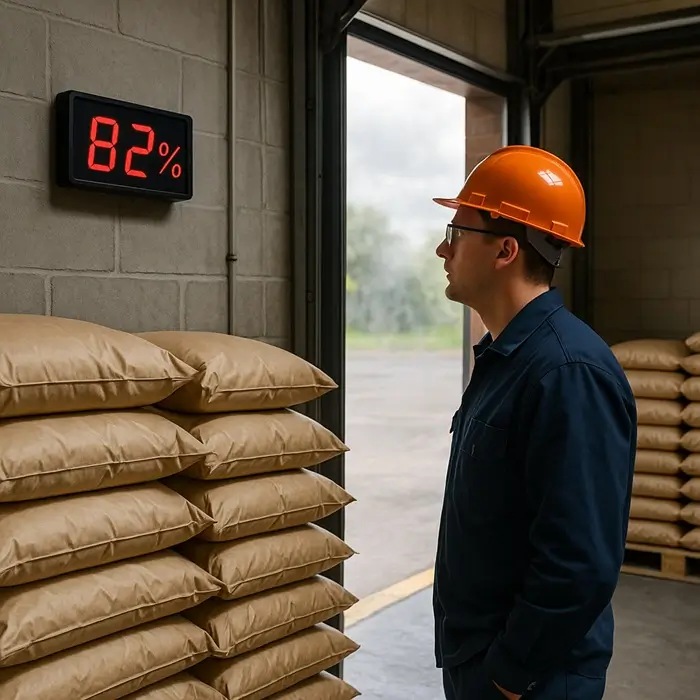
Illustration of moisture and environmental sensitivity in powder processing.

Environmental failures are often transient and location-dependent. Reconstruct the actual temperature and humidity path, compare product and air dew points, and distinguish bulk water content from the surface state that controls cohesion, charge, reaction, or dissolution.

Troubleshooting

Moisture and environmental sensitivity

Moisture content, water activity, dew point,
and conditioning history answer different
questions

Environmental failures are often transient and location-dependent.
Reconstruct the actual temperature and humidity path, compare
product and air dew points, and distinguish bulk water content from
the surface state that controls cohesion, charge, reaction, or dissolution.


By what you see

By what you see

Performance follows season or weather; problems appear after cold storage or startup; material changes after exposure; or sealed packs drift over time.

By what changed

By what changed

After storage, transfer, or packaging; after dew point, temperature, or humidity changed; or when a new batch responds differently to the same conditions.

By likely mechanism

By likely mechanism

Hygroscopic sorption, condensation, moisture redistribution, drying-induced charge or brittleness, or moisture-driven reaction and phase change.

By measurement route

By measurement route

Choose the measurement that best separates moisture content, water activity, condensation risk, and the functional response under the failed conditions.

Find your route

Start with the observed failure, then add context

Environmental failures are often transient and location-dependent. Reconstruct the actual temperature and humidity path, compare product and air dew points, and distinguish bulk water content from the surface state that controls cohesion, charge, reaction, or dissolution.

  1. 1Observation
  2. 2Change or context
  3. 3Route

Step 1  What are you seeing?

Step 2  What changed, or when does it happen?

The same environmental failure can come from different mechanisms depending on temperature and humidity history, exposure, transfer conditions, packaging, or the material itself.

Step 3  Your diagnostic route

Quick diagnostic comparison

Separate the leading routes before changing the process

Use the pattern and event history to select the first discriminating measurement. The table is a triage aid, not a substitute for reproducing the failed state.

Use the observed pattern and the change that preceded it to select the first discriminator. The pattern does not prove the mechanism.

What you observeWhat changedLikely mechanismMeasurement that separates it
Performance follows season or weatherAfter humidity, temperature, or exposure conditions changedHygroscopic sorption or condensationWater activity plus environmental history: Did the material cross a sorption or condensation boundary?
Problems appear after cold storage or startupAfter cold storage, warm-up, or startup conditions changedCondensation or moisture redistributionProduct and wall temperature versus air dew point: Could liquid water have formed locally?
Material changes after an open hold or transferAfter open exposure, conveying, drying, or purge conditions changedHygroscopic sorption, moisture redistribution, or drying-induced effectsWater activity and moisture response before and after exposure under the actual process condition.
Material changes inside closed packagingAfter barrier, headspace, seal, fill temperature, or storage conditions changedMoisture redistribution or moisture-driven reaction / phase changeLocation-resolved moisture and water activity, followed by conditioned functional testing if the material change persists.

Use the measurement under the material state and environmental conditions that produced the failure.

Likely mechanisms

Separate moisture uptake, condensation, redistribution, and persistent material change

Environmental sensitivity is not one mechanism. Reconstruct the temperature and humidity history, locate where the material state first changes, and then test the water state or physical response that can explain the failure.

Hygroscopic sorption

The powder gains or loses water as it moves toward equilibrium with the surrounding atmosphere, changing the surface state even when total moisture changes only modestly.

Separate it with: water activity, sorption response, and exposure-time conditioning.
Moisture Control for Powders

Condensation

A cold product, wall, pipe, or package surface can cross the local dew point and acquire liquid water rapidly, creating a failure that average room humidity does not explain.

Separate it with: product and surface temperature compared with local air dew point.
Dew point, water activity, and caking windows

Drying-induced charge or brittleness

Very dry conditions can reduce surface conductivity, increase electrostatic effects, or make fragile particles more prone to fracture during handling.

Separate it with: humidity-conditioned electrostatic or mechanical response.
When Humidity Spikes Hit Your Powder Flow

Moisture redistribution

Water can migrate between components, particle populations, or warmer and cooler zones without a large change in the total water measured for the package.

Separate it with: location-resolved moisture and water activity before and after conditioning.
Why Moisture Content Misleads

Moisture-driven reaction or phase change

Hydration, hydrolysis, crystallization, glass transition, or other solid-state changes can persist even after the original environmental excursion has ended.

Separate it with: thermal, chemical, and solid-state analysis under matched conditioning.
Moisture as a Formulation Risk: Beyond Standard Hygroscopicity Testing

ⓘ Diagnostic note

A room RH value does not describe the powder’s full moisture history

The controlling condition may be a short exposure, local condensation event, product temperature, water activity, or internal redistribution. Reproduce the relevant path rather than testing only one ambient RH setpoint.

Measurement routes

Measure the environmental state and the resulting powder response

Choose measurements that reproduce the failed conditioning history and separate how much water is present from how available it is, whether condensation occurred, and which functional property actually changed.

Water state and sorption

Distinguish total moisture from water activity, hygroscopic response, and sorption or desorption history under the relevant temperature and humidity range.

Condensation and conditioning

Compare product, wall, and air temperature with dew point, then condition samples through the real environmental window rather than relying on one room-RH reading.

Functional response

Measure the property that actually failed after conditioning, such as flow, electrostatic behavior, mechanical integrity, wettability, or a persistent solid-state change.

Process context

Where the exposure occurs determines what environmental history matters

Keep residence time, product temperature, wall temperature, gas condition, exposure duration, and packaging history attached to the diagnosis. The same powder can fail by a different moisture route in a different process step.

01

Storage & discharge

Long residence times, cold walls, warm-up cycles, and headspace conditions can create sorption or condensation before discharge.

02

Conveying & transfer

Gas temperature, dew point, receiver conditions, and transfer time can dry, cool, humidify, or condense moisture on the powder.

03

Feeding & dosing

Moisture-driven cohesion, packing, or density drift can change feeder fill and delivery even when the mechanical settings are unchanged.

04

Filling & packaging

Fill temperature, barrier performance, headspace, seal quality, and later temperature cycling control the packaged environmental history.

05

Mixing & blending

Components can differ in hygroscopicity or initial water state, allowing redistribution during blending, holding, or subsequent storage.

06

Process environment

When no single equipment step explains the failure, trace the complete air, temperature, exposure, and hold history across the entire process.

Go deeper

Guides and articles for moisture and environmental sensitivity

Use the deeper technical material to reconstruct the environmental history, distinguish moisture state from ambient conditions, and connect the exposure to the powder property that actually failed.
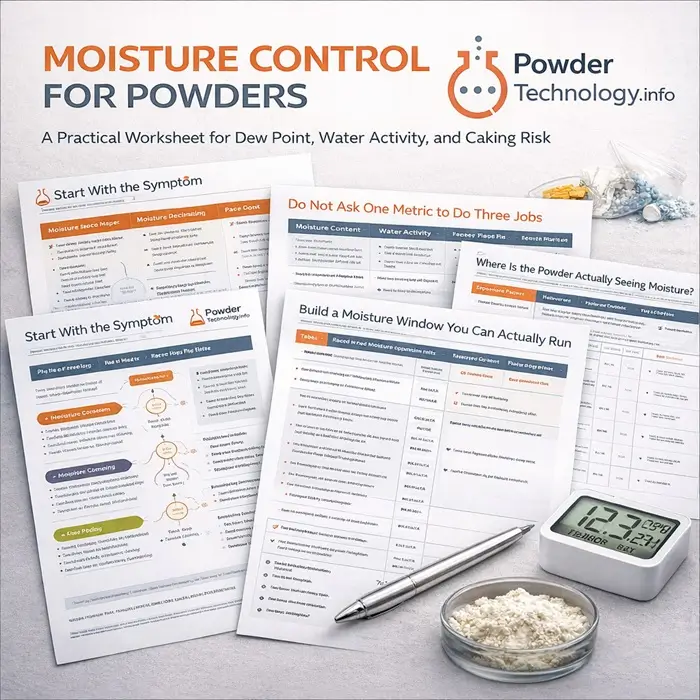
Moisture control for powders using dew point and water activity

Moisture Control for Powders: Dew Point, Water Activity, and Caking Windows

Connects dew point, water activity, sorption, and exposure history to the environmental windows in which powder behavior begins to change.

Powder caking prevention and moisture-related storage behavior

Powder Caking Prevention: Causes, Testing Methods, and Proven Fixes

Shows how moisture, consolidation, temperature, and storage history interact in caking and how testing can separate the dominant cause.

Humidity spike affecting stored powder flow

When Humidity Spikes Hit Your Powder Flow

Examines why short humidity excursions and exposure history can change powder handling even when average climate values appear acceptable.

Moisture sensitivity

Use the Particle Behavior child to understand hygroscopicity, water activity, sorption, and environmental response.

Moisture articles

Browse published PTI articles covering humidity, moisture exposure, caking, storage, and environmental response.

Moisture testing

Use the Test Methods family to compare moisture content, water activity, sorption, and environmental conditioning.

Storage & discharge

Follow the Process & Equipment child when storage conditions or temperature history drive the failure.

FAQ

Moisture and environmental sensitivity questions

No. Moisture content tells you how much water is present, but it does not by itself show how available that water is, how strongly the powder will sorb from the air, or whether a short condensation event changed the surface state. Water activity, sorption behavior, temperature, and exposure history may be equally important.
The product, hopper wall, pipe, or package may remain colder than the surrounding air. If a surface temperature falls below the local dew point, condensation can occur even when the room relative humidity does not appear extreme. Compare actual product and surface temperatures with local dew point during storage and warm-up.
Moisture content measures the amount of water in the material. Water activity describes the thermodynamic availability of that water and is more directly related to equilibrium with the surrounding atmosphere. Materials with similar moisture contents can therefore behave differently if their water activity or sorption history differs.
Yes. Moisture can redistribute between components or temperature zones inside a closed package, while barrier performance, headspace conditions, fill temperature, and temperature cycling can also change the local state. A sealed package prevents some external exchange but does not guarantee a uniform or unchanged internal moisture condition.
Reproduce the relevant environmental path, not just one relative-humidity setpoint. Match the temperature, humidity or dew point, exposure duration, storage or consolidation history, and any subsequent warm-up or drying step. Then measure the property that failed under the same conditioned state.
Start with moisture content, water activity, and the real temperature and humidity history. Add sorption or conditioning tests when equilibrium response matters. Then measure the affected function, such as flow, electrostatic behavior, strength, wettability, or solid-state response, under the same environmental window.

Independent diagnostic support

Need the measurement, not just the guidance?

PowderTechnology.info works closely with Delft Solids Solutions, a contract research organization specializing in the physical behavior of powders and granules. DSS provides contract testing and characterization, with its laboratory working in accordance with ISO 17025. Contact Delft Solids Solutions.