Table of contents
In science and engineering, we often define invention as creating something entirely new or making a process workable for the first time. However, this definition raises a question: can we call a technique an invention if another culture already practiced it empirically, even without formal codification? Furthermore, does mechanization or patenting transform an old method into something genuinely new, or does it represent reinvention?
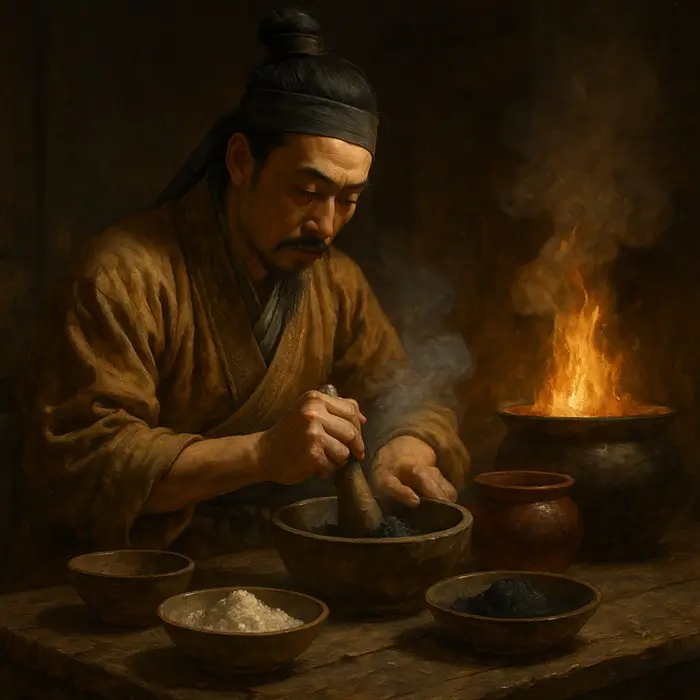
Archaeological evidence, written records, and oral traditions consistently reveal that many so-called “modern inventions” had much earlier precedents. Ancient powder technologies provide a clear example. Long before industrial science, civilizations ground ores, blended clays, compacted powders, and controlled sintering with remarkable precision. Later, Western laboratories presented these practices as new inventions, even though artisans had used them for centuries.
Consequently, the story of ancient powder technologies shows that invention often emerges less from creating knowledge out of nothing and more from recognizing, systematizing, and reinventing practices that already existed.
Systems of Learning: Apprenticeship versus University
Knowledge rarely emerged fully formed in classrooms. Instead, for most of history, societies transmitted it through apprenticeships. A younger practitioner observed, repeated, and mastered techniques under the guidance of a skilled teacher. These practitioners worked with powders, pigments, metals, and clays at levels of precision that rival modern engineering. Yet historical accounts often labeled them “artisans,” diminishing their role. In reality, they functioned as engineers in everything but title.
The difference between an apprentice and a modern engineer remains largely semantic. Both applied systematic methods to solve material challenges. Over time, universities standardized what apprenticeships once transmitted. As institutions claimed authority, they reframed many rediscoveries as modern breakthroughs, even though older traditions had already embedded the same principles.
Powder Technology as a Hidden Continuum
Powder science today covers particle characterization, surface chemistry, flow mechanics, sintering, and formulation design. Modern industries, from energy storage to additive manufacturing, rely heavily on powders. However, historical accounts often attribute the “invention” of powder technologies to European scientists of the 18th to 20th centuries. In reality, civilizations in Asia, Africa, and the Americas had already established grinding, classification, blending, compaction, and thermal transformation as core practices. These methods formed the foundation of what we now call ancient powder technologies.
Western science later codified, measured, and mechanized these processes, integrating them into industrial systems with patents and standards. In doing so, it obscured the true origins and contributions of earlier civilizations.
Ancient Metallurgy and Powder Processing
The earliest metallurgy used powders. In Mesopotamia and Egypt around 3000 BCE, copper ores such as malachite and azurite were ground into fine powders before smelting. Crushing increased surface area, accelerating reduction with charcoal in small furnaces. Artisans knew empirically that finer powders yielded faster extraction.
In South America, the Moche and later the Incas ground ores for silver and gold. Mortars and grinding stones found at sites were explicitly for ore preparation, not food. The role of particle size in pyrometallurgy was understood long before Europe’s Scientific Revolution.
In India by 500 BCE, artisans practiced early powder metallurgy. Wootz steel, the origin of Damascus blades, was produced by compacting iron powders and carbon-rich plant matter in sealed crucibles. Heating sintered the powders into dense ingots, with carbide particles dispersed in ferrite, creating extraordinary sharpness and toughness. European scientists of the 19th century, such as William Coolidge, later patented tungsten powder compaction for lamp filaments. Textbooks date powder metallurgy to this industrial period, yet the principle had been used two millennia earlier. The difference lies in mechanisation, while the original tenets still remain true.
Modern resources, such as the ASM International Powder Metallurgy reference, trace this history while emphasizing industrial standardization.
Ceramics, Clays, and Pigment Powders
Chinese porcelain, perfected between the Tang and Song dynasties, relied on kaolin clays that were ground, fractionated, and blended. Particle size determined plasticity, shrinkage, and sintering temperature. The translucency of high-fired porcelain depended on fine aluminosilicate dispersion. Europe did not replicate true porcelain until the 18th century at Meissen, essentially reverse-engineering the process rather than inventing it.
Pigment grinding was also advanced. Egyptian artisans used powdered azurite, malachite, hematite, and cinnabar to produce durable paints. Mayan and Aztec artisans created Maya Blue, a complex of indigo dye and palygorskite clay powder, remarkably stable against acids and weathering. Western science treated pigment manufacture as a 19th-century advance when ultramarine was synthesized in 1828. Yet Afghan lapis lazuli powders had been processed for millennia.
For deeper insight into mineral pigments and their industrial relevance, visit the Royal Society of Chemistry.
Gunpowder and Energetics
Gunpowder remains the most famous powder technology in history. The military explosives and propellants market, valued at USD 3.44 billion in 2024 and projected to reach USD 4.22 billion by 2030, reflects its enduring global importance. That scale shows how ancient knowledge continues to drive billion-dollar industries.
By the 9th century CE, Tang dynasty alchemists mixed saltpeter, sulfur, and charcoal in precise ratios. Particle size and blending homogeneity determined whether mixtures produced weak flares or powerful propellants. By the 11th century, Chinese artisans granulated powders, increasing burn consistency and safety. Recipes refined to about 75:15:10 still form the basis of black powder today.
Gunpowder reached Europe by the 13th century already highly developed. Europeans contributed cannon casting, battlefield application, and mechanized milling. Yet Western science claimed disproportionate credit, overlooking Chinese origins.
Powdered Medicines and Pharmaceuticals
Ayurvedic medicine in India and Traditional Chinese Medicine relied heavily on powdered herbs. Practitioners dried, ground, and sieved materials to control texture. They delivered powders as teas, poultices, or compressed tablets. Indigenous American peoples also ground maize, cacao, and coca into powders for both medicinal and ritual use.
Western pharmacopeias of the 18th and 19th centuries claimed powders, tablets, and capsules as inventions of modern pharmacy. Industrial ball mills and roller mills enabled precise size reduction, and later granulation methods improved flow and compaction. Yet healers had used powders as dosage forms for thousands of years.
The real shift came with standardization in the pharmaceutical industry. Industrial scientists quantified dissolution rates, bioavailability, and flow functions. They framed refinements of older traditions as inventions.
Rubber, Fillers, and Polymer Powders
Mesoamerican civilizations processed latex into elastic materials more than 1,000 years ago. They mixed Hevea latex with morning glory vine juice, which contained sulfur compounds that cross-linked polymer chains. This process produced resilient rubber for balls, waterproofing, and footwear. When Charles Goodyear patented vulcanization in 1839, the West credited him with inventing rubber technology. In reality, he mechanized and reframed an indigenous composite process.
Industrial science later promoted powders as fillers in polymers as a 20th-century advance. Yet artisans had strengthened matrices with powdered inclusions for centuries. Roman builders mixed ground volcanic ash into lime plasters, improving durability through particle packing and chemical reaction.
The Scientific Pattern of Reinvention
Across powder metallurgy, pigments, ceramics, pharmaceuticals, and polymers, the same cycle repeats:
-
Discovery and mastery in non-Western cultures.
-
Transmission into Western contexts, often without acknowledgement.
-
Mechanization and measurement in Europe’s industrial era.
-
Rebranding as invention, erasing older contributions.
Patents, journals, and universities emerged in Europe, framing knowledge within Western contexts. Colonial and neo-colonial narratives reinforced this erasure, diminishing indigenous technologies as rudimentary despite their sophistication.
Conclusion
Powder technologies have always driven human progress. Ancient civilizations mastered grinding, mixing, compaction, and sintering long before the West systematized these techniques. Europe mechanized and quantified them, but intellectual property systems reframed prior knowledge as invention, obscuring its origins.
Recognizing this history enriches modern engineering. It situates current powder science within a global continuum and shows that progress evolves rather than erupts. Innovation advances when we acknowledge the vast archive of human ingenuity that came before us. Many of these traditions now appear in UNESCO’s Intangible Cultural Heritage framework, highlighting their enduring global value.
Check out these related articles


Advertisement
[the_ad id=”7029″]