
Powder property
Adhesion
Attachment to another surface depends
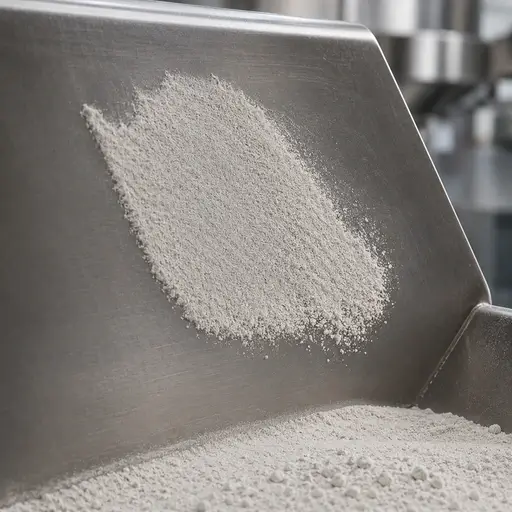
Powder adhesion is the attraction or attachment between particles and another surface, including equipment walls, substrates, coatings, tooling, filters, and packages. It can arise from van der Waals forces, capillary bridges, electrostatics, chemical bonding, softening, or mechanical interlocking.
Powder property
Adhesion
Attachment to another surface depends
Powder adhesion is the attraction or attachment between particles
and another surface, including equipment walls, substrates, coatings,
tooling, filters, and packages. It can arise from van der Waals forces,
capillary bridges, electrostatics, chemical bonding, softening,
or mechanical interlocking.




Core concept
Adhesion belongs to a defined pair of contacting surfaces
A powder does not possess one universal adhesion value. Attachment depends on the particle surface, the opposing material, their roughness, contact area, load, separation rate, and surrounding environment. Adhesion differs from cohesion. Here, adhesion describes attachment between particles and another surface, while cohesion describes resistance to separation within the powder. A material can be strongly cohesive but weakly adhesive to a selected wall, or the reverse. Deposits may also strengthen after initial attachment through compaction, moisture migration, softening, crystallization, or chemical change. Diagnose both the first attachment event and the mechanism that makes the layer persist.
What controls it
Six groups of variables govern adhesion
Attachment changes when the interfacial force, real contact area, or mechanical strength of the deposited layer changes.
States and interpretation
Similar deposits can arise from different attachment mechanisms
Change one relevant condition at a time and examine both the deposit and the surface beneath it.
| Adhesion regime | Typical evidence | Diagnostic intervention | Useful confirmation |
|---|---|---|---|
| Dry surface attraction | Fine particles adhere without visible liquid or softening | Change surface treatment, roughness, or particle fines | Pull-off force and surface-energy comparison |
| Moisture-assisted | Deposit increases with humidity, condensation, or dwell time | Control dew point, water activity, or surface temperature | Conditioned adhesion and moisture sorption |
| Electrostatic | Light particles attach after movement and respond to grounding or humidity | Change contact materials, charge dissipation, or grounding | Charge magnitude, polarity, and decay |
| Softening or bonded deposit | Tacky layer, smeared material, or strength growth with heat and time | Reduce temperature, contact load, or residence time | Thermal analysis and deposit composition |
How to measure it
Choose a method by the attachment event
Measure the actual interface when possible and distinguish initial attachment from deposit growth and removal strength.
Where it matters
Adhesion becomes a fouling and transfer constraint
Adhesion matters where material must release cleanly from equipment or attach uniformly to a selected substrate.
Go deeper
Three practical routes into powder adhesion
Explore how tack is measured, how temperature and moisture create persistent sticking, and why equipment surfaces change with use.


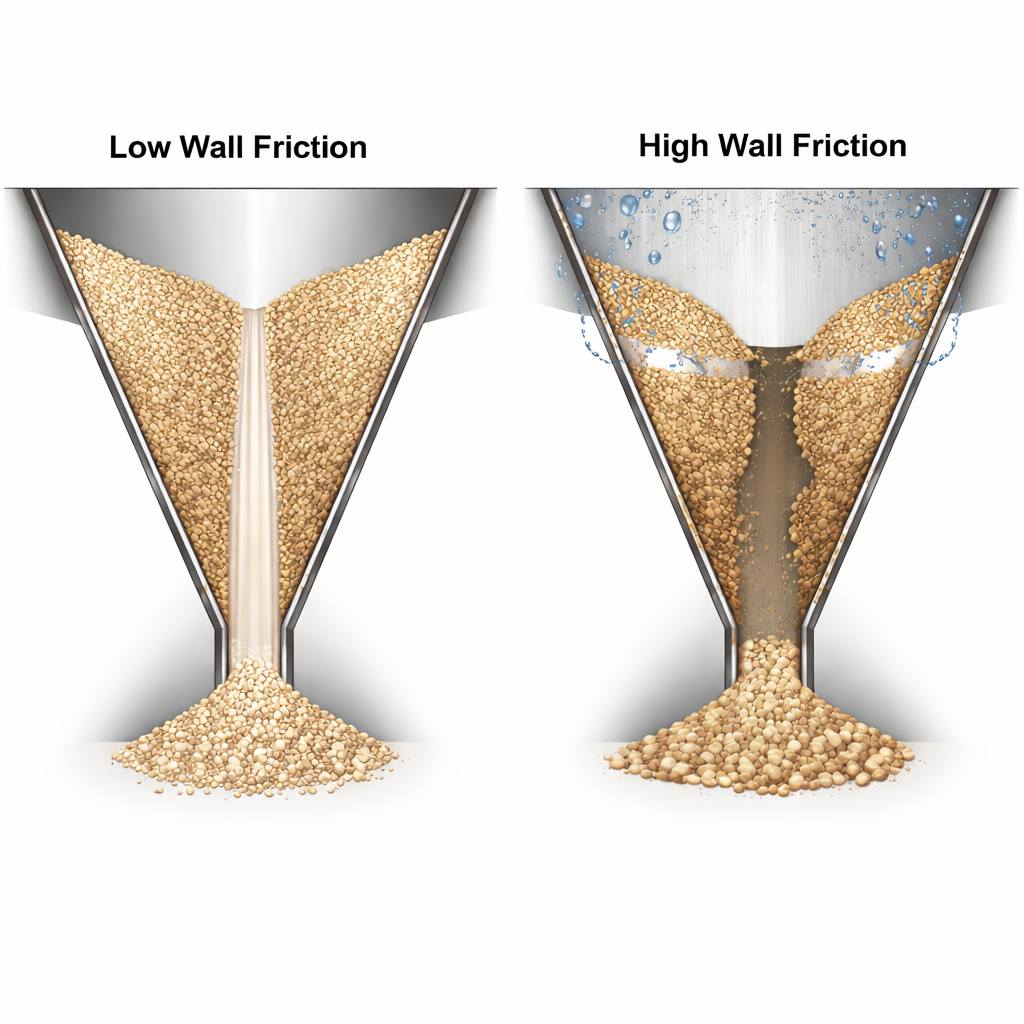
Need the measurement, not just the guidance?
If the remaining uncertainty concerns particle-wall adhesion, tack, deposit strength, wall-condition drift, electrostatic attachment, or temperature-dependent sticking, select the measurement around the material state and process decision. PowderTechnology.info can help define the test sequence, sample conditions, and interpretation route. For laboratory support, explore our Delft Solids Solutions partner page or visit Delft Solids Solutions directly.