
Powder property

Powder flowability

A condition-dependent bulk behavior,
not a fixed material constant
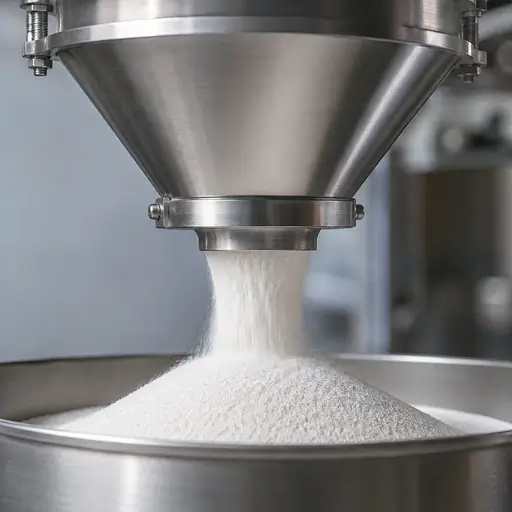
Flowability describes whether a powder can rearrange and move
under a particular combination of stress, aeration, wall contact,
time, moisture, and process geometry. A result is useful only when
those conditions match the decision you need to make.


Icon representing the first technical route

Definition

What flowability means and why one label cannot describe every process.

Icon representing the second technical route

Governing variables

How particle, bulk, environmental, and equipment conditions interact.

Icon representing the third technical route

Measurement

Which tests describe strength, wall interaction, air response, or screening behavior.

Icon representing the fourth technical route

Process relevance

Where flowability becomes storage, conveying, feeding, filling, or forming performance.

Core concept

Flowability belongs to the powder-process system

A powder does not possess one universal flowability value. The observed behavior emerges from particle interactions, the state of the bulk bed, the surrounding environment, and the way the equipment loads and moves the material.

Loose pouring, consolidated hopper discharge, aerated transfer, screw feeding, and powder-bed spreading impose different stress paths. A material may perform well in one regime and fail in another without any contradiction.

PowderTechnology.info Insight

Describe the condition and decision with the result, for example, “cohesive strength after four hours of consolidation” or “aerated flow response after pneumatic transfer,” rather than simply “good flow.”

What controls it

Six groups of variables govern powder flow

No variable acts alone. The diagnostic value comes from identifying which interaction changed under the real process condition.

Particle size and fines

Smaller particles increase specific surface area and contact density. A modest shift in the fine tail can raise cohesion and restrict air paths even when D50 remains stable.

Shape and surface condition

Angular, elongated, rough, coated, or contaminated particles interlock and transmit forces differently from smooth, rounded particles.

Cohesion and consolidation

Normal stress and storage time strengthen the contact network. The resulting unconfined yield strength is a key input when assessing arching and ratholing risk.

Packing and compressibility

Packing state changes bulk density, voidage, contact number, and stress in the solid skeleton. Bulk and tapped density indices indicate it but do not identify its cause.

Air and permeability

Retained or displaced air changes effective stress and apparent bulk density. Low permeability can turn steady discharge into pauses, surges, or flooding.

Moisture, temperature, and charge

Humidity, water activity, temperature history, and electrostatic charge alter contact forces and wall adhesion. Their effect depends on material history and exposure time.

Regimes and terminology

The word flow covers different physical regimes

Use the process state to decide which measurement and interpretation belong together.

Flow regimeTypical contextInterpretation priority
Loose, low-stress flowPouring, angle of repose, small-orifice screeningUseful for controlled comparison, not hopper design
Consolidated flowStorage, hopper and silo dischargeStrength and wall friction become decisive
Aerated or fluidized flowPneumatic transfer, receiver fill, rapid dischargePermeability, deaeration time, and density state matter
Forced flowScrew feeding, mixing, blade movementRate, confinement, work input, and history affect response
Spreading or depositionPowder-bed fusion, coating, dosing onto a surfaceDynamic rearrangement, agglomerates, charge, and layer interaction matter

How to measure it

Choose a measurement by the uncertainty

A test earns its place when its loading, output, and limitation match the process question. The dedicated testing page provides the full selection logic.

Shear and flow function

Quantify cohesive strength across relevant consolidation stresses and calculate whether a stable arch or rathole is plausible.

Wall friction

Measure powder slip against the actual wall or liner material to assess mass-flow geometry and stagnant-zone risk.

Permeability and deaeration

Determine whether air can enter or leave the bed quickly enough for filling, discharge, and feeder cycles.

Bulk and tapped density

Screen packing change and compressibility. Use the result to raise a mechanism question, not as a universal flow prediction.

Dynamic and aerated testing

Compare energy or resistance in conditioned, compacted, and aerated states when moving-bed behavior matters.

Simple comparative tests

Angle, orifice, avalanche, and timed discharge methods support QC when geometry and procedure are tightly controlled.

Where it matters

Flowability becomes a process outcome

The same material-property interaction appears differently depending on where the powder is stored, transferred, metered, or formed.

01

Storage and hoppers

Arching, ratholing, stagnant zones, flooding, or unreliable restart.

02

Conveying and receivers

Aeration, filter loading, line instability, attrition, and inconsistent discharge state.

03

Feeding and dosing

Fill-factor drift, torque variation, refill shock, density swings, and pulsation.

04

Blending and transfer

Segregation, dead zones, inconsistent residence time, and consolidation history.

05

Filling and packaging

Variable fill weight, dust release, bag or liner restriction, and slow emptying.

06

Forming and deposition

Die fill, compaction uniformity, recoating, and layer consistency.

Go deeper

Three strong routes into flowability

These articles add depth without replacing the topic, testing, or troubleshooting pages.

Powder Flowability: Factors and Measurement Techniques Techniques

Powder Flowability: Factors and Measurement Techniques

A focused overview of why the test must match the process condition.

Read the article

Powder Deaeration: Flushing, Surging, and Air Retention

Powder Deaeration: Flushing, Surging, and Air Retention

How retained air and permeability change apparent flow performance.

Read the article

Powder Operating Window

Powder Operating Window: Why a Good Powder Fails in the Wrong Process

How process conditions move a powder from reliable behavior into failure.

Read the article

Troubleshoot

Diagnose poor flow and discharge.

Measure

Choose methods for powder flow behavior.

Process

Connect flowability with processing.

Explore properties

Browse the Particle Behavior & Characteristics hub.

Need the measurement, not just the guidance?

If the remaining uncertainty concerns strength, wall friction, density state, permeability, or dynamic response, select the measurement around the process condition rather than ordering a generic flow test. PowderTechnology.info works closely with Delft Solids Solutions for independent laboratory testing and interpretation. Discuss the measurement question with DSS


Delft Solids Solutions logo