
Powder property

Density and packing

Material density and powder-bed density answer
different questions
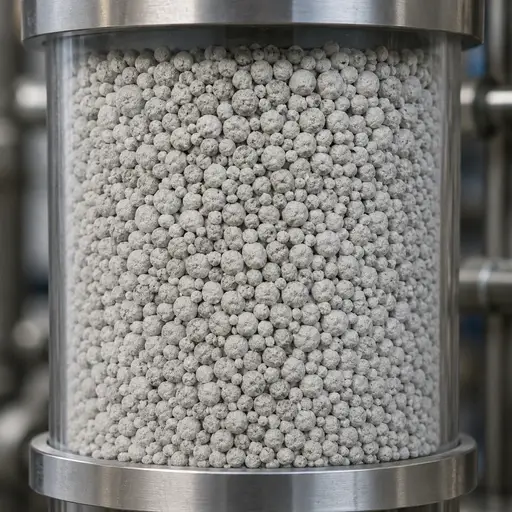
Density and packing connect particle material, internal structure,
arrangement, and process history. Skeletal density is based on the
volume inaccessible to the measurement gas, while accessible pore
space is excluded according to the gas and method.


Icon representing the first technical route

Definition

Which density is being measured and what physical volume definition belongs with the reported result.

Icon representing the second technical route

Governing variables

How PSD, morphology, porosity, stress, vibration, and air change overall packing behavior.

Icon representing the third technical route

Measurement

Which methods distinguish material density, bulk state, compressibility, and compact density.

Icon representing the fourth technical route

Process relevance

Where density state affects storage, dosing, filling, compaction, and transport behavior.

Core concept

Density depends on which volume is counted

Skeletal density is based on the volume inaccessible to the measurement gas, while accessible pore space is excluded according to the gas and method. The same powder can therefore have several valid density values. Loose pouring, vibration, tapping, consolidation, aeration, and handling history change bulk packing without changing the solid material. Choose the density definition that matches the decision and report the preparation state with every bulk result.

PowderTechnology.info Insight

Do not use bulk density alone to infer flowability. It describes a packing state, while flow also depends on cohesion, wall interaction, stress history, permeability, moisture, and equipment conditions.

What controls it

Six groups of variables govern density and packing

Packing emerges from particle geometry, internal structure, and the way the bed is formed and loaded.

Particle material density

Composition and solid phase determine the density of the particle skeleton measured by a suitable displacement method.

Particle size distribution

Fine particles can occupy voids between coarse particles, increasing packing density while also changing cohesion and segregation.

Shape and surface texture

Rounded particles often rearrange efficiently, while angular, flaky, rough, or fibrous particles create more open or interlocked structures.

Internal porosity

Open, closed, and inaccessible pores change the relationship between skeletal, envelope, and apparent particle density.

Preparation and deposition

Pour height, filling rate, vibration, tapping, aeration, and sample handling determine the initial bed structure.

Stress and compressibility

Normal load rearranges and deforms the bed, changing voidage, contact number, permeability, and volumetric response.

States and interpretation

The same powder can occupy different density states

State the volume definition and preparation route before comparing density values.

Density state Volume included Typical use Main caution
Skeletal density Volume inaccessible to the measurement gas Composition, porosity calculations, formulation comparison Gas-accessible pores and gas interaction affect interpretation
Envelope density External particle envelope including internal voids Particle and granule structure Method resolution and envelope definition matter
Loose bulk density Particles plus interparticle voids after controlled filling Storage, filling, and volumetric capacity Highly sensitive to preparation and aeration
Tapped density Bed volume after a defined tapping protocol Packing change and tapped-density comparison Not a universal process maximum
Consolidated density Bed volume after a defined applied stress history Stress-dependent packing and compressibility Depends on stress level and loading history

How to measure it

Choose a measurement by the density definition

A useful result begins by deciding whether the uncertainty concerns the material, the particle envelope, or the powder bed.

Gas pycnometry

Measure skeletal volume through gas displacement while considering pore accessibility and material-gas interaction.

Envelope or displacement density

Estimate external particle or compact volume when internal voids belong inside the measured envelope.

Loose bulk density

Measure mass per controlled poured volume using a defined funnel, container, and filling procedure.

Tapped density

Apply a defined tapping sequence to quantify packing change and resulting bulk-density stabilization.

Compressibility under stress

Measure bed density across relevant normal loads rather than relying on one tapped endpoint.

Process-matched volumetric check

Compare receiver, feeder, package, or die fill density at the actual cycle stage that controls performance.

Where it matters

Packing density becomes a volumetric process constraint

Bed density changes capacity, gas movement, stress transmission, dose volume, and the amount of material delivered per cycle.

01

Storage and hoppers

Usable capacity, consolidation, permeability, wall stress, and restart condition.

02

Conveying and receivers

Aerated arrival density, settling time, receiver fill level, and discharge-state drift.

03

Feeding and dosing

Screw fill factor, volumetric-to-mass conversion, refill shock, and dose consistency.

04

Filling and packaging

Fill weight, package volume, settlement, headspace, and apparent underfill.

05

Forming and compaction

Die fill, density gradients, compressibility, bonding, and dimensional consistency.

06

Mixing and segregation

Density differences, percolation, trajectory separation, and blend composition drift.

Go deeper

Three practical routes into density and packing

Explore how bulk-density results, packing state, and process history change volumetric powder behavior.

Bulk density measurement and interpretation

Bulk Density Alone Can Mislead Powder Analysis

Why one bulk-density value cannot explain flow, packing history, or process performance by itself.

Read the article

Assessing powder packing density

Powder Packing Density: Assessing and Optimizing

How particle properties and preparation conditions influence packing efficiency.

Read the article

Characterizing bulk density in powders

Characterizing Bulk Density in Powders: Why It Matters

Where bulk density affects storage, dosing, packaging, and process control.

Read the article

Troubleshoot

Diagnose feeding and dosing variation.

Measure

Choose methods for density and packing.

Process

Connect packing state with processing.

Explore properties

Browse the Particle Behavior & Characteristics hub.

Need the measurement, not just the guidance?

If the remaining uncertainty concerns skeletal density, bulk-density state, compressibility, packing history, or volumetric process variation, select the measurement around the material state and process decision. PowderTechnology.info can help define the test sequence, sample conditions, and interpretation route. For laboratory support, explore our Delft Solids Solutions partner page or visit Delft Solids Solutions directly.


Delft Solids Solutions logo