
Powder property
Powder permeability
Gas transport through a powder bed depends on its structure and state
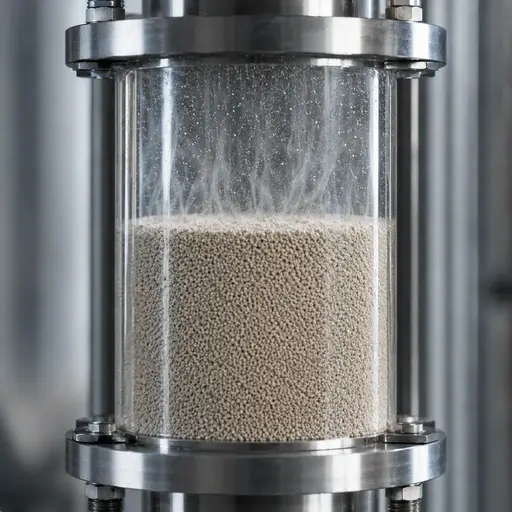
Permeability describes how readily gas moves through the connected voids in a powder bed under a pressure gradient. Packing, stress, fines, moisture, and process history determine the available pathways, so the result must represent the bed state that controls the operation.
Powder property
Powder permeability
Gas transport through a powder bed depends
on its structure and state
Permeability describes how readily gas moves through the connected voids
in a powder bed under a pressure gradient. Packing, stress, fines, moisture,
and process history determine the available pathways, so the result must
represent the bed state that controls the operation.




Core concept
Permeability belongs to the powder-bed state
A powder does not possess one universal permeability value. Gas transport emerges from the connected pore structure created by particle size, shape, packing, consolidation, and the way the sample was prepared.
A loose poured bed, a consolidated hopper, and a recently aerated receiver can contain the same solids while presenting very different voidage and pressure-drop behavior. Permeability can therefore change during the process even when composition is unchanged.
What controls it
Six groups of variables govern gas transport through the bed
No variable acts alone. The useful question is which change altered the connected air pathways under the real process condition.
States and interpretation
The same powder can occupy different permeability states
Match sample preparation, stress, and gas-flow range to the state that exists when the process succeeds or fails.
| Powder-bed state | What changes | Likely consequence | Useful comparison |
|---|---|---|---|
| Loose poured | High voidage and open pathways | Lower pressure drop, but poor repeatability if filling varies | Control pour height, bed height, and preparation |
| Consolidated | Pore throats narrow as stress increases | Permeability may collapse under hopper or storage load | Measure across the operating stress range |
| Aerated or expanded | Gas occupies an enlarged, low-density structure | Flushing, surging, delayed settlement, or density drift | Track deaeration and density relaxation with time |
| Discharging | Dilation requires replacement air through the bed | Pressure gradients, pulsing, ratholing, or unstable rate | Compare stability against discharge rate and vent condition |
How to measure it
Choose a measurement by the gas-transport question
A permeability result earns its place when bed preparation, loading, and gas-flow conditions reproduce the process uncertainty. The dedicated testing page provides the full selection logic.
Where it matters
Permeability becomes a process-timing constraint
The same bed can create different symptoms depending on whether gas must enter during discharge or escape after conveying, filling, or compaction.
Go deeper
Three strong routes into permeability
Explore how powder permeability affects dosing stability, air retention and hopper discharge in practical processing situations.


Need the measurement, not just the guidance?
If the remaining uncertainty concerns pressure drop, permeability loss under stress, deaeration time, or aeration response, select the measurement around the powder-bed state and process cycle rather than ordering a generic flow test. PowderTechnology.info works closely with Delft Solids Solutions for independent laboratory testing and interpretation. Discuss the measurement question with DSS