
Test methods
Permeability, Aeration and Deaeration
Measure gas transport, aeration response, and the time needed to release retained air
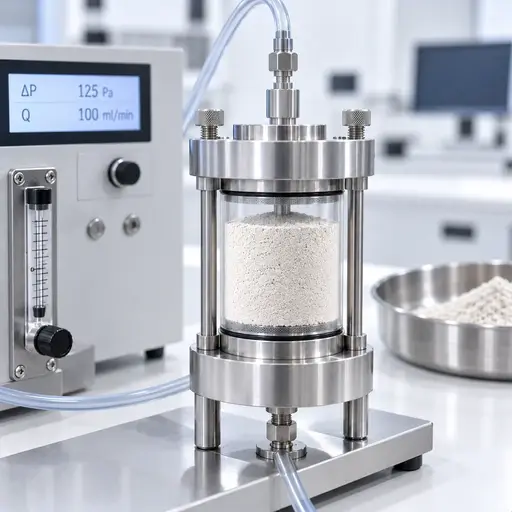
A powder bed can resist gas flow, change its resistance to motion when aerated, and take time to settle after the gas supply stops. These are different measurements. Select the route that represents the bed structure, applied stress, gas conditions, and process timescale behind the handling problem.
Test methods
Permeability, Aeration and Deaeration
Measure gas transport, aeration response, and the time needed to release retained air
A powder bed can resist gas flow, change its resistance to motion when aerated, and take time to settle after the gas supply stops. These are different measurements. Select the route that represents the bed structure, applied stress, gas conditions, and process timescale behind the handling problem.




Select a method
Choose the gas-powder response you need to measure
These six routes distinguish steady transport, stress-dependent transport, resistance to motion, settling, fluidization, and thin-layer resistance. Some share hardware but use different procedures and outputs.
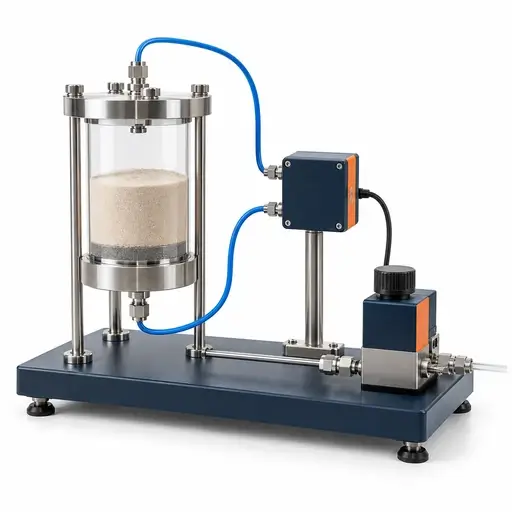
Powder-bed gas permeability
Pass a controlled gas flow through a stationary bed and measure the pressure difference across it.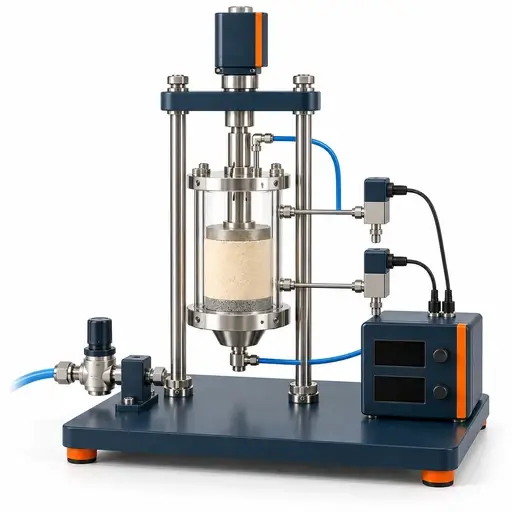
Permeability under consolidation
Measure gas pressure drop through a powder bed at controlled levels of mechanical consolidation.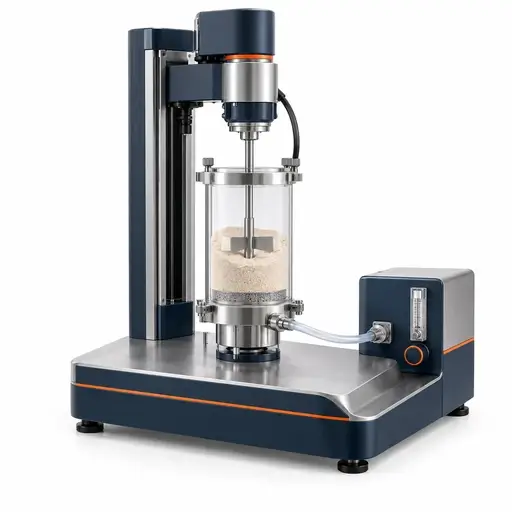
Aerated powder rheometry
Move a blade through a powder bed while measuring torque and axial force with controlled upward gas flow through the bed.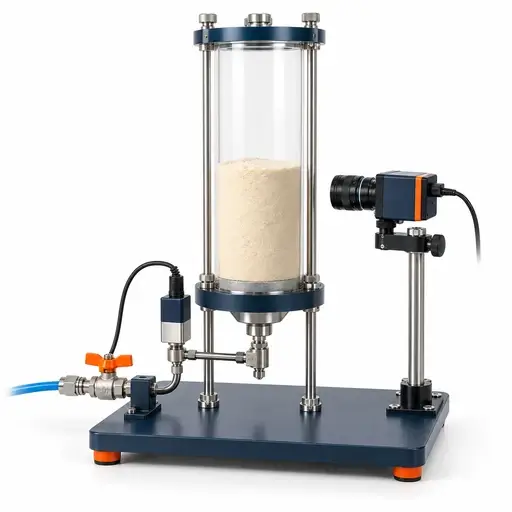
Deaeration and air-retention testing
Track bed height and, where instrumented, excess pressure as an initially aerated bed settles after gas input stops.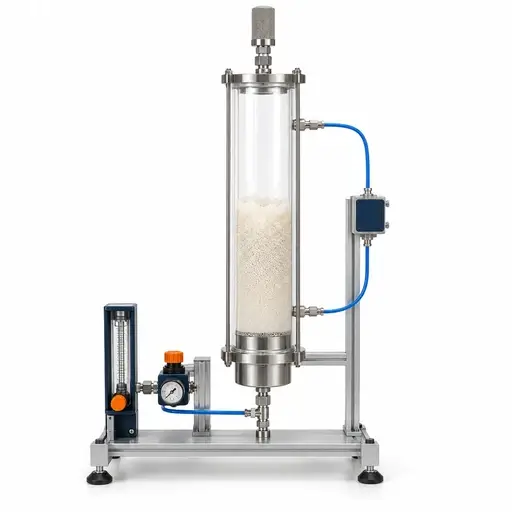
Fluidization onset and bed expansion
Increase and decrease upward gas flow while measuring bed pressure drop and observing height, channels, and motion.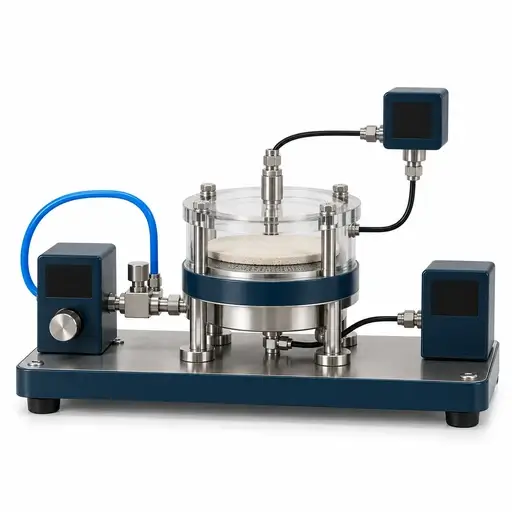
Dry powder-cake gas permeability
Measure gas pressure drop across a supported thin powder layer and separate its resistance from the fixture and support.Core concept
Gas transport depends on bed state
Permeability describes gas transport through the connected voids of a powder bed in a defined packing state. It is not particle porosity, gas-adsorption surface area, or a universal constant for every state of the same powder. Bed thickness, packing, fines, consolidation, moisture, and preferential channels affect the measured response.
Aeration introduces gas into the bed. Fluidization is a particular condition in which upward gas drag substantially supports the particles. Deaeration follows a change or stop in gas input and involves both gas escape and bed rearrangement. An aeration-energy curve, a pressure-flow curve, and a settling-time curve therefore answer different questions.
Key takeaway
Choose the response that governs the process
Use stationary-bed permeability testing when the question is resistance to gas transport, add controlled consolidation when packing changes that resistance, and use aerated rheometry when gas changes resistance to powder movement. Measure deaeration directly when the available settling time is the constraint, and use a fluidization column when bed lift, expansion, or channeling is the question. Match the test to the process bed state and gas conditions; neither a single permeability value nor an aerated flow-energy result predicts full-scale venting, flooding, or feeder stability on its own.
What controls it
Six decisions define a useful gas-powder test
Specify the physical state and operating question before choosing a test cell or accepting a ranking.
Selection and interpretation
Separate steady transport from transient behavior
Pressure drop, permeability, flow energy, bed expansion, and settling time are different outputs. Compare methods only after aligning the bed state, geometry, gas conditions, and definition of the result.
Engineering question | Primary route | Useful output | Critical boundary |
|---|---|---|---|
| How readily does gas cross the settled bed? | Powder-bed gas permeability | Pressure-flow curve and permeability | Keep bed structure stable and verify model validity |
| Does consolidation close the gas pathways? | Permeability under consolidation | Permeability versus stress and density | Measure bed thickness at each stress |
| Does gas change resistance to powder movement? | Aerated powder rheometry | Flow energy versus gas velocity | Mechanical response is not permeability |
| Will the powder settle before the next process step? | Deaeration and air-retention testing | Height and pressure recovery over time | Specify initial aeration, venting, and endpoint |
| Does the bed fluidize or channel? | Fluidization onset and bed expansion | Pressure drop, expansion, and observed onset | Confirm pressure behavior with bed observation |
| How much resistance comes from a deposited layer? | Dry powder-cake gas permeability | Cake resistance and qualified permeability | Separate the support baseline and check bypass |
How to measure it
Select the method by the evidence the decision requires
The method sections below separate principle, sample state, preparation, output, limitation, disagreement, and decision use. Use the image selector above to jump directly to a method.
Test method 01
Powder-bed gas permeability
Measurement principle: Pass a controlled gas flow through a stationary bed and measure the pressure difference across it.
Suitable sample state: A reproducibly filled powder bed below disruptive expansion or fluidization.
Sample preparation: Control bed mass, height, diameter, gas conditions, flow direction, support resistance, and pressure taps. Check leaks and allow each flow step to stabilize.
Test method 02
Permeability under consolidation
Measurement principle: Measure gas pressure drop through a powder bed at controlled levels of mechanical consolidation.
Suitable sample state: A powder bed subjected to a representative loading and unloading sequence.
Sample preparation: Define stress steps, dwell time, porous-piston arrangement, gas velocity, and load history. Measure current bed height at each state and keep the loading hardware permeable to gas.
Test method 03
Aerated powder rheometry
Measurement principle: Move a blade through a powder bed while measuring torque and axial force at controlled upward gas velocities.
Suitable sample state: A conditioned powder bed tested through a defined sequence of aeration states.
Sample preparation: Fix vessel, blade trajectory, speed, conditioning, sample mass, gas-velocity steps, and stabilization time. Record channeling, expansion, fines loss, and any change in bed state.
Test method 04
Deaeration and air-retention testing
Measurement principle: Track bed height and, where instrumented, excess pressure as an initially aerated bed settles after gas input stops.
Suitable sample state: A powder bed brought to a reproducible initial aeration state.
Sample preparation: Define initial gas velocity and duration, shutoff behavior, vent paths, bed depth, elapsed-time origin, sampling rate, and endpoint. Prevent vibration and record any fines loss.
Test method 05
Fluidization onset and bed expansion
Measurement principle: Increase and decrease upward gas flow while measuring bed pressure drop and observing height, channels, and motion.
Suitable sample state: A representative powder or granule bed with sufficient freeboard and controlled gas distribution.
Sample preparation: Specify distributor, column diameter, bed mass, particle-size distribution, gas conditions, ramp rate, hold times, and up/down cycles. Subtract distributor pressure loss and monitor elutriation.
Test method 06
Dry powder-cake gas permeability
Measurement principle: Measure gas pressure drop across a supported thin powder layer and separate its resistance from the fixture and support.
Suitable sample state: A dry deposited cake or prepared thin powder layer representative of the application.
Sample preparation: Define support medium, deposition or packing procedure, mass per area, thickness, gas conditions, and pressure history. Measure the clean-support baseline and check edge sealing.
Conditional routes
Extend the test when the operating conditions demand it
Use these additions when gas properties, nonlinear flow, coupled signals, or scale remain unresolved.
Gas compressibility and nonlinear flow
Use absolute pressures and an appropriate compressible or inertial-flow treatment when the simple Darcy assumptions fail. Report the gas-flow reference conditions.
Process gas and temperature
Repeat measurements with relevant gas properties and material conditioning when ambient air does not represent the application.
Coupled pressure and settling measurements
Record both signals when a bed appears settled but pressure relaxation may still affect discharge. Document the vent resistance and sensor response.
Process confirmation
Compare laboratory findings with receiver pressure, refill timing, bed level, and discharge behavior. Use the actual vessel and vent geometry to assess scale effects.
Where it matters
Turn gas-powder measurements into process questions
Use the measured bed state and recovery time to decide what to investigate in the operating equipment.
Technical FAQ
Common questions about gas-powder measurements
Check the physical meaning of the output before using it to explain a process problem.
Go deeper
Connect the measurements to powder behavior
Continue with three published PTI articles on permeability, deaeration, and aerated dynamic testing.


Technical basis / sources
Standards and supporting guidance
The standards below apply to the specified FT4 measurements. The supporting PTI articles explain process interpretation; they do not replace the test procedures.
-
- ASTM D8327-24: pressure-drop and gas-permeability measurements as functions of consolidation stress, superficial gas velocity, or both, using the Freeman Technology FT4 Powder Rheometer.
-
- ASTM D8328-24: dynamic powder testing using the FT4, including aeration-related parameters. Identify the exact protocol and configuration used.
-
- Powder Permeability, The Hidden Cause of Dosing Instability: practical context for gas transport and dosing behavior.
-
- Powder Deaeration: Flushing, Surging, and Air Retention: interpretation of settling, retained air, and process timing.
-
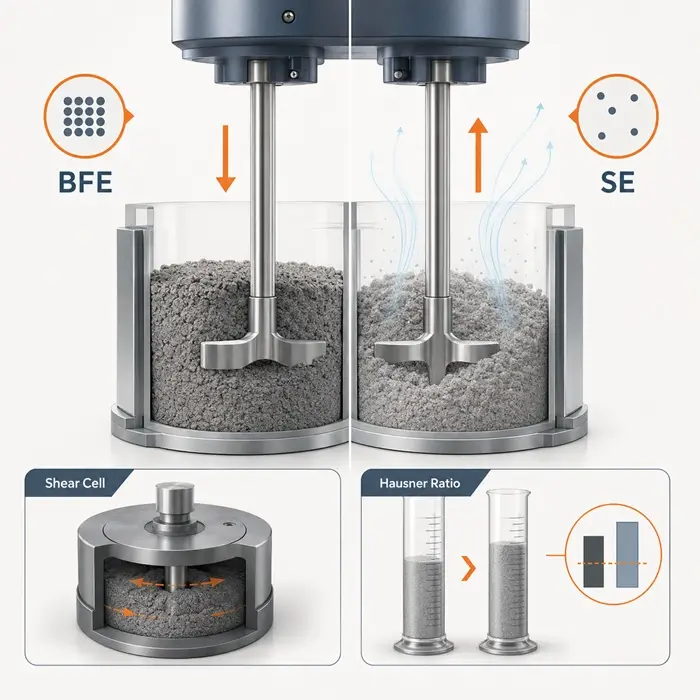
- Dynamic and Aerated Powder Testing: What Flow Energy Adds Beyond the Shear Cell and Hausner Ratio: the role and limits of aerated flow-energy measurements.
For other apparatus, transient deaeration, fluidization columns, and dry powder-cake fixtures, document and validate the application-specific procedure. State the geometry, boundary conditions, raw outputs, calculation model, and endpoint. The simple Darcy calculation requires stable-bed viscous flow with negligible gas-density change; the cited FT4 standards do not establish universal procedures for all six routes.
Need the measurement, not just the guidance?
If the unresolved question concerns gas resistance, consolidation-dependent permeability, aeration sensitivity, bed expansion, or recovery after refill, define the relevant bed state and process timescale before commissioning tests. Agree the sample conditioning, test sequence, raw outputs, and interpretation boundaries with the laboratory. PTI works closely with Delft Solids Solutions, a contract research organization specializing in the physical behavior of powders and granules. Contact Delft Solids Solutions.