Powder property
Electrostatic effects
Charge generation, retention, and dissipation
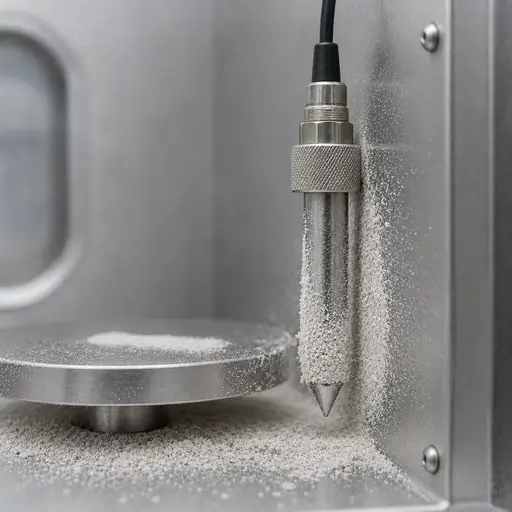
Electrostatic effects arise when particles gain, lose, retain, or redistribute charge during contact and separation. Charge polarity, magnitude, decay time, conductivity, humidity, particle size, and equipment materials determine whether electrostatics cause adhesion, agglomeration, segregation, poor flow, dust attraction, or ignition risk.
Powder property
Electrostatic effects
Charge generation, retention, and dissipation
Electrostatic effects arise when particles gain, lose, retain, or redistribute charge
during contact and separation. Charge polarity, magnitude, decay time, conductivity,
humidity, particle size, and equipment materials determine whether electrostatics cause
adhesion, agglomeration, segregation, poor flow, dust attraction, or ignition risk.



Core concept
Electrostatic behavior is system-dependent
Triboelectric charge develops when surfaces contact and separate, particularly when their materials or surface states differ. The amount and polarity depend on the pair of materials, surface condition, contact mechanics, and previous charge state. Induction and polarization can then create attraction even without direct charge transfer to every particle. Charge magnitude alone does not define the process consequence. Decay time determines how long charge persists, while particle size and mobility determine where charged material accumulates. A bulk average can also hide short, localized charge peaks. Measure generation and dissipation under representative contact, humidity, residence time, and grounding conditions, then connect the result to the observed failure.
What controls it
Six groups of variables govern electrostatic effects
Electrostatic behavior reflects how charge is generated, transported, stored, and dissipated across the complete handling route.
States and interpretation
The same average charge can conceal different process risks
Measure polarity, distribution, and persistence as well as the bulk charge level.
| Charge state | Likely observation | Interpretation risk | Useful confirmation |
|---|---|---|---|
| High charge, rapid decay | Strong response near the charging event but limited persistence | Delayed sampling may miss the peak | In-line or immediate measurement |
| Moderate charge, slow decay | Persistent adhesion or transfer into downstream equipment | One charge reading may understate duration | Charge-decay curve under process humidity |
| Mixed polarity | Agglomeration, segregation, or unstable bulk averages | Positive and negative fractions can cancel in the mean | Fraction-resolved polarity measurement |
| Localized peaks | Intermittent deposits, shocks, or ignition-relevant events | Averaging obscures short-duration maxima | Time-resolved measurement at the process location |
How to measure it
Choose a method by the charge question
Electrostatic tests must preserve the timing and contact history responsible for charge generation and loss.
Where it matters
Electrostatics become a handling, quality, and safety constraint
Charge matters wherever particles repeatedly contact surfaces, separate rapidly, or remain electrically isolated.
Go deeper
Three practical routes into powder electrostatics
Explore systematic troubleshooting, triboelectric generation, and the persistence of charge after the initial contact event.

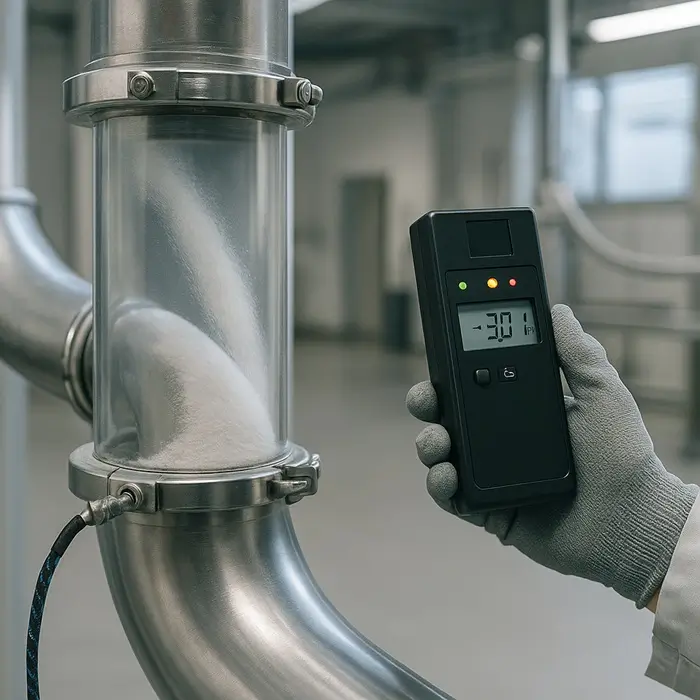
Need the measurement, not just the guidance?
If the remaining uncertainty concerns charge generation, polarity, charge decay, conductivity, humidity effects, or localized electrostatic peaks, select the measurement around the material state and process decision. PowderTechnology.info can help define the test sequence, sample conditions, and interpretation route. For laboratory support, explore our Delft Solids Solutions partner page or visit Delft Solids Solutions directly.