Updated: November 7, 2026
Table of contents

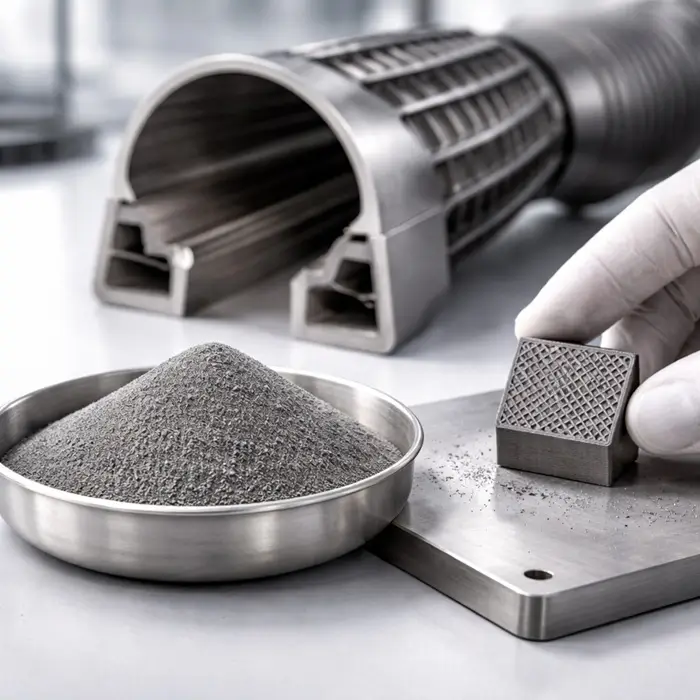
Illustrative metal geometry with curved internal openings.
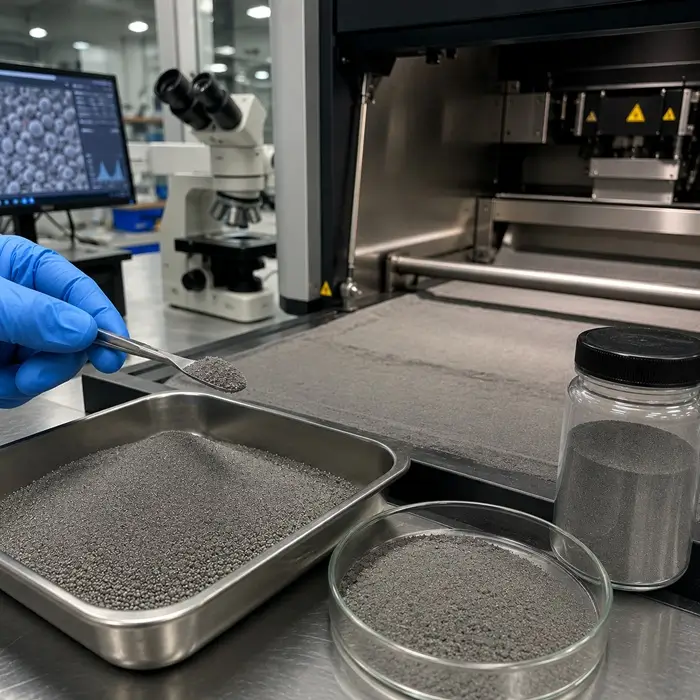
In metal powder bed fusion, part quality begins before the laser reaches the material. Particle size, flowability, spreading behavior, and packing uniformity all influence the layers from which a component is built. Controlling these properties is an important part of qualifying metal powder for additive manufacturing.
Fluent Metal, a startup based in Cambridge, Massachusetts, is developing a printer that feeds thin metal wire into a printhead, melts the tip, and deposits individual droplets onto a surface. Each droplet becomes part of the growing component. The process replaces powder spreading and recoating with control of droplet formation, temperature, placement, solidification, and metallurgical bonding.
A droplet must arrive with enough thermal energy to bond to the existing material without spreading so far that it distorts the intended geometry. Achieving that balance is particularly demanding without substrate preheating.
How Does Fluent Metal’s Liquid Metal Printing Work?
Fluent Metal uses drop-on-demand liquid metal printing, in which discrete quantities of molten metal are deposited according to a digital build pattern.
Liquid metal jetting itself is not new. Researchers have investigated several methods for generating and ejecting droplets, including mechanical, pneumatic, and electromagnetic actuation. A 2021 review by Ansell describes the development of these systems and the challenges involved in processing different metals. [1]
What distinguishes Fluent Metal’s approach is the generation of droplets directly from wire rather than from a reservoir of molten metal.
Its patented system advances metal microwire toward a heating region, where the wire tip melts. A controlled change in momentum separates the droplet from the remaining wire, allowing it to travel toward the build surface. The process repeats as the printhead follows the programmed geometry. [2]
A later patent application describes the use of multiple plasma arcs to control droplet formation and energy delivery. Parameters such as arc timing, duration, current, and voltage provide ways to influence how the droplet develops and separates from the wire. [3]
A droplet with insufficient thermal energy may solidify before forming an adequate metallurgical bond. Excessive energy can produce uncontrolled spreading or unwanted remelting of the underlying material. Variations in droplet size and placement can introduce dimensional errors.
Changing droplet temperature influences spreading, solidification time, and the thermal history of the deposited material. Positioning accuracy must therefore be evaluated alongside the thermal conditions at the receiving surface.
What Has Changed Since Fluent Metal’s 2024 Launch?
Fluent Metal emerged from stealth in March 2024 with $5.5 million in total venture funding. This included an additional $3.2 million investment led by E15, with participation from Pillar VC and industry investors. [4]
The company initially promoted a powder-free, laser-free route to metal printing with broad material compatibility and lower equipment requirements.
Patents Focus on Droplet Formation and Control
In January 2025, Fluent Metal received US Patent 12,186,800 B2, Metal deposition system. The patent describes methods for generating and depositing molten droplets directly from microwire. [2]
A further international patent application, WO2026006860A1, published on January 2, 2026, addresses metal droplet formation using multiple plasma arcs. [3]
The disclosures explain the proposed process architecture and how the company intends to control droplet generation. They also distinguish the printhead from reservoir-based systems, in which wire or other feedstock is melted and held as liquid metal before deposition.
NSF Research Targets Bonding Without Substrate Heating
In October 2025, the US National Science Foundation awarded Fluent Metal $305,000 through its Small Business Innovation Research Phase I program. The scheduled award period was October 1, 2025, to September 30, 2026. [5]
The research focused on two questions: how plasma arc parameters affect the thermal energy available for metallurgical bonding, and how wire motion and droplet separation influence deposition accuracy.
Fluent Metal aims to achieve reliable bonding without preheating the base component.
Its anticipated technical results included producing sample cubes with an internal density greater than 95% and dimensional accuracy within ±300 µm.
These were development targets, not reported achievements. A review of the public NSF award record and available company updates found no measured outcomes against these targets reported by November 7, 2026.
For context, Barrionuevo and colleagues reported a maximum relative density of 99.7% while investigating LPBF process parameters for 316L stainless steel. [6] That result concerns a different alloy and process; it is not an acceptance threshold for Fluent Metal.
The Oak Ridge results below show why the interfaces between deposited layers also need examination.
A Desktop Printer Becomes the Product Goal
In April 2026, founder Peter Schmitt outlined plans for a compact metal printer intended to operate from a standard electrical outlet. The proposed system uses interchangeable metal wire and oxygen-scrubber cartridges, with a target price of approximately $3,000. [7]
The announcement included a laboratory demonstration of bronze deposition. Schmitt explained that the demonstration was filmed without the inert cover to make the process easier to see.
At a target price of $3,000, the proposed printer would enter a different market from industrial metal AM systems. Its practical scope will depend on which alloys, geometries, and mechanical properties it can deliver consistently.
What Independent Liquid Metal Jetting Research Reveals
In 2025, Sumit Bahl and colleagues at Oak Ridge National Laboratory (ORNL) published a study of the microstructure, tensile properties, and fatigue behavior of A356 aluminum alloy produced by drop-on-demand liquid metal jetting. [8]
The research used a commercial ElemX printer, operating with the manufacturer’s recommended parameters for 4008 aluminum wire. The wire composition was equivalent to the widely used A356 casting alloy.
A Different Printer With a Heated Build Surface
The ElemX system uses a reservoir-based magnetohydrodynamic process. Wire is fed into a heated crucible, where it melts and forms a reservoir of liquid metal. A pulsed magnetic field generates Lorentz forces that eject droplets through a nozzle.
The droplets are deposited onto a heated build plate while a high-purity argon shroud limits their exposure to oxygen.
In the ORNL study, the molten aluminum was maintained at approximately 825 °C. The build plate was set to 475 °C, while the measured substrate surface temperature was approximately 440 °C.
This arrangement differs fundamentally from Fluent Metal’s proposed direct wire-to-droplet process. The heated plate helps maintain conditions favorable for droplet spreading and bonding, while argon shielding reduces oxidation during deposition.
High Yield Strength, Lower Ductility
After peak-aging heat treatment, the ORNL specimens achieved an approximately isotropic yield strength of 250 MPa.
Ductility was less uniform. Elongation averaged 6.1 ± 1.4% in the build direction, compared with 9.4 ± 1.0% in the transverse direction.
Atom probe tomography revealed an aluminum-magnesium-silicon-oxygen film only a few nanometers thick, despite the argon shielding.
The mechanically important oxide interfaces were located at layer boundaries. The authors specifically observed delamination along these boundaries, rather than at the track or inter-droplet boundaries where oxidation might also have been expected.
The interval between successive layers is longer than the interval between adjacent droplets or tracks, giving the oxide more time to grow at layer boundaries.
Almost Fully Dense, but Poor Fatigue Performance
X-ray computed tomography (XCT) measurements of the as-fabricated ORNL material showed approximately 0.1 vol% porosity, equivalent to about 99.9% density.
The scan used a voxel size of 26.2 µm and a minimum defect size of two voxels. Consequently, the reported porosity describes voids detectable at the scan’s resolution, not nanometer-scale oxide films.
Despite the low measured porosity, fatigue testing revealed a substantial performance gap.
The researchers defined fatigue strength using a run-out criterion of 10⁷ cycles without fracture. Tests were conducted under fully reversed loading, with a stress ratio of R = −1, at 30 Hz.
The reported fatigue strengths for the peak-aged materials were:
| Material | Fatigue strength at 10⁷ cycles |
|---|---|
| Liquid metal jetted A356-T6 | 60 MPa |
| Cast A356, reference dataset 1 | 90 MPa |
| Cast A356, reference dataset 2 | 70 MPa |
| LPBF A357-T6 | 200 MPa |
Source: Bahl et al. (2025). [8] The cast and LPBF values are literature comparisons involving different alloys and study conditions, not a controlled comparison isolating the manufacturing process.
Fatigue cracks initiated at lack-of-fusion defects and propagated along layer boundaries through delamination of the metal-oxide interfaces. The near-full density therefore did not establish interfacial integrity under cyclic loading.
The Trade-Off Between Substrate Temperature and Oxidation
The ORNL researchers suggested that oxide films may continue growing after deposition. Elevated build temperatures and longer intervals between successive layers could allow additional oxidation of exposed surfaces.
Forgoing substrate preheating changes the thermal balance; it does not keep the growing component at room temperature. Repeated droplet deposition can heat it. Any reduction in post-deposition oxide growth would depend on the actual time–temperature history and oxygen exposure.
A cooler receiving surface also makes metallurgical bonding more demanding because the incoming droplet has less opportunity to remelt or fuse with the existing material.
Increasing droplet thermal energy may improve bonding while also changing spreading, solidification behavior, and geometric accuracy. Tests need to resolve these effects together with the deposited material’s temperature history.
Fluent Metal’s NSF research directly addresses this balance through plasma arc energy control and droplet separation dynamics.
The ORNL results do not establish that Fluent Metal will produce the same defects. They identify the mechanisms that should be measured when evaluating its process.
What Changes When Metal Powder Is Removed?
In LPBF, particle size distribution, morphology, cohesion, and packing behavior influence how material spreads and consolidates. The interaction between powder and recoater can produce streaks, bare regions, and density variations even when the feedstock meets its nominal specification.
Our article on powder spreading and recoater interaction explains how these layer defects develop.
Wire-fed liquid metal printing avoids these particular mechanisms. There is no loose powder bed to spread or maintain, and no unused powder to recover after each build.
Material handling shifts from powder conditioning and recovery to wire feeding, surface condition, and droplet generation.
Wire Quality Becomes a Process Variable
Fluent Metal’s process depends on feeding and melting wire with sufficient consistency to generate repeatable droplets.
Wire diameter influences the amount of metal supplied during each feeding movement. Surface condition and composition can affect melting and oxidation, while variations in feed motion can disturb droplet formation and separation.
Commercial availability of a particular alloy in wire form is therefore only one part of material compatibility. The wire must also meet the dimensional and surface requirements of the deposition process.
Copper, aluminum, stainless steel, and refractory metals differ considerably in melting temperature, thermal conductivity, oxidation behavior, and solidification characteristics. Each material will require its own processing window.
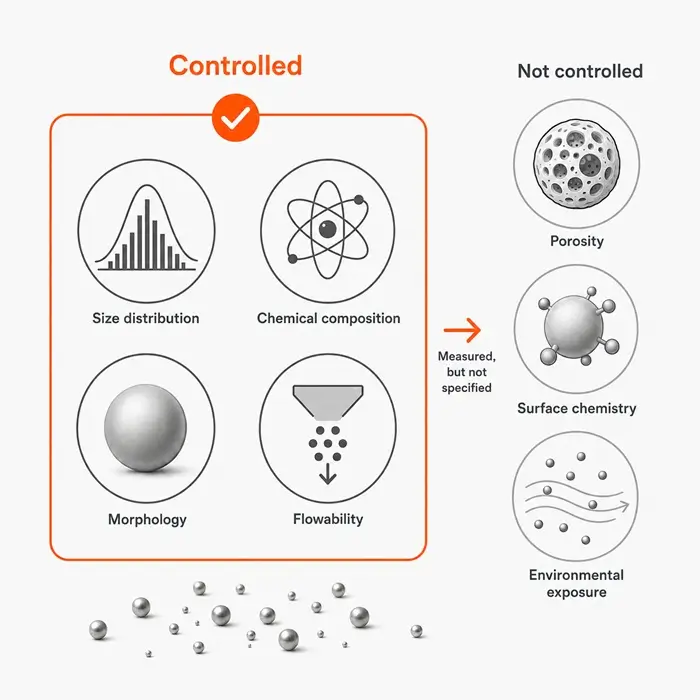
The same principle applies in powder-based additive manufacturing. As discussed in SAE AIR7359: Why Some Metal Powder Feedstock Properties Are Left Out of AM Specifications, qualification depends on demonstrating which material properties actually predict process performance, not simply measuring every available property.
For Fluent Metal, wire specifications will need to be connected to droplet stability, bonding, defect formation, and finished-part performance.
Powder-Free Does Not Mean Hazard-Free
Removing loose powder eliminates powder dispensing, recoating, and powder recovery. Depending on the material, this can reduce airborne-particle exposure and certain combustible-dust hazards.
Liquid metal deposition introduces different safety considerations. Molten droplets, hot surfaces, electrical equipment, process emissions, and atmosphere control all require assessment. The controls needed for bronze printing may differ from those required for higher-melting or more reactive metals.
Fluent Metal’s desktop concept includes oxygen-scrubber cartridges, but the ventilation, enclosure, and fire protection requirements of a particular installation will depend on the equipment and materials involved.
Material efficiency also needs to be measured across the complete manufacturing process. Start-up losses, unsuccessful builds, finishing operations, and rejected components contribute to waste even when droplets are generated only as needed.
How Does Fluent Metal Compare With WAAM and DED?
Wire-fed additive manufacturing is already established in several industrial processes.
Wire arc additive manufacturing (WAAM), a form of directed energy deposition (DED), uses an electric arc to melt continuously fed metal wire. Other DED systems use laser or electron-beam energy to melt wire as it enters the deposition region.
The principal difference is how the material is delivered and consolidated.
Conventional WAAM deposits wire into a continuously maintained melt pool. It is particularly useful for producing large metal structures at high deposition rates, although the heat input, surface finish, and dimensional control often require subsequent machining. [9]
Fluent Metal generates individual droplets and deposits them separately, without maintaining a molten metal reservoir or a continuous arc-driven melt pool on the component. That approach may provide greater flexibility for localized deposition and smaller features, provided droplet placement and bonding can be controlled.
| Process | Material delivery | Main characteristic |
|---|---|---|
| Fluent Metal | Individual molten droplets generated directly from wire | Discrete deposition without a molten reservoir |
| WAAM / DED-Arc | Wire melted by an electric arc into a continuous melt pool | High deposition rates for larger components |
| Laser wire DED | Wire melted by a focused laser into a localized melt pool | Controlled material addition, commonly used for repair and near-net-shape builds |
| LPBF | Metal powder spread in layers and selectively melted | Fine features and complex geometries, with powder handling and recoating requirements |
For large structural parts requiring substantial material deposition, WAAM may have a clear productivity advantage. LPBF is better suited to many geometrically complex components with fine features.
Compact equipment and controlled droplet deposition could make Fluent Metal suitable for localized features, coatings, and small-scale manufacturing.
A useful equipment comparison would use the same alloy and comparable part requirements.
What Would Demonstrate That the Technology Is Ready?
Qualification requires repeated builds that meet the intended application’s requirements. The evidence should connect droplet behavior to the resulting interfaces and part properties.
| Evaluation area | Evidence needed |
|---|---|
| Droplet control | Droplet size distribution, ejection frequency, placement accuracy, and repeatability |
| Bond integrity | Interfacial microstructure, oxide distribution, lack-of-fusion defects, and porosity |
| Mechanical properties | Tensile behavior in different orientations, fatigue resistance, and application-specific testing |
| Dimensional accuracy | Measured deviations across representative geometries and repeated builds |
| Material compatibility | Validated processing windows for defined alloys and wire specifications |
| Production performance | Deposition rate, build time, finishing effort, material losses, and rejection rate |
Small cubes are useful during process development because they provide a manageable geometry for investigating density and dimensional accuracy. However, applications introduce additional requirements.
A coating deposited onto an existing component must adhere to the substrate and withstand the intended service conditions. Residual stress, dilution, surface preparation, and substrate temperature may influence performance.
A freestanding part introduces different challenges, including geometric stability, build orientation, and bonding between successive layers.
Fluent Metal’s NSF project identified coatings on industrial components as an initial market, with rapid prototyping and small-batch manufacturing as potential later applications. [5]
Conclusion
Fluent Metal’s approach replaces powder spreading and molten-metal reservoirs with droplets generated directly from wire. Its patents and NSF-funded research identify the development challenge: controlling droplet formation while achieving metallurgical bonding without substrate preheating.
The independent ORNL results show how oxide-containing layer boundaries can limit fatigue performance despite low detectable porosity. Fluent Metal uses a different deposition process, so those findings identify mechanisms to investigate rather than predict its performance.
At the proposed $3,000 price, the desktop printer would address workshops and laboratories outside the industrial LPBF and WAAM market. Repeatable tests on defined alloys and representative parts will establish whether it can deliver useful bond strength, accuracy, and deposition rates.
Frequently asked questions
References
- Ansell, T. Y. Current Status of Liquid Metal Printing. Journal of Manufacturing and Materials Processing, 5(2), 31 (2021).
- Fluent Metal Inc. Metal deposition system, US Patent 12,186,800 B2. Granted January 7, 2025.
- Fluent Metal Inc. Metal droplet formation using multiple plasma arcs, WO2026006860A1. Published January 2, 2026.
- Digital Engineering 24/7. Startup Fluent Metal Launches to Offer Liquid Metal Printing. March 2024.
- National Science Foundation. SBIR Phase I: Drop-on Demand Liquid Metal Additive Manufacturing, Award 2528245. October 1, 2025–September 30, 2026.
- Barrionuevo, G. O., Ramos-Grez, J. A., Sánchez-Sánchez, X., Zapata-Hidalgo, D., Mullo, J. L., and Puma-Araujo, S. D. Influence of the Processing Parameters on the Microstructure and Mechanical Properties of 316L Stainless Steel Fabricated by Laser Powder Bed Fusion. Journal of Manufacturing and Materials Processing, 8(1), 35 (2024).
- Schmitt, P. Fluent Metal desktop-printer development announcement. LinkedIn, April 8, 2026.
- Bahl, S., Knapp, G. L., Gomez, A., Poplawsky, J. D., Haynes, J. A., Dehoff, R. R., Plotkowski, A., and Shyam, A. Impact of droplet oxidation on mechanical properties of an Al-7Si-0.4Mg alloy fabricated with liquid metal jetting. Additive Manufacturing, 103, 104775 (2025). Open-access accepted manuscript.
- Fraunhofer IAPT. WAAM in Industrial Production: Additive Manufacturing and Repair of Large Components. Technical overview.