Plastic pellets rarely feel like a powder risk. Yet the EU plastic pellet loss regulation changes that overnight. Pellets roll, stay visible, and seem easy to sweep. However, repeated spills create microplastic pollution quickly. Regulation (EU) 2025/2365 makes leakage a compliance topic across the EU supply chain.
Read the EU news article: Reducing microplastic pollution: New EU legislation enters into force.
What changed with the EU plastic pellet loss regulation
The Regulation targets preventable pellet loss, not formulation. It applies to economic operators that handled plastic pellets in quantities of 5 tonnes or more in the previous calendar year. It also reaches EU and non-EU carriers transporting pellets within the Union. Economic operators must also register by notifying the competent authority about each installation they operate or control.
The Regulation entered into force on 16 December 2025. Most provisions apply from 17 December 2027. That gives you time, yet not much slack for slow plants.
A key trigger sits at 1,500 tonnes handled per site per year. Above that, operators need third-party certification or a permit. Smaller firms can use simplified pathways, including self-declarations in some cases.
Why pellet loss looks like a bulk solids problem
Pellets behave like macro powders at transfer points. They bounce, they scatter, and they hide in corners. Attrition then creates fines that behave like classic dust. Therefore, the same weak points show up again and again.
You typically lose pellets at:
-
truck unloading and silo charging
-
pneumatic conveying bends and filters
-
big bag discharge frames and liner swaps
-
screeners, mixers, and regrind dosing
-
packaging and loading stations
Once losses become routine, housekeeping turns into a cost centre. Compliance turns it into a documented process step.
The hidden KPI: your loss budget
The Regulation expects you to prevent loss. However, it also pushes you to estimate and record losses. Many plants track throughput well, yet they never quantify what ends up on floors, ledges, and filters.
Treat pellet loss like a mass balance.
Start by defining a loss budget per line, per month:
-
map every transfer point and assign a spill risk rating
-
weigh vacuum waste and filter catch from that zone
-
log all spill events, even small ones
-
compare first out and last out samples for fines and segregation
-
convert the result into pellets lost per tonne handled
That KPI drives practical decisions. It also gives auditors something verifiable.
Controls that reduce losses quickly
Begin with engineering controls, then support them with routines.
Containment and sealing
Use proper loading spouts, tight flexible connections, and sealed inspection ports. Add catch trays under frequent disconnect points. Keep drop heights short, because bounce drives scatter.
Conveying discipline
Avoid excessive air velocity and sharp elbows. Where you must use pneumatics, control grounding and filtration. Fines will amplify both loss and cleaning load.
Cleaning that does not spread pellets
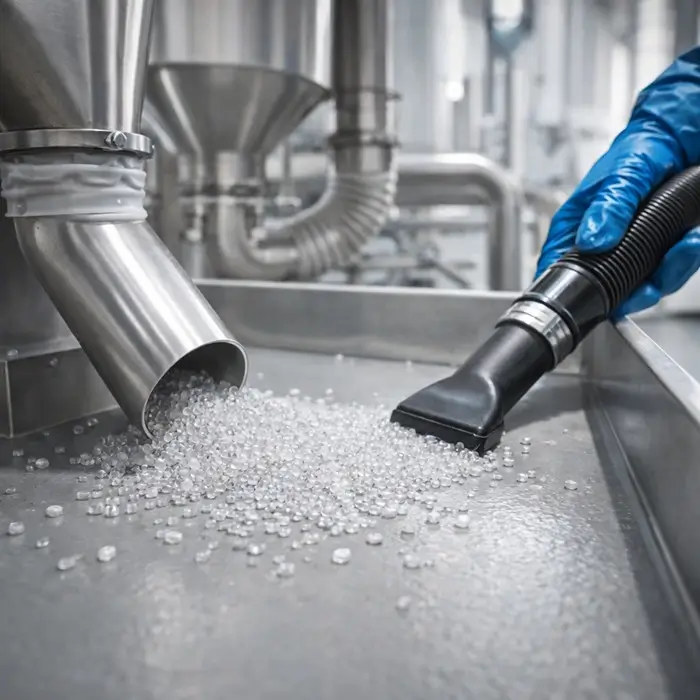
Ban dry sweeping in pellet zones. Instead, use industrial vacuums with closed containers. Define where recovered pellets go, because rework can become a contamination path.
Spill response as a standard work step
Build a pellet spill kit per area. Train operators on when to stop a line, how to isolate a spill, and how to document it. Small events matter because frequency creates totals.
How to prepare without overengineering
You do not need a perfect system on day one. You need a repeatable one.
Pick one high-risk area, often unloading or big bag discharge. Run a four-week baseline. Then fix one physical weakness per week, and trend your loss KPI. When the number drops, you have proof of control, not just good intentions.
Quick audit readiness checklist
Use this as a final internal check before you claim readiness:
-
installation registration is done for each site you control
-
transfer points are mapped and ranked by spill risk
-
spill response steps exist and operators follow them
-
loss estimates are logged monthly, not guessed yearly
-
vacuum waste and filter catch are weighed consistently
-
corrective actions are recorded when losses spike
Pellets may look benign. In 2026 and 2027, they will behave like an audited powder stream. Plants that treat pellet loss as bulk handling science will stay ahead.