
🔑 Key Takeaway
Triboelectric separation exploits the fact that different materials charge to opposite polarity when they contact each other, which allows a free-fall or belt-type separator to split them in an electric field. The technique depends on selecting a material pair with a large and stable charge difference, controlling feed moisture and particle size range, and tuning contact intensity in the charging device. Under favorable conditions it can reach purities in the high nineties for a target stream, but it is a dry, pair-specific method that usually complements rather than replaces density- or optical-based sorting.
Table of contents

Most powder technology coverage of triboelectric charging treats it as something to control: a source of dust cohesion, bridging, or ignition risk in conveying and handling. In plastics recycling and mineral processing, the same phenomenon is deliberately amplified. When two dissimilar materials contact and separate, differences in surface work function drive a net transfer of electrons, leaving one material positively charged and the other negatively charged. Triboelectric separation uses that charge split to pull a mixed granular or flaked feed apart in an electric field, without water, reagents, or density differences.
The technique is not a universal sorter. It works within a defined process window set by which material pair is being separated, how much moisture is in the feed, what particle size range is fed to the charger, and how much contact energy the charging device delivers. Push any of those variables outside their working range and separation efficiency drops quickly, sometimes without an obvious warning sign on the equipment. This article looks at how pair selection, feed conditioning, and charging intensity interact, what purity levels the method can realistically support, and how it compares with density-based and optical sorting routes.
Charge Difference as a Sorting Signal, Not Just a Hazard
Contact electrification occurs because materials differ in the energy required to remove an electron from their surface, commonly discussed in terms of effective surface work function. When two materials touch and separate, electrons move across the interface toward the material with the higher electron affinity at that contact event, leaving a measurable charge imbalance on each surface. For an insulating polymer or mineral particle, that charge does not immediately dissipate, which is exactly what makes the effect useful for sorting rather than just a nuisance in a hopper or chute. A review of triboelectrostatic separation research for granular plastic waste describes this work-function-driven electron transfer as the basis of the separation mechanism, while noting that the effective surface work function of a given plastic is difficult to measure directly and is usually inferred from charging behavior rather than read from a materials table (Habib and Miles, Waste Management).
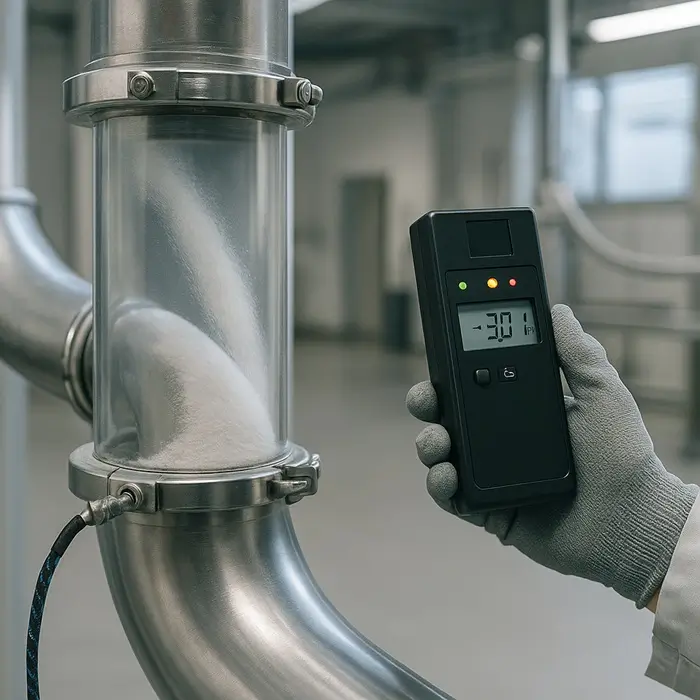
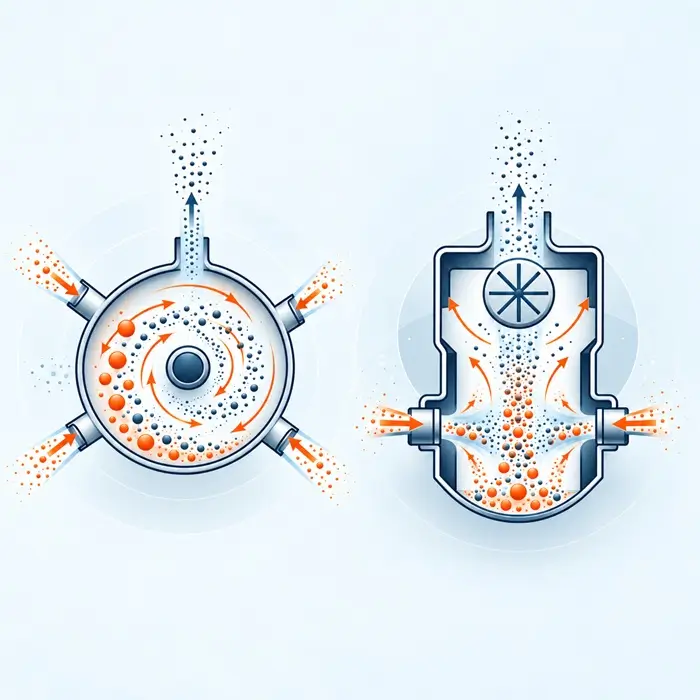
In a triboelectric separator, the mixed feed is charged by repeated contact against itself, a charging tube wall, or a vibrating plate, then released into a DC electric field, typically in a free-fall or inclined-belt configuration. Positively and negatively charged particles deflect toward opposite electrodes, and particles that never developed enough charge, or charged to the wrong polarity for their material, end up misreported into the wrong stream or in a low-charge middlings fraction. The background mechanics of contact charging, including why charge sign and magnitude vary between materials and process conditions, are covered in more general terms in Triboelectric Charging in Powders: The Science, Failure Modes, and Industrial Controls; the separation application described here is a deliberate, amplified use of the same underlying charge-transfer physics.
Selecting Material Pairs by Charge Polarity
A triboelectric separator does not sort an arbitrary mixture. It sorts a pair, or a small set of components, whose members reliably charge to opposite polarity, or at least to a clearly different magnitude, under the chosen contact conditions. Pair selection generally starts with a triboelectric series position, a ranked ordering of materials by their tendency to charge positive or negative against a common reference surface, but a series position from the literature is a starting screening tool rather than a guarantee, since charging behavior also depends on surface contamination, moisture, additive content, and the specific contact partner used in the actual separator.
Plastics recycling pairs
In post-consumer and post-industrial plastics recycling, triboelectric separation is most established for binary or near-binary mixtures where the two polymers charge in clearly opposite directions against each other or against a shared charging medium. Removing PVC from a PET-rich stream is a frequently studied case, since even small amounts of PVC contamination can degrade recycled PET quality, and one study reports PVC rejection and PET recovery in the PET product both above 99 percent under optimized conditions, with PET purity exceeding 99.99 percent in the best case (Dodbiba et al., Colloids and Surfaces A). Separating polyolefins from each other is a harder pair because HDPE and PP sit closer together on typical charging series; one study reports PP recovered at roughly 93 percent recovery and 96 percent purity, and HDPE at roughly 96 percent recovery and 93 percent purity, under tuned charging and field conditions (Application of tribo-electrostatic separation in the recycling of plastic wastes, Waste Management). These numbers describe specific feed compositions and equipment settings; they indicate what the method can achieve under favorable conditions, not a fixed guarantee for every mixed-plastic stream.
Mineral processing pairs
Triboelectrostatic separation predates its plastics recycling use by decades in mineral processing, where it is applied to pairs that are difficult to separate by density or flotation because the two minerals are chemically or texturally similar. Potash beneficiation is the longest-running industrial example: sylvite (KCl) and halite (NaCl) have almost identical density and crystal habit, which limits gravity-based separation, but they charge to different polarity under controlled dry contact conditions, which supports separation in free-fall electrostatic separators at industrial scale (A review of the research on triboelectric separation technology, Minerals Engineering). Coal cleaning is a second application area, where triboelectrostatic separation is used to reject mineral matter, including quartz, from coal; separation performance for a coal-quartz mixture has been shown to depend strongly on surface pretreatment of the particles before charging, with both thermal and chemical surface conditioning improving separation outcomes compared with untreated feed (Separation of the coal-quartz mixture using tribo-electrostatic separator, International Journal of Coal Preparation and Utilization). In both cases, pair selection is inseparable from surface conditioning: the raw minerals may not charge apart cleanly until moisture, adsorbed species, or fine coatings on the particle surfaces are addressed first.
What Controls Separation Efficiency
Once a material pair is confirmed to charge apart, the achievable separation efficiency is set by three interacting process variables: feed moisture, particle size range, and contact intensity in the charging device. None of these acts in isolation, and pushing one variable to an extreme can undo an improvement made elsewhere.
Feed moisture and the charging window
Moisture on a particle surface increases surface conductivity, which allows charge to leak away between the contact event and the separation field rather than being retained long enough to drive deflection. The relationship is not simply linear: measured triboelectric charge in humid conditions has been shown to first increase with relative humidity, before decreasing again once humidity rises further, and the saturation charge that smaller particles can hold drops more sharply in humid air than the charge on larger particles (Influence of moisture content and triboelectric charging conditions on the tribo-electrostatic separation of actual granular mixtures of waste plastics, Advanced Powder Technology). Practically, this means there is usually a moisture window rather than a single target value, and feed that is fully dried is not automatically the best-charging feed. Where feed moisture varies with incoming lot or ambient humidity, tracking dew point and water activity alongside bulk moisture content gives a more complete picture of what the surface is actually exposed to, as discussed in Moisture Control for Powders: Dew Point, Water Activity, and Caking Windows and in Triboelectric Charging in Powders: Why Humidity Matters.
Particle size range
Particle size affects both how much charge a particle can carry relative to its mass and how that charge translates into deflection in the separator field. Smaller particles have been reported to charge more effectively than larger ones in tribo-aero-electrostatic separation of plastics, up to a point; below a certain size, electrostatic adhesion of particles to the grounded charging surface itself starts to interfere with further charge buildup and with clean release into the separation field (Effect of particle size on the tribo-aero-electrostatic separation of plastics, Waste Management). This gives triboelectric separation a workable particle size band rather than a single optimum, and a feed with a wide size distribution, or with a significant fines fraction outside that band, can under-perform even when the bulk material pair charges well. Screening or classifying the feed to a controlled size range before charging is a common way to keep the process inside its effective window; interpreting where a feed’s fines and oversize fractions sit relative to that window follows the same logic used in Particle Size Distribution Interpretation: Reading D10, D50, D90, Fines, and Oversize in Process Context.
Contact intensity and charger design
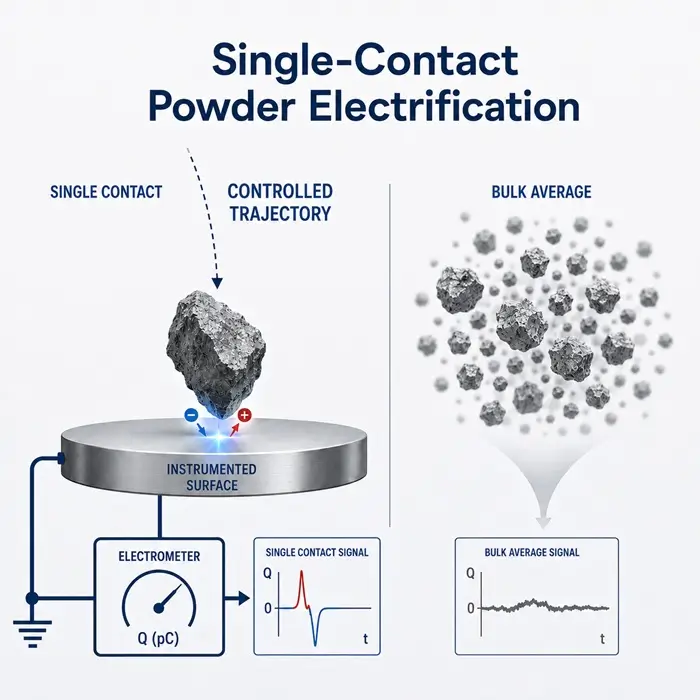
Charge transfer per contact event is not fixed for a given material pair; it depends on contact force, contact area, sliding versus impact contact, and how many contact events a particle experiences before it reaches the separation field. Charging tube geometry, particle velocity, residence time in the charger, and whether the charging surface itself is periodically cleaned or refreshed all influence how much of the theoretical charge difference between two materials is actually realized on a given production run. Isolating how much charge a single contact event transfers, separate from the cumulative effect of many contacts, is the basis of controlled bench-scale characterization described in Single-Contact Electrification Testing: Isolating Charge Transfer Per Contact, and tracking how quickly a charged particle loses that charge again is covered in Charge Decay Time: A Fast Predictor of Powder Handling Risk. Both measurements are diagnostic inputs for tuning a charger, not a direct prediction of full-scale separator purity, since field strength, particle trajectory, and splitter position also determine where a given charge level ends up reporting.
What Purity Levels Are Realistic
The purity a triboelectric separator can deliver is pair-specific and condition-specific, and reported figures in the literature span a wide range depending on how far apart the two materials charge and how tightly moisture, size, and contact conditions are controlled. For a favorable, well-separated pair such as PVC in a PET-rich stream, purities and recoveries above 99 percent have been reported under optimized conditions (Dodbiba et al., Colloids and Surfaces A). For a closer pair such as HDPE and PP, single-pass purities in the low-to-mid nineties are more representative of what has been demonstrated (Waste Management), and reaching a higher purity target for a closer pair typically means accepting lower recovery of the target stream, re-processing the middlings fraction, or adding a second separation pass. A single laboratory purity number is a decision input for evaluating whether the method fits a given feed and purity specification; it is not, by itself, a guarantee of what a full production line will achieve, since real feed streams carry more contamination, wider particle size distributions, and more variable moisture history than a controlled test batch.
Where Triboelectric Separation Fits Relative to Density and Optical Sorting
Density-based separation, including sink-float media separation, jigging, and hydrocyclone classification, sorts on bulk density difference and does not require the particles to hold a surface charge or to be dry. It is generally the more robust choice when the target materials differ clearly in density and when process water is available and its disposal or treatment is not a constraint. Triboelectric separation instead becomes relevant when the materials of interest are close in density, as with many common plastic pairs and with sylvite and halite in potash ore, or when a dry process is preferred because water use, wastewater treatment, or moisture pickup in the product is a concern. Optical and near-infrared sorting identifies material by spectral or visual signature rather than by bulk physical property, which allows it to separate materials of similar density and similar charging behavior, and it can typically handle a wider range of particle sizes and colors in a single pass than a triboelectric separator can. Optical sorting generally requires that particles be presented as discrete, unobstructed pieces to a sensor and camera system, and it depends on the target material having a distinguishable spectral response, which is not guaranteed for black or heavily pigmented plastics or for visually similar mineral grains. In practice, the three approaches are often complementary rather than competing: a plant may use density or optical sorting for a coarse first cut and triboelectric separation for a finer, close-property polishing step, or the reverse, depending on which material pair is hardest to resolve at which stage of the process.
A Practical Checklist for Evaluating Triboelectric Separation
Before committing to triboelectric separation for a new material pair, a few process questions help set expectations rather than assuming the method will behave the same way it did in a published study or a vendor trial. First, confirm the two target materials actually charge to a stable, opposite, or clearly different polarity against each other or against the intended charging surface, using bench-scale contact charging rather than a general triboelectric series position alone. Second, characterize the feed’s moisture content and its variability, since the charging response is nonlinear with humidity and a feed that is sometimes dry and sometimes damp can produce inconsistent daily performance even with no change in equipment settings. Third, check the feed’s particle size distribution against the separator’s effective working range, since a wide distribution or a significant fines fraction can dilute an otherwise workable charge difference. Fourth, treat any purity and recovery numbers from a bench test as a decision input for the process design, not as a fixed production guarantee, and plan for a middlings or reprocessing stream where the target purity is close to what the method can support. Finally, compare the projected purity and throughput against density- or optical-sorting alternatives for the same material pair before assuming triboelectric separation is the only, or the best, dry-process option available.