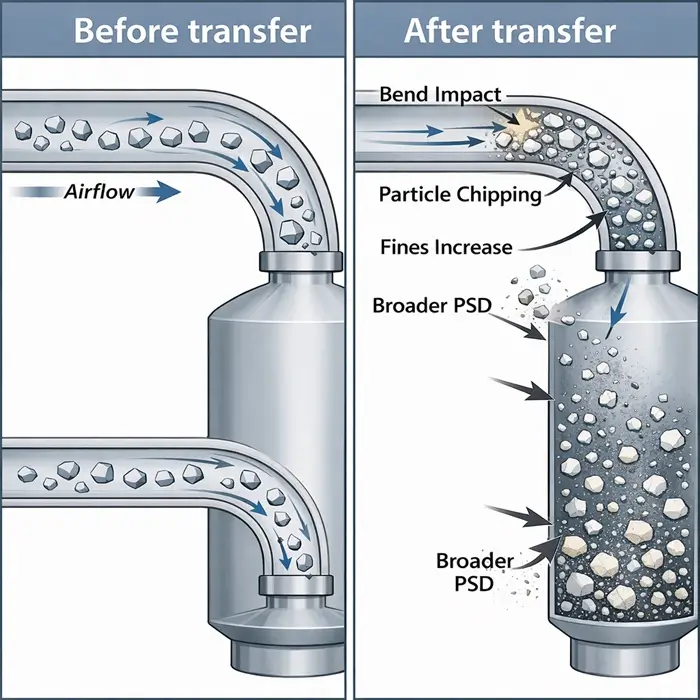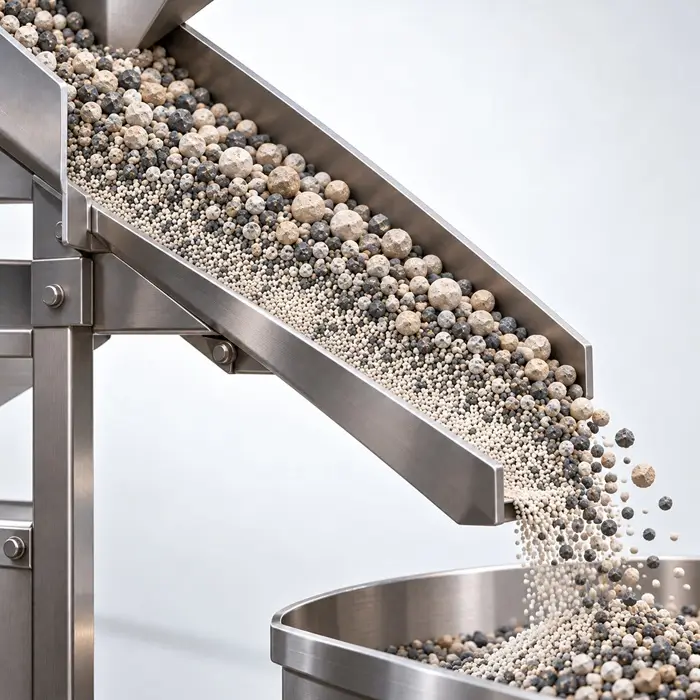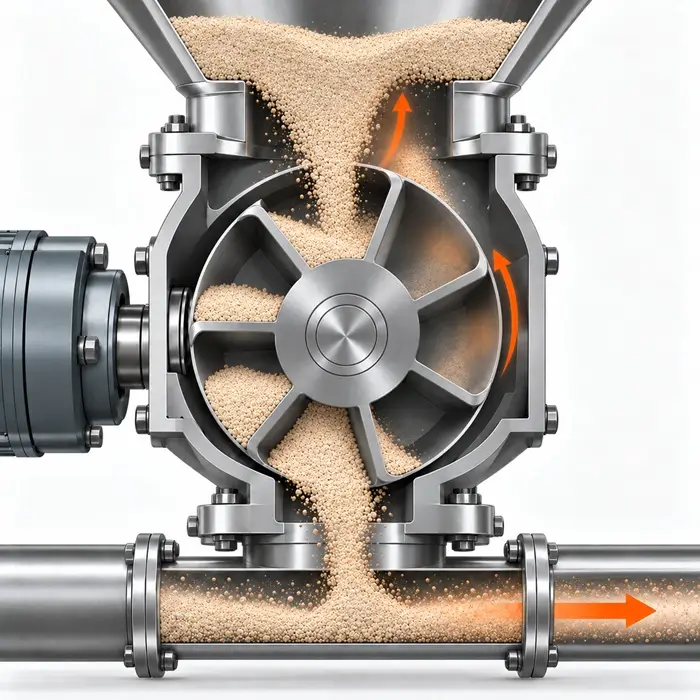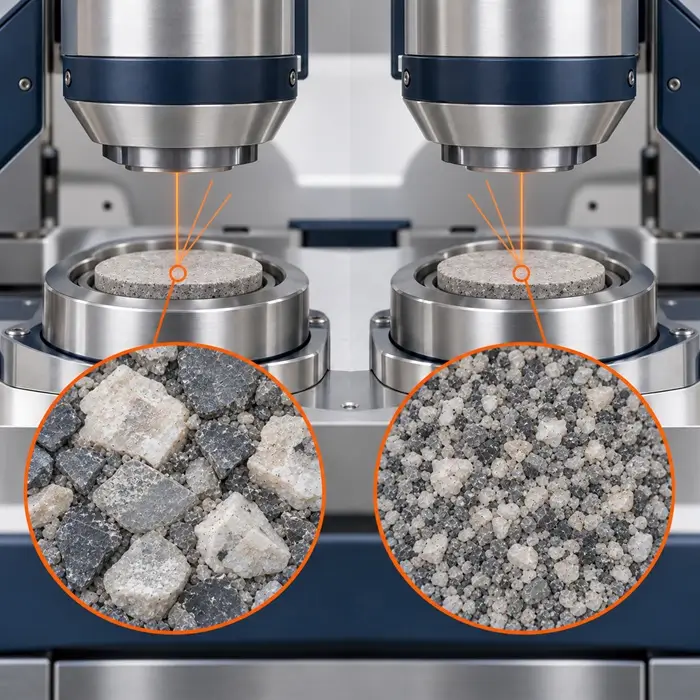
A downstream increase in fines does not automatically point back to milling. Fragile particles can be damaged during feeding itself, especially where they experience concentrated shear, repeated contact, or trapping in small clearances.
Where Can the Damage Occur?
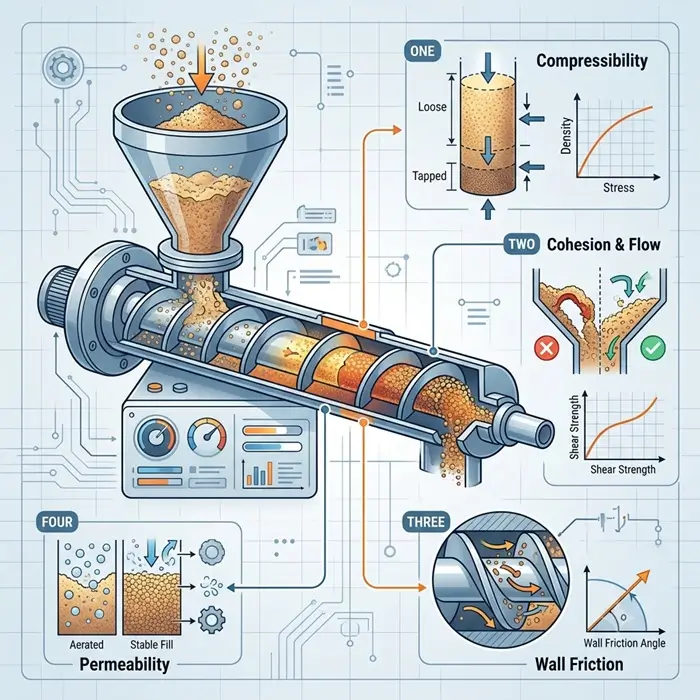
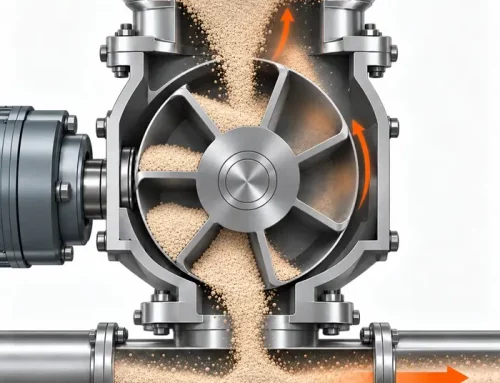
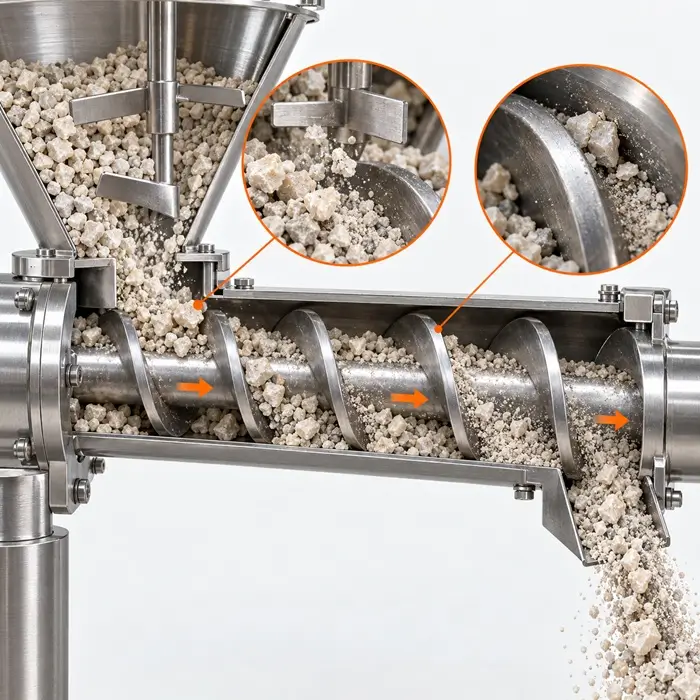
A screw does more than transport powder. Particles can be compressed within the bed, sheared against neighboring particles, rubbed against screw and casing surfaces, and damaged through repeated mechanical contacts.
One high-risk location is the clearance between the screw flight and casing. Particles entering a gap comparable with their own size can become trapped and broken as the moving flight passes the stationary wall. Attrition in small clearances is strongly dependent on the ratio between particle size and gap width.
If the feeder includes a hopper agitator, stirrer, or impeller, treat that as a separate potential damage zone. Feed-frame studies confirm that mechanically agitated feeding equipment can change particle-size distribution through applied shear.
Gamble and colleagues studied the horizontal force-fed screw system of an Alexanderwerk WP120 roller compactor, rather than a standalone volumetric or loss-in-weight feeder. They localized API attrition mainly to the bottom of the hopper at the screw interface and within the screw itself.
The WP120 result is therefore an equipment-specific severe attrition case. Similar shear, clearance, and contact mechanisms can exist in metering feeders, but the magnitude of the observed size reduction should not be transferred to them.
Why Does Screw Speed Matter?
Higher screw speed increases the frequency of mechanical interactions within the feed system. Particle strength, screw geometry, clearance, fill state, residence time, and throughput determine how much of that mechanical input produces breakage.
Gamble tested feed-screw speeds of 19, 40, 60, and 80 rpm while changing roll speeds to 5, 8, 10, and 12 rpm to compensate for the corresponding change in powder transmission rate. Samples were collected in the pre-nip region before roll compaction.
API particle size decreased with increasing feed-screw speed and transmission rate, with some plateauing at the highest condition. Because screw speed, transmission rate, and associated powder residence and fill conditions changed together, this should not be interpreted as a clean single-variable screw-speed relationship.
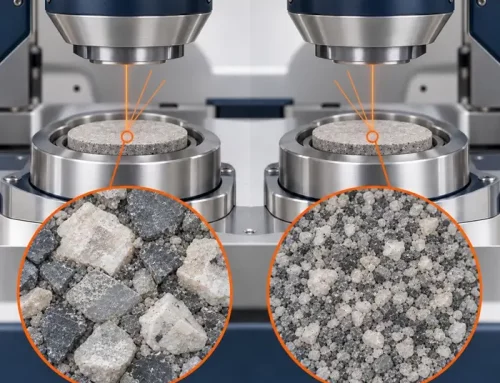
In the separate full-transmission experiment, API D50 decreased from about 176 µm initially to about 35 µm after passage from the hopper through the WP120 feed system to the pre-nip sampling position. That reduction is evidence that feeding can produce substantial attrition in a vulnerable material, not a typical reduction ratio for screw feeders.
Why Does It Matter?
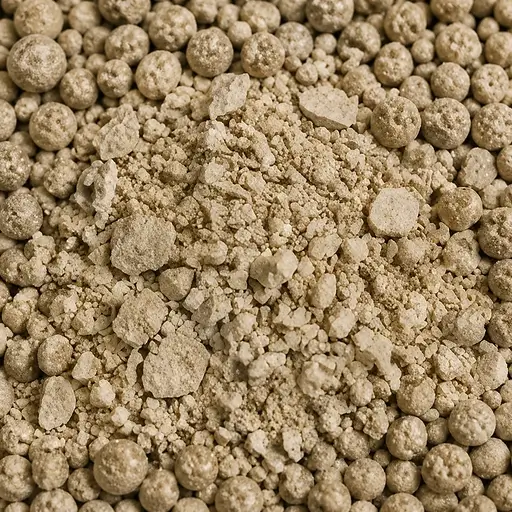
Additional fines can alter flowability, dustiness, segregation tendency, packing, and dosing behavior. In pharmaceuticals, changing API particle size can also affect dissolution and subsequent dosage-form performance.
For a broader diagnostic route when breakage is suspected elsewhere in the process, see PTI’s Attrition, Breakage and Wear troubleshooting guide.
Why Can a Normal PSD Miss It?
A whole-blend PSD may hide selective damage. In Gamble’s formulation, attrition occurred in the API rather than uniformly across all blend components, so the researchers combined image analysis with Raman identification to determine the API size distribution separately.
A stable whole-blend D50 therefore does not prove that every component survived feeding unchanged.
How Do You Prove the Feeder Is Responsible?
-
- Establish PSD and particle morphology immediately before the feeder.
-
- Riffle-split the pre-feeder sample and use one portion as a handling blank. Take that portion through the same sampling, transfer, storage, and analytical workflow without passing it through the feeder.
-
- Sample directly after the feeder, before another transfer or process step can introduce additional damage.
-
- Compare the fines fraction and full PSD, not D50 alone. If one component may be more fragile, use component-specific imaging or spectroscopy where practical.
-
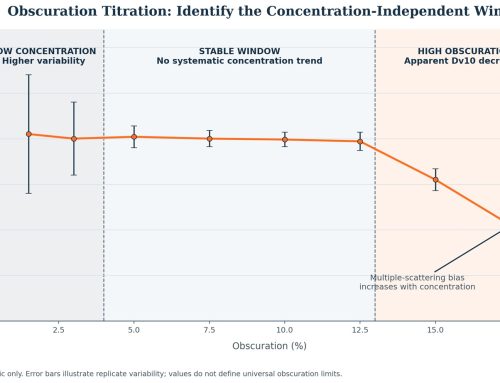
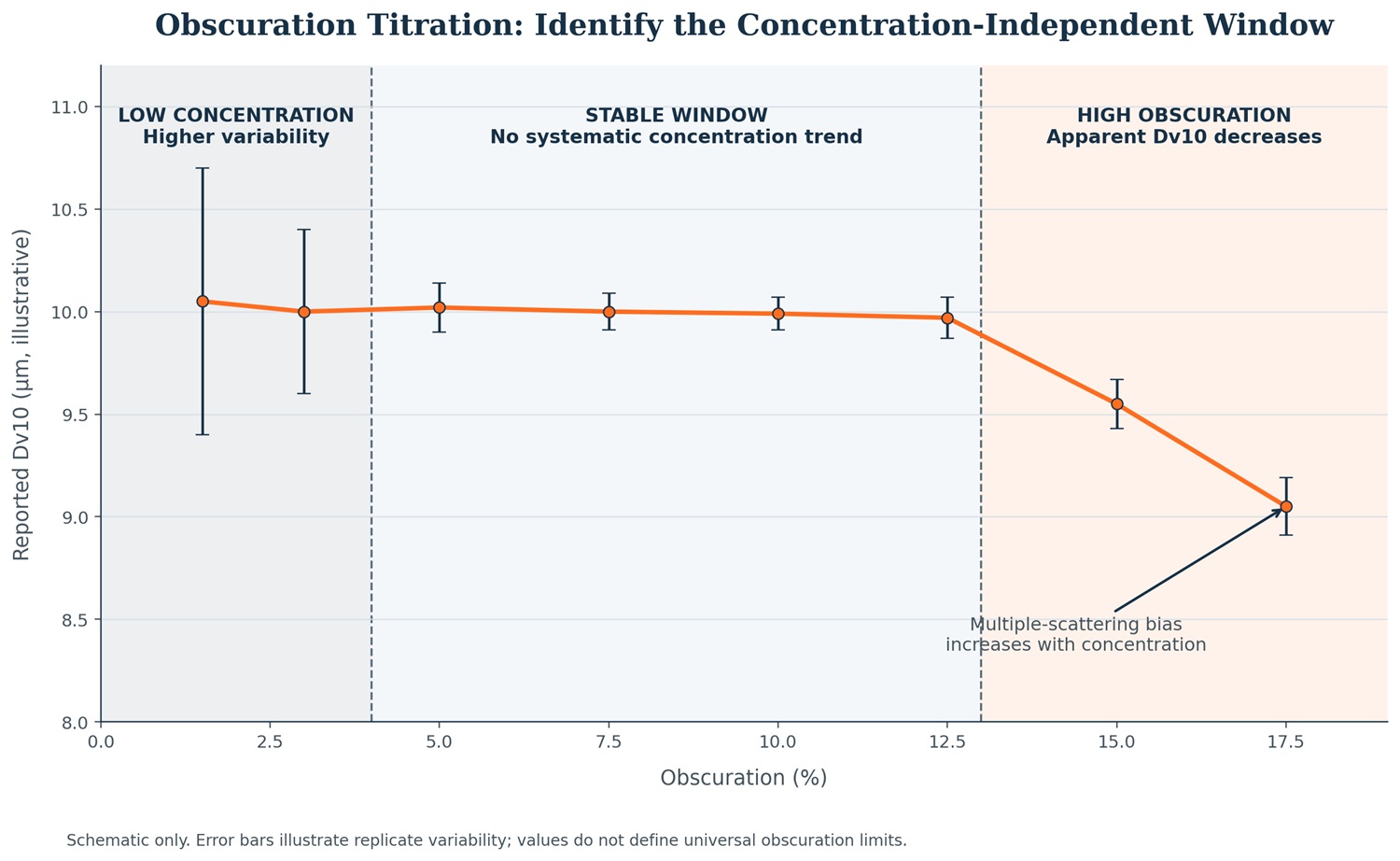
- Control the measurement method. For fragile particles, use the lowest dry-dispersion pressure that achieves adequate dispersion, or confirm the result using image analysis or another low-damage method. Aerodynamic dispersion itself can fracture vulnerable particles and create apparent fines.
-
- Repeat the comparison at controlled screw speeds and, where relevant, different agitator conditions while keeping the remaining process variables as consistent as practical.
If the downstream shift survives the handling blank and low-damage measurement method and changes reproducibly with feeder operation, the feeder is the most likely source.
What Should You Change?
Identify the damage zone before reducing screw speed. Examine screw speed, flight-tip clearance, screw geometry, fill state, hopper agitation, and throughput together. Lower speed may reduce attrition but can also destabilize filling or dosing.
PTI’s Screw Feeder Dosing Accuracy and Powder Compressibility article covers the complementary problem of how powder state affects feeder output and dosing behavior.
The acceptable operating condition is the one that delivers the required feed rate while keeping particle damage within the product specification or a defined downstream-performance threshold.
Technical Basis / Sources
- Gamble, J. F., Dennis, A. B., Hutchins, P., Jones, J. W., Musembi, P., & Tobyn, M. (2017). Determination of process variables affecting drug particle attrition within multi-component blends during powder feed transmission. Pharmaceutical Development and Technology, 22(7), 904–909. Localizes component-specific API attrition within an Alexanderwerk WP120 powder-feed system and examines hopper location, feed-screw operation, and processing conditions.
- Crutchley, C. C., & Bridgwater, J. (1997). Particle Attrition in Small Clearances. KONA Powder and Particle Journal, 15, 21–31. Demonstrates particle trapping and breakage between a moving element and stationary wall and shows the influence of clearance-to-particle-size ratio.
- Ahmadian, H., & Ghadiri, M. (2021). Granule attrition by coupled particle impact and shearing. Advanced Powder Technology, 32(1), 204–210. Demonstrates how repeated impact and shear can combine to cause granule attrition under process-relevant mechanical stresses.
- Mendez, R., Velazquez, C., & Muzzio, F. J. (2012). Effect of feed frame design and operating parameters on powder attrition, particle breakage, and powder properties. Powder Technology, 229, 253–260. Shows that mechanically agitated feeding equipment can alter particle-size distribution and powder properties, with attrition depending on equipment and operating conditions.
- Bonakdar, T., Ali, M., & Ghadiri, M. (2021). Particle breakability assessment using an Aero S disperser. International Journal of Pharmaceutics, 597, 120365. Demonstrates that aerodynamic dry dispersion can itself break vulnerable particles, supporting measurement-energy controls when diagnosing process-induced fines.