

Test methods
Dustiness and Airborne Release
Match the release stimulus to the airborne metric
Powders release airborne material when handling and airflow detach and transport particles.
A drum, a falling stream, vigorous shaking, and a single drop impose different conditions.
Select the method by the handling question and whether you need collected mass,
particle-number information, or a comparative optical response.




Select a method
Choose the release stimulus and measurement basis
Six laboratory routes combine different disturbances with mass collection or aerosol observation. Similar-looking drums can use different sampling arrangements and procedures.
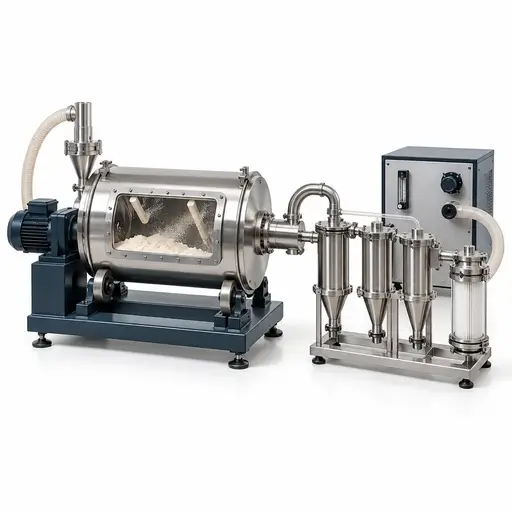
Rotating-drum dustiness
A rotating drum repeatedly lifts and drops a bulk sample while controlled airflow transfers released dust to a collection system.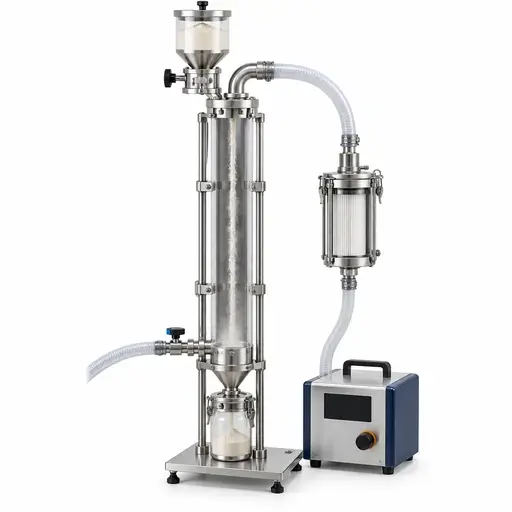
Continuous-drop dustiness
A controlled feed falls through an enclosed column while airflow conveys released dust to samplers.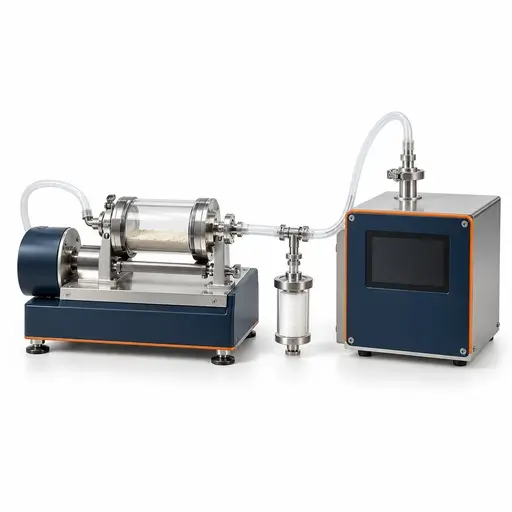
Small rotating-drum dustiness
A small drum generates airborne particles for respirable collection and connected aerosol measurements.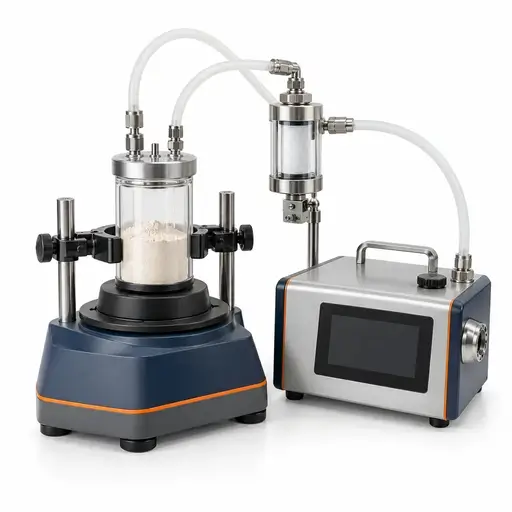
Vortex-shaker dustiness
Dry powder in a vessel is vigorously agitated while controlled airflow carries released particles to collection and aerosol instruments.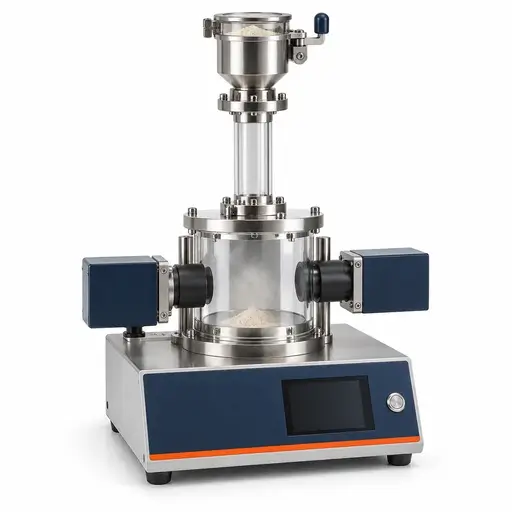
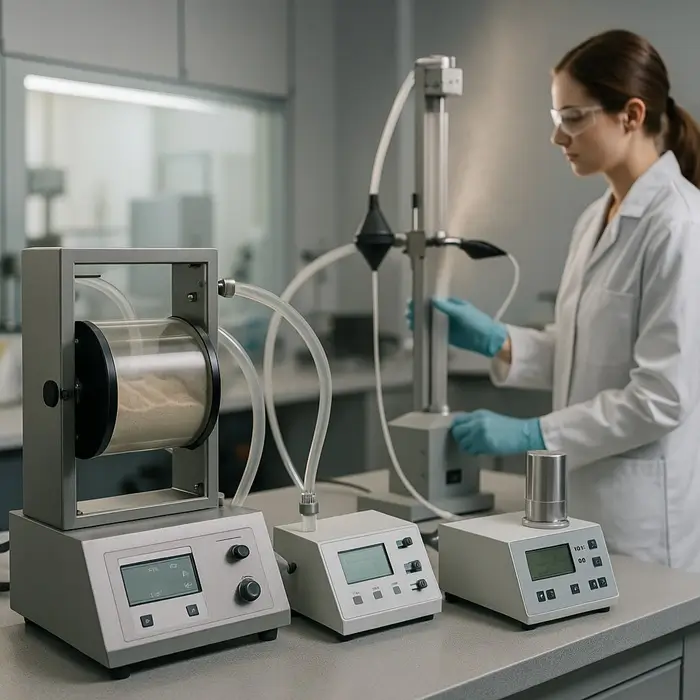
Single-drop optical dustiness
A discrete sample falls into an enclosed chamber and optical attenuation is monitored as the airborne material evolves.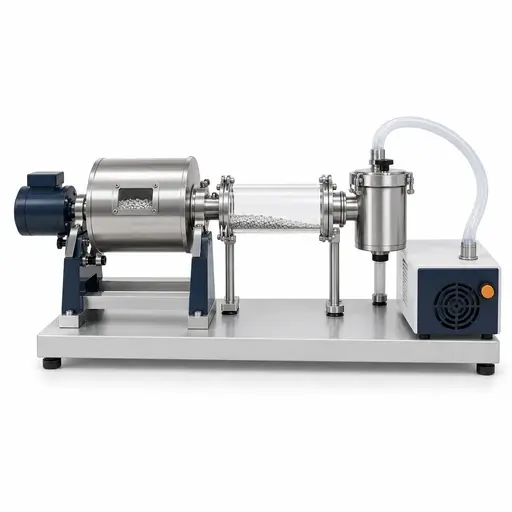
Heubach-type dust release
Material is handled in a rotating drum while airflow passes through a separation section to a filter for gravimetric collection.Core concept
Release depends on the test
Dustiness describes a material response to a defined disturbance. Fine particles may remain attached to larger particles, separate from agglomerates, or form through handling damage. Their presence in the bulk does not establish how much becomes airborne. A measured release also depends on transport through the apparatus and the collection or detection system.
Keep the quantities separate. A dustiness mass fraction relates collected airborne mass to the tested material. Air concentration relates material to sampled air volume. Particle-number and optical measurements have different weighting and detection limits. None can be substituted for another without a defensible measurement model.
Key takeaway
Choose the release condition before the instrument
Use rotating-drum testing for repeated disturbance, continuous drop for falling transfer, small-drum or vortex methods for appropriately scoped respirable mass and particle-number characterization, single-drop optical testing for a defined rapid comparison, and a specified Heubach procedure for collected dust after drum handling. Preserve sample condition and report the exact apparatus, collection fraction, units, and calculation. Compare like-for-like results within a method; do not translate a dustiness category, optical index, or bulk fines percentage directly into workplace exposure or a universal dust-control requirement.
What controls it
Six decisions define a defensible dustiness test
Define the release scenario and required output before comparing suppliers, formulations, or test laboratories.
Selection and interpretation
Keep mass, number, and optical results separate
For a mass-based result, report the collected fraction, blank correction, tested-material basis, and units, such as mg/kg where required. Do not confuse that ratio with mg/m³ of sampled air. Health-related aerosol fractions follow sampling conventions rather than hard geometric sieve cutoffs; bulk particle-size data cannot supply them directly.
Engineering question | Primary route | Useful output | Critical boundary |
|---|---|---|---|
| What is released during repeated handling? | Rotating drum | Inhalable, thoracic, and respirable mass fractions | Use the specified drum and collection procedure |
| What is released during falling transfer? | Continuous drop | Inhalable and respirable mass fractions | Feeding and airflow define the test; thoracic sampling is not specified |
| Do respirable mass and particle-number behavior differ? | Small rotating drum | Mass, number-based metrics, and aerosol size information | Number is not chemical identity or evidence of isolated nanoparticles |
| What does vigorous agitation release? | Vortex shaker | Respirable mass and number-based release descriptors | Respect the material scope and energetic stimulus |
| How does a discrete dust plume behave optically? | Single-drop optical | Attenuation trace and procedure-specific indices | Optical response cannot be assumed proportional to respirable mass |
| How much dust reaches a filter after drum handling? | Specified Heubach procedure | Collected mass and the stated normalized value | Apparatus-defined collection is not automatically a health-related fraction |
How to measure it
Select the method by the evidence the decision requires
The method sections below separate principle, sample state, preparation, output, limitation, disagreement, and decision use. Use the image selector above to jump directly to a method.
Test method 01
Rotating-drum dustiness
Measurement principle: A rotating drum repeatedly lifts and drops a bulk sample while controlled airflow transfers released dust to a collection system.
Suitable sample state: Representative powdered, granular, or pelletized material within the method scope.
Sample preparation: Control sample volume and mass, conditioning, loading, drum configuration, rotation, duration, airflow, collection media, blanks, and weighing conditions. Use fresh representative subsamples for replicates.
Test method 02
Continuous-drop dustiness
Measurement principle: A controlled feed falls through an enclosed column while airflow conveys released dust to samplers.
Suitable sample state: Powdered, granular, or pelletized material that can be fed reproducibly within the procedure.
Sample preparation: Control feeding, tested mass, drop geometry, airflow, sample condition, sampling duration, collection media, background, and filter handling. Record irregular feed or bridging.
Test method 03
Small rotating-drum dustiness
Measurement principle: A small drum generates airborne particles for respirable collection and connected aerosol measurements.
Suitable sample state: Representative material within EN 17199-4 scope, including material containing or releasing respirable nano-objects and their aggregates and agglomerates, or other respirable particles.
Sample preparation: Control sample selection, drum settings, airflow, sampling branches, background, dilution if used, tubing, instrument range, and run timing. Confirm sufficient sample representativeness.
Test method 04
Vortex-shaker dustiness
Measurement principle: Dry powder in a vessel is vigorously agitated while controlled airflow carries released particles to collection and aerosol instruments.
Suitable sample state: Powder suitable for the small vessel and the scope of EN 17199-5.
Sample preparation: Control sample mass and preparation, vessel geometry, shaker settings, airflow, duration, background, and sampling-line configuration. Check instrument overload and dilution corrections.
Test method 05
Single-drop optical dustiness
Measurement principle: A discrete sample falls into an enclosed chamber and optical attenuation is monitored as the airborne material evolves.
Suitable sample state: Bulk material compatible with the release mechanism and the optical measurement range.
Sample preparation: Specify sample amount and condition, release and drop geometry, chamber state, optical baseline, window cleanliness, timing, and the index calculation. Check complete release and repeatability.
Test method 06
Heubach-type dust release
Measurement principle: Material is handled in a rotating drum while airflow passes through a separation section to a filter for gravimetric collection.
Suitable sample state: Powders or granular products compatible with the selected Heubach apparatus and application procedure.
Sample preparation: Specify apparatus type, sample amount, drum speed, test duration, airflow, conditioning, separation section, filter, blank correction, weighing, and normalization basis.
Conditional routes
When dustiness needs a companion measurement
Add the measurement that answers the remaining exposure, identity, particle-damage, or process-safety question.
Actual workplace exposure is the question
Use a suitable occupational-hygiene assessment with task and breathing-zone sampling where required. Laboratory dustiness can inform source characterization but does not establish exposure-limit compliance.
The identity of released particles matters
Collect airborne material for appropriate microscopy or chemical analysis. An aerosol counter cannot by itself distinguish the target material from background particles or identify aggregates and individual primary particles.
Handling may generate fresh fines
Pair dustiness testing with a defined attrition or breakage trial and before/after material characterization. Separate new particle generation from release of fines already present. Compare mechanical-strength methods.
Ignition or explosion behavior is the decision
Commission appropriate combustible-dust characterization and process-safety assessment. Dustiness, particle size, and visible plume intensity do not establish ignition sensitivity or explosion severity.
Process relevance
Connect laboratory release to the handling question
Laboratory comparisons support material and process decisions when the stimulus and reporting basis are explicit.
Technical FAQ
Common questions about dustiness testing
These distinctions help prevent misleading comparisons and unsupported conclusions from laboratory release data.
Go deeper
Continue into dust release and control
Read these published PTI articles for method comparison and process context. The scoped references below identify the technical basis for this page.


Technical basis / sources
Sources and scope boundaries
Use the full selected procedure and verify its applicability to the sample. Apparatus descriptions and generated equipment illustrations are not construction drawings or proof of standard conformity.
- EN 15051-1:2025: requirements and selection of bulk-material dustiness methods.
- EN 15051-2:2025: rotating-drum testing with inhalable, thoracic, and respirable mass-fraction outputs.
- EN 15051-3:2025: continuous-drop testing with inhalable and respirable mass-fraction outputs.
- EN 17199-1:2019: general requirements for the EN 17199 series.
- EN 17199-4:2019: small rotating-drum method; distinguish respirable mass from number-based outputs.
- EN 17199-5:2019: vortex-shaker method with its powder applicability limits and specified aerosol measurements.
- NIOSH: Quantification of Airborne Dusts From Powders: background on release mechanisms, test configurations, and interpretation.
- Palas DustView II: instrument reference for single-drop optical attenuation; use its specific procedure and scope.
- ILVO Heubach dustmeter: an application example of drum, separation-cylinder, and filter collection for treated seeds; not a universal protocol for every bulk material.
Need the measurement, not just the guidance?
If the uncertainty concerns dust release during transfer, repeated handling, vigorous agitation, or product-quality testing, define the relevant sample condition and release scenario before commissioning tests. Agree the method, collection fraction, reporting basis, operating conditions, and interpretation boundaries with the laboratory. PTI works closely with Delft Solids Solutions, a contract research organization specializing in the physical behavior of powders and granules. Contact Delft Solids Solutions.
