
Powder property
Compaction behavior
Powder beds rearrange, deform, fracture, densify, and recover during compaction
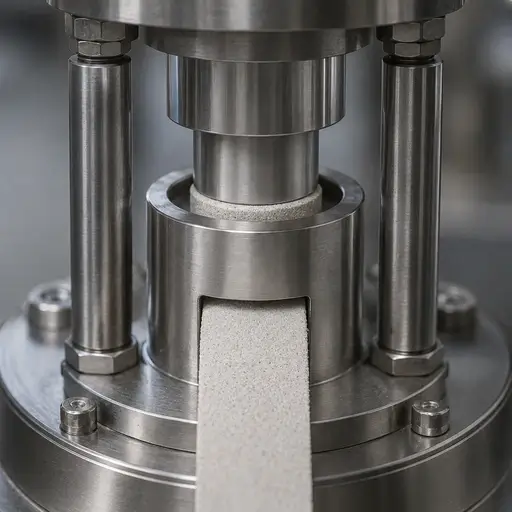
Compaction behavior describes how a powder bed changes volume and develops structure as stress is applied, held, and removed. Rearrangement, particle deformation, fragmentation, air escape, friction, bonding, and elastic recovery together determine compact density, strength, defects, and dimensional stability.
Powder property
Compaction behavior
Powder beds rearrange, deform, fracture, densify,
and recover during compaction
Compaction behavior describes how a powder bed changes volume and develops
structure as stress is applied, held, and removed. Rearrangement, particle
deformation, fragmentation, air escape, friction, bonding, and elastic recovery
together determine compact density, strength, defects, and dimensional stability.




Core concept
Compaction is a loading path, not a single pressure value
At low stress, particles rearrange and air leaves the bed. With increasing stress, contacts deform, brittle particles fracture, ductile particles flatten, and the contact network becomes more constrained. The balance depends on the material and its initial packing state. Peak pressure alone cannot describe this history. Loading rate, dwell, tooling friction, decompression, and ejection all influence density gradients, stored elastic energy, bonding, and damage. Interpret the complete pressure-density and force-displacement response together with compact strength, porosity, and recovery after unloading.
What controls it
Six groups of variables govern compaction behavior
Densification reflects the starting bed, the particle failure mode, and the way stress and gas move through the compact.
States and interpretation
Similar final densities can conceal different compaction paths
Separate rearrangement, deformation, fragmentation, bonding, and recovery before comparing formulations.
| Compaction stage | Dominant response | Useful output | Interpretation risk |
|---|---|---|---|
| Filling and seating | Packing, orientation, and initial air displacement | Initial bulk density and fill variation | Sampling and die filling can dominate the result |
| Loading | Rearrangement, deformation, fracture, and pore closure | Pressure-density or force-displacement curve | Tool friction creates nonuniform stress |
| Dwell and unloading | Stress relaxation and elastic recovery | Relaxation rate and unloading work | Short tests can miss delayed recovery |
| Ejection and storage | Wall release, springback, cracking, and strength evolution | Ejection force, dimensions, strength, and defects | Post-compaction time and humidity change results |
How to measure it
Choose a compaction method by the failure stage
Reproduce the fill, stress path, dwell, release, and endpoint that control the actual product decision.
Where it matters
Compaction behavior becomes a density, strength, and defect constraint
The same powder can respond differently when the stress path, gas escape, tooling, or upstream state changes.
Go deeper
Three practical routes into powder compaction
Explore deformation under pressure, industrial compaction methods, and the solid-fraction variation created during roller compaction.


Need the measurement, not just the guidance?
If the remaining uncertainty concerns compressibility, deformation, air escape, density gradients, compact strength, springback, or ejection behavior, select the measurement around the material state and process decision. PowderTechnology.info can help define the test sequence, sample conditions, and interpretation route. For laboratory support, explore our Delft Solids Solutions partner page or visit Delft Solids Solutions directly.