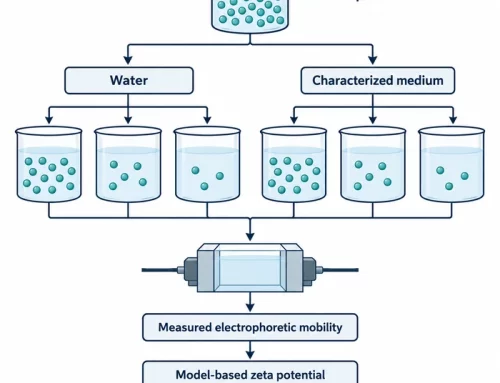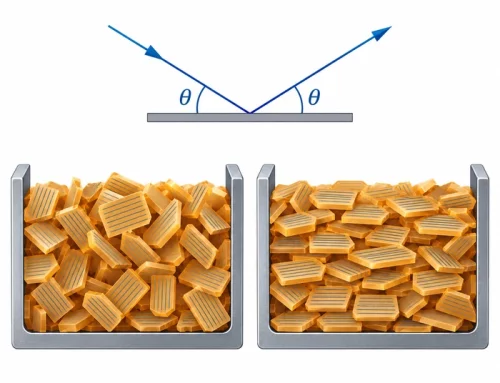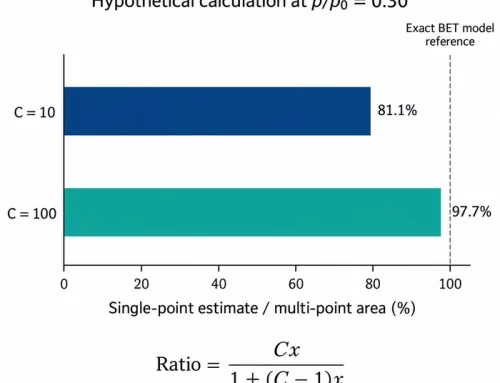
Particle motion and software input handling are separate parts of the measurement. Conceptual illustration, not instrument data.
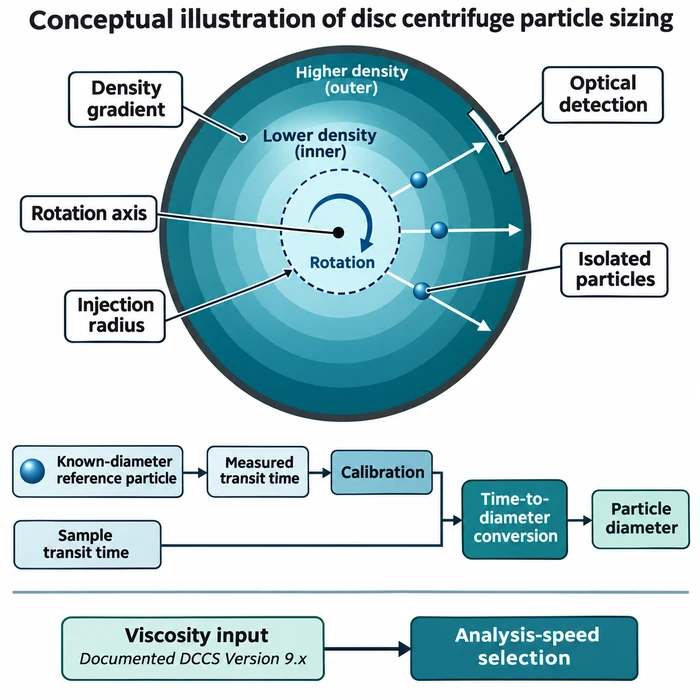
You discover that a centrifugal-sedimentation method contains the wrong liquid viscosity. Should the reported diameter be corrected, or should the measurement be repeated? First establish what that entry actually controls. A liquid property that affects particle motion need not appear as an independent input in the software’s final size calculation.
How the calculation route changes the answer
Centrifugal sedimentation infers an equivalent settling diameter from particle motion through liquid, as PTI’s centrifugal-sedimentation overview explains. The next question is how the software converts measured transit time into size.
The CPS Disc Centrifuge Operating Manual, covering DCCS Version 9.x, states that Liquid Viscosity is used to calculate an optimum analysis speed and does not enter the particle-size calculation. Instead, a known-diameter calibration standard establishes a combined time-to-size constant, K. Calibration incorporates the operating conditions during the standard measurement; changes in liquid temperature or gradient condition before the sample measurement can affect its applicability.
In a direct Stokes-based calculation, with transit time, density contrast, rotational speed, and geometry fixed, diameter scales with the square root of entered viscosity: d ∝ √η. An entry 10% too high therefore gives a calculated diameter approximately 4.9% too high (√1.10 ≈ 1.049). This is not an automatic correction for calibrated CPS results.
Particle density matters in both routes because the density difference between particle and liquid governs settling. In the documented CPS route, check both sample and calibration-standard density entries. The manual emphasizes accurate standard density when standard and sample materials differ. A viscosity-only correction does not substitute for checking density.
The manual requires accurate viscosity for accurate absolute weight distributions, but not for relative distributions (printed p. 45, Liquid Viscosity). Check the installed software version against its applicable documentation before extending these Version 9.x findings to another version.
Separate the software entry from the physical measurement
Reprocessing an unchanged transit-time record tests the calculation. Changing the liquid composition or temperature changes the physical measurement. An unchanged diameter after editing a software field therefore does not show that liquid conditions are unimportant.
The particle-size method controls include density, viscosity, temperature, concentration, dispersion stability, and rotor conditions. ISO 13318-1:2024 addresses dilute dispersions in which particles move as isolated particles. If the sample falls outside that condition, correcting an input alone does not establish measurement validity.
Check the input and decide the disposition
Retrieve the installed software version, method file, calibration record, and output being questioned. Trace the viscosity value to the actual gradient composition and analysis temperature. PTI’s viscosity guidance explains why the measurement conditions belong with the value.
Check units: 1 cP = 1 mPa·s = 0.001 Pa·s. Convert kinematic viscosity in cSt to dynamic viscosity in mPa·s by multiplying by liquid density in g/cm³, using both values at the same temperature.
If reprocessing is supported, preserve the original record and compare two copies with only the viscosity entry changed. Hold calibration, density assumptions, and reporting basis fixed. Compare diameter separately from absolute weight.
Use the documented field behavior and reprocessing result to identify the affected output. If acquisition conditions are implicated, review the method controls listed above and determine whether a repeat is needed. Record the accepted input, its source, units, temperature, and the reason for the final disposition.
Technical Basis / Sources
- CPS Instruments, Inc. CPS Disc Centrifuge Operating Manual. Copyright 2005; updated June 2004 (as printed). Covers Version 9.x operating software and DC12000/DC18000/DC20000/DC24000 centrifuges.
- International Organization for Standardization. ISO 13318-1:2024. Determination of particle size distribution by centrifugal liquid sedimentation methods — Part 1: General principles, requirements and guidance. Second edition, October 2024.