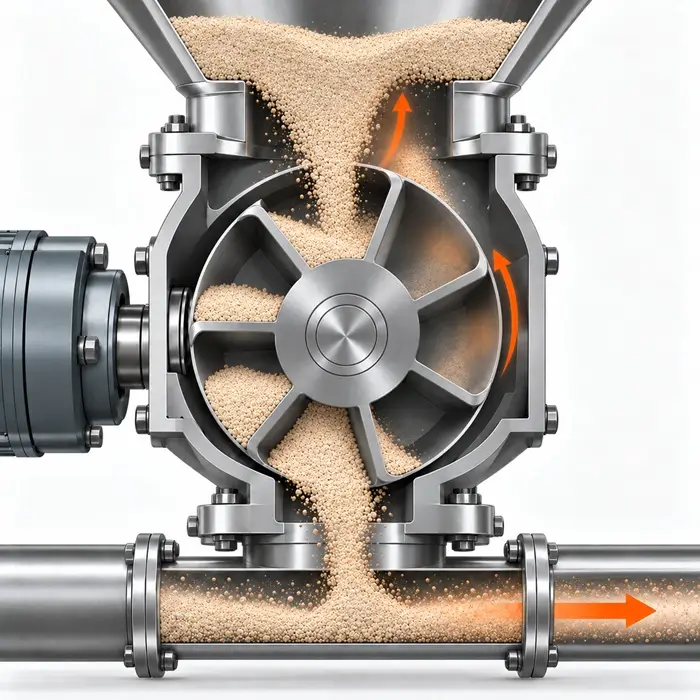
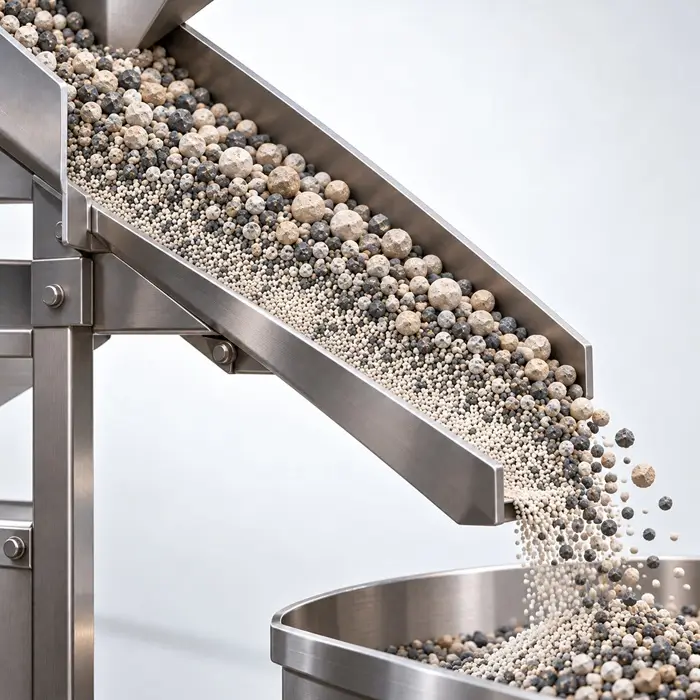
Assay drift between early and late bags, or composition differences between drums from the same batch, can occur even when the mixer is performing correctly. The segregation may be happening during transfer.
What Happens Inside the Flowing Layer?
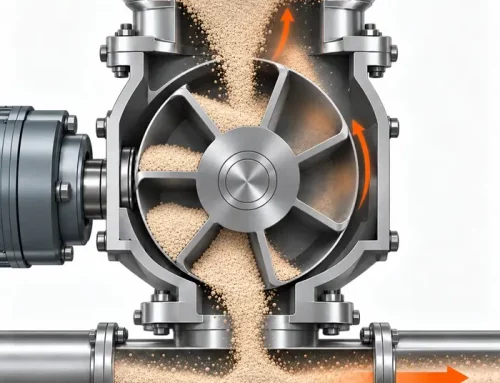
As granular material moves down an inclined chute, neighboring particles continually rearrange. Temporary voids open in the sheared bed, allowing smaller particles to percolate downward, while squeeze expulsion moves particles upward and preferentially leaves larger particles near the free surface.
Segregation competes with collisional and shear-induced diffusion, which remix particles as the bulk material moves downstream. Deng, Umbanhowar, Ottino, and Lueptow showed that the resulting concentration profile depends on the balance between segregation, diffusion, and advection, together with the velocity profile and basal slip.
This mechanism applies most directly to dry, relatively free-flowing mixtures. ASTM D6940/D6940M-20 notes that sifting segregation can occur around a mean particle size of 50 µm and can become dominant above about 100 µm when the material is sufficiently free flowing. Cohesive fines or moisture can suppress percolation and introduce other mechanisms. The ASTM apparatus is limited to particles no larger than 3 mm.
Density can also oppose or reinforce size segregation. Large dense particles can partly counter the tendency of large particles to rise, while large light particles can strengthen it.
Why Chute Design Changes the Outcome
Chute geometry changes shear, particle velocity, and particle-wall interaction, so it changes how segregation develops.
Deng and colleagues describe a characteristic streamwise segregation length. Shortening a transfer can help while the concentration gradient is still developing, but once segregation is essentially fully developed, removing part of the chute may achieve little.
Panda and Tan found lower streamwise segregation in their tested dry granular mixtures when chute inclination was reduced and surface roughness increased. They also observed slightly less streamwise segregation in semicircular than rectangular chutes. These are not universal design rules. Lower angles and rougher surfaces can increase holdup, buildup, and stick-slip behavior, particularly with cohesive materials.
How Do You Prove the Chute Is Responsible?
Do not change the blender first. Locate where composition first changes.
- Confirm blend uniformity immediately before the chute.
- Immediately after the chute, take full-stream cuts at defined intervals from start to end of discharge. Do not scoop from the receiving heap, because deposition may already have re-segregated the material.
- Compare PSD or component concentration over time with the pre-chute reference. A steady chute can redistribute particles within the stream without changing its average composition, so look for start-up and run-out transients rather than expecting a constant before-to-after offset.
- Where possible, divide the discharging stream at the chute lip across its depth or width. Fines concentrated in the lower portion of the stream implicate segregation inside the chute. Fines concentrated near the impact region, with coarser material traveling farther across the receiving heap, point toward trajectory or deposition segregation.
At the chute exit, coarse particles can travel farther than fines because of trajectory differences, while very fine particles may be preferentially carried by air during free fall. The chute lip and receiver therefore create a second opportunity for segregation after a depthwise gradient has developed inside the chute.
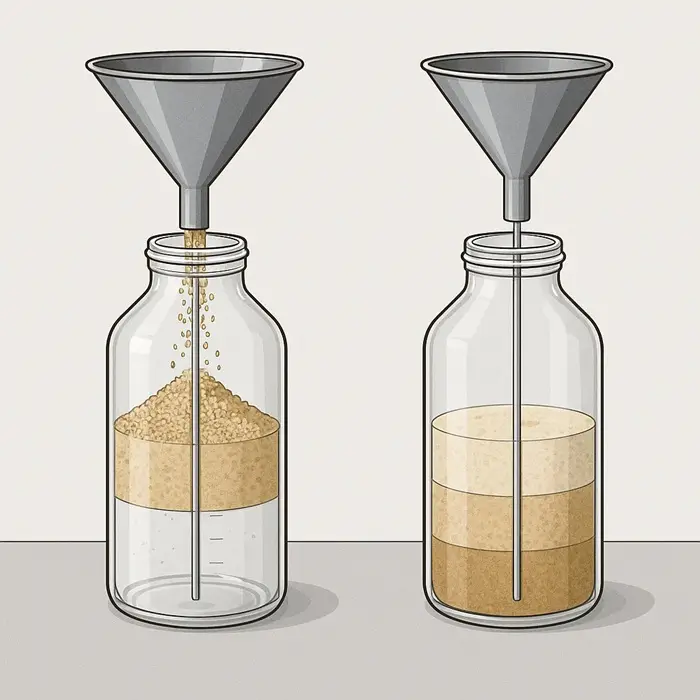
A controlled segregation-propensity test can help separate material tendency from process-induced segregation. PTI’s Powder Segregation Diagnosis During Mixing, Conveying, and Filling provides the broader diagnostic route, while Powder Segregation Test: The 20 Minute Bottle Method provides a practical comparative screen.
What Should You Change?
If the chute is confirmed as the active step, modify the condition creating relative particle motion rather than automatically changing the formulation. Depending on the process, that may mean changing flow rate, fill level, wall condition, chute cross-section, transfer geometry, or how the stream enters the receiver.
Shortening the chute should only be considered where the existing transfer length still contributes materially to the developing segregation profile. If the gradient is already fully developed before discharge, changing the final section may have little effect.
Technical Basis / Sources
- Deng, Z., Umbanhowar, P. B., Ottino, J. M., & Lueptow, R. M. (2018). Continuum modelling of segregating tridisperse granular chute flow. Proceedings of the Royal Society A, 474(2211), 20170384. Models developing chute segregation as the competition between advection, diffusion, and segregation and describes the characteristic streamwise segregation length.
- Gray, J. M. N. T. (2018). Particle Segregation in Dense Granular Flows. Annual Review of Fluid Mechanics, 50, 407–433. Reviews kinetic sieving and squeeze expulsion as the dominant gravity-driven size-segregation mechanisms in dense sheared granular flows.
- Panda, S., & Tan, D. S. (2020). Effect of external factors on segregation of different granular mixtures. Advanced Powder Technology, 31(2), 571–594. Examines chute inclination, surface roughness, fill level, and cross-sectional geometry and identifies conditions that reduced segregation in the granular systems studied.
- Hadi, A., Roepal, R., Pang, Y., & Schott, D. L. (2024). DEM Modelling of Segregation in Granular Materials: A Review. KONA Powder and Particle Journal, 41, 78–107. Reviews DEM modeling of industrial segregation, including chute geometry, operating conditions, trajectory segregation, and the limitations of transferring results between systems.
- ASTM D6940/D6940M-20. Standard Practice for Measuring Sifting Segregation Tendencies of Bulk Solids. Defines a standardized sifting-segregation test and discusses particle-size difference, mean particle size, free-flowing behavior, and the 3 mm maximum particle-size limitation of the apparatus.
- Duan, Y., Peckham, J., Umbanhowar, P. B., Ottino, J. M., & Lueptow, R. M. (2023). Designing minimally segregating granular mixtures for gravity-driven surface flows. AIChE Journal, 69(4), e18032. Shows how size-driven percolation and density-driven segregation can oppose or reinforce one another when particle species differ in both size and density.