Table of contents
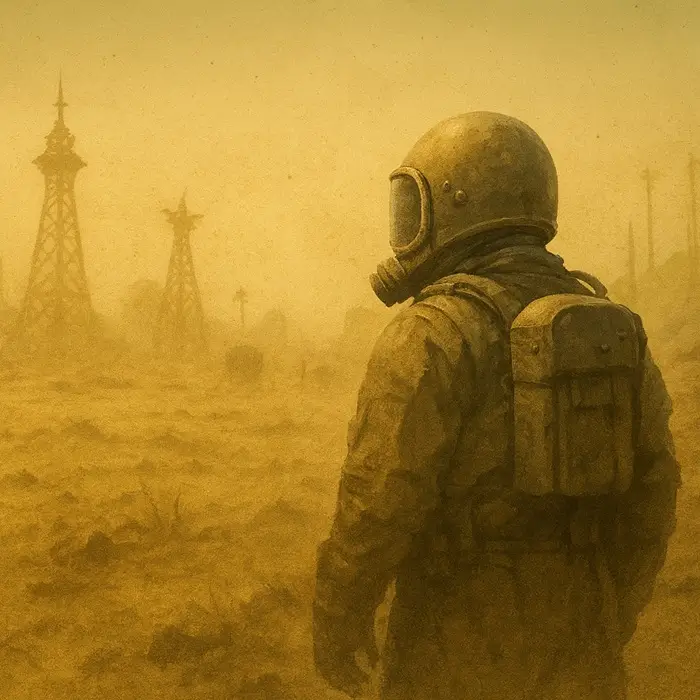
If you play the game or watch the show, the Fallout wasteland feels strangely believable. Ruined cities, broken infrastructure, dust everywhere. Season two arrives on Prime Video on 17 December 2025, and New Vegas brings even more desert haze into view.
The question is simple. How close is that wasteland to real nuclear fallout, if you look at it as a “powder person”?
What fallout actually is: a dirty particle story
Real nuclear fallout is not a glowing mist that clings to everything. It is a cloud of solid and liquid particles, loaded with radionuclides, thrown into the air by a blast or accident. As the cloud cools and travels, particles settle out in bands downwind.
Larger particles fall close to ground zero within minutes or hours. They are often sand, soil, and structural debris fused with fission products. Smaller particles stay aloft for days and can travel hundreds of kilometres before settling. They carry isotopes such as iodine-131, caesium-137, and strontium-90, each with its own decay patterns and risks.
So Fallout gets one big thing right. After a nuclear event, the main danger for most survivors is not the flash. It is the particles that settle silently afterwards, and the dust that keeps moving long after the blast.
The air outside: constant haze or patchy plumes?
Fallout shows a more or less uniform wasteland. Dust blows everywhere. Any ruin, any canyon, any main road looks coated in the same grey film.
Reality is messier and more patchy. Fallout bands follow wind, rain, and terrain. Chernobyl and Fukushima both left complex maps of deposition, with high activity in some villages and much lower levels a few kilometres away.
Close to the source, fallout can be brutally intense. Further away, the pattern becomes broken. Valleys channel plumes. Showers wash particles out. Forest canopies capture activity and release it slowly through leaves, soil, and resuspension.
That last part actually brings the game world back into focus. Once radionuclides sit in soil or dust, they can re enter the air for years. Studies after Fukushima showed caesium-137 in airborne dust long after the accident, driven by wind, farming, and traffic.
So the idea of a landscape where dust keeps carrying risk feels fair. Fallout exaggerates the uniformity. It does not exaggerate the persistence.
Vaults versus real shelters: air, filters, and food
Fallout loves the fantasy of the closed Vault. Centuries underground. Families and politics, but plenty of air and food. A few failing systems, but no basic survival crisis.
Real shelter guidance is more modest. Official advice after a detonation usually says: get inside fast, stay away from windows, move toward the centre or basement, and remain sheltered for at least 24 hours. Many guides extend that to a range of two to fourteen days, depending on distance and plume.
The logic is simple. Fallout radiation drops quickly in the first days after an event. The classic rule of thumb says that dose rate falls by about a factor of ten for every sevenfold increase in time.
Keeping people underground for two centuries is a different game. Then you worry less about external gamma dose and more about ventilation, carbon dioxide, trace gases, and microbial growth. You need ongoing power, spare parts, and working filters. You also need a sustainable food supply, which means storage, agriculture, or both.
From a powder point of view, Vault life would be ruled by fine solids anyway. Dehydrated foods, vitamin premixes, flour, nutrient powders, filter dust, corrosion products. Every material change or leak would show up first as dust on filters and surfaces.
Fallout treats Vaults more as closed dioramas than as fragile processing plants. That keeps the story simple. In reality, a Vault would feel closer to a (most likely) cramped, permanently running factory.
Mutants and ghouls versus real radiation injury
The most obvious fiction in Fallout lies in its people. Ghouls, super mutants, and healthy wanderers all share the same world. Some shrug off enormous doses. Others slowly rot yet stay conscious for centuries.
Real ionising radiation behaves differently. At high doses over a short time, it kills cells and damages organs. Very high whole-body doses cause acute radiation syndrome with nausea, bone marrow collapse, and sometimes death within weeks. At lower doses spread over time, risk rises mainly through increased cancer rates, particularly thyroid cancer in children after radioiodine exposure.
Radiation does not select for cinematic mutations that stabilise and grant immortality. You get increased mutation rates in cells, but most mutations either kill the cell or contribute to long-term cancer risk. Tissue slowly fails rather than gaining new super abilities.
So here, Fallout clearly chooses story over biology. It uses ghouls to show the long exposure cost without removing important characters.
Still, one element feels real. People in the wasteland always fear “hot spots”. They worry about sleeping near a crater or drinking from the wrong source. In real accidents, the fear centres around contaminated soil, water, milk, and leafy vegetables. That is less visual than glowing barrels, but the underlying anxiety is familiar.
Dust, resuspension, and the long tail of contamination
Fallout’s strongest link to reality is simply this: dust never leaves the story, literally. It hangs in ruined streets, deserts, and collapsed buildings. It coats armour, guns, and robots. After Chernobyl and Fukushima, the same pattern appeared in quieter form. Once radionuclides settled in soil and vegetation, they didn’t just stay there. Wind lifted fine particles. Tractors and vehicles lofted dust. Seasonal changes reshaped the contamination map year after year. From a powder engineering perspective, it’s all about particle size, cohesion, and surface chemistry. Fine, dry, poorly bound particles resuspend easily. Moist, cohesive soil crusts tend to hold onto activity until they crack or erode. Vegetation captures fallout, then passes it to litter, soil, and eventually deeper layers.
Fallout compresses this long tail into a single aesthetic. In the show, every step kicks up risk. In practice, some roads would be fairly safe, while sheltered corners could hold the highest surface activity on the map.
How you would really measure a wasteland
If you dropped a solids lab into Fallout’s Los Angeles, your first instinct would probably not be to grab a gun. You would most likely reach for instruments. The wasteland would become a mapping project. You would start with dose-rate meters and spectrometers to track external gamma fields. Then you would sample soil, building dust, and water. You would sort particles by size and measure caesium, strontium, and other key radionuclides per fraction.
From there, the wasteland becomes a slow optimisation challenge.
You would identify “clean corridors” with low surface activity and lower resuspension risk. You would classify hot spots where fine contaminated dust collects behind obstacles or in building interiors. You would look for materials that bind radionuclides strongly, and materials that release them easily during abrasion or weathering.
Decontamination would also look different from the quick hose downs you sometimes see on screen. You would favour methods that remove contaminated material without spreading fine particles. Wet wiping, controlled vacuuming, surface removal, and targeted shielding would matter more than dramatic scrubbing.
In short, you would treat the wasteland as a contaminated powder plant with broken walls and no maintenance department.
Where Fallout is closer to truth than it seems
Fallout takes huge liberties with biology and engineering. Still, two things feel honest. First, the time scale. The Great War happened in 2077. The games and series take place about two centuries later. That sounds extreme, yet long-lived radionuclides do shape landscapes over decades, even when the acute phase ends within weeks. Caesium-137, for example, has a half-life of around thirty years and continues to drive exposure through soil and food pathways long after the original plume passes.
Second, the social memory. In Fallout, people forget details but remember fear. They know some vaults failed and some zones glow. They treat dust and ruins as dangerous, even when they cannot explain why. Real accidents leave similar scars. Stories about “that forest” or “that field” persist long after measured doses fall.
Seen through a powder lens, Fallout is less about mutants and more about fine solids that never truly stay put. The show uses dust as a visual shorthand for contamination, decay, and time. Real nuclear fallout would not look exactly like that. It would be patchier, duller, and far more boring to watch. It would still be a world where tiny particles, carried by air and tracked by boots, quietly decide who can live where.
Check out these related articles

Advertisement
[the_ad id=”7029″]