
Powder property
Segregation
A uniform blend can separate whenever components move differently
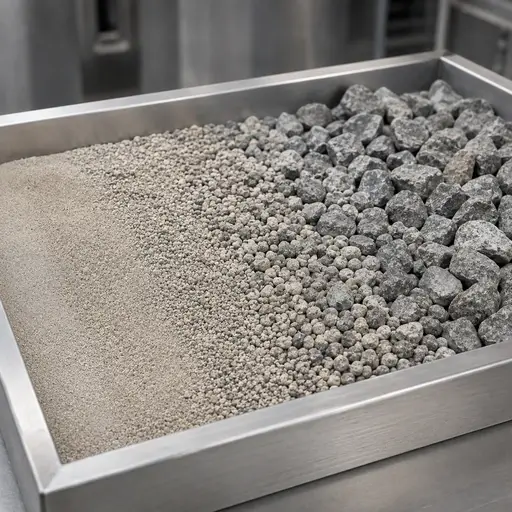
Segregation is the spatial separation of powder or granular components caused by differences in size, density, shape, surface condition, mobility, or aerodynamic response. It can occur during filling, transfer, vibration, conveying, discharge, sampling, and feeding even when the preceding mixer produced an acceptable blend.
Powder property
Segregation
A uniform blend can separate whenever components
move differently
Segregation is the spatial separation of powder or granular components caused by
differences in size, density, shape, surface condition, mobility, or aerodynamic
response. It can occur during filling, transfer, vibration, conveying, discharge,
sampling, and feeding even when the preceding mixer produced an acceptable blend.



Core concept
Segregation occurs when components follow different paths
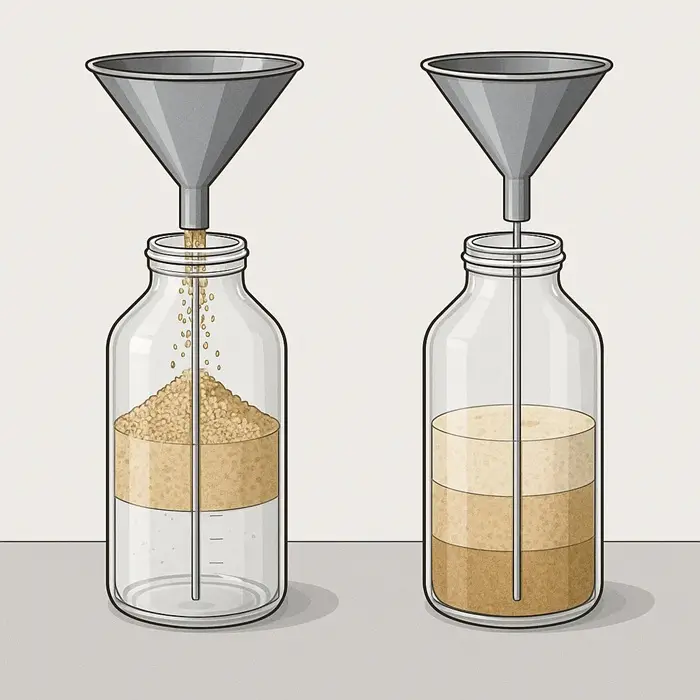
A mixer can create a uniform state, but later handling introduces opportunities for components to percolate, roll, sift, become airborne, follow different trajectories, or discharge at different rates. The mechanism depends on both the formulation and the equipment path. Segregation is not identical to poor mixing. Poor mixing fails to create uniformity; segregation destroys or redistributes uniformity after it has been achieved. Sampling can also mimic either problem when the sample does not represent the moving or stored material. Map composition by location and time across the process. One composite sample can conceal the pattern needed to identify the separation mechanism.
What controls it
Six groups of variables govern segregation
Segregation risk increases when component differences create unequal mobility and the process provides enough movement or air for separation.
States and interpretation
Different segregation mechanisms create different spatial patterns
Use the observed location and timing of composition change to select the mechanism and test route.
| Segregation mechanism | Typical pattern | Dominant driver | Useful confirmation |
|---|---|---|---|
| Sifting or percolation | Fines move downward through a coarse particle structure | Size ratio, voids, vibration, and bed movement | Layered sampling after controlled vibration |
| Rolling segregation | Coarse or spherical particles accumulate toward a heap perimeter | Mobility and angle differences during pile formation | Radial sampling across a controlled heap |
| Trajectory segregation | Components land at different distances after a transfer | Size, density, shape, velocity, and drop geometry | Position-resolved samples after the transfer point |
| Elutriation | Fines remain airborne or concentrate near filters and receivers | Air velocity, settling behavior, and fine-particle cohesion | Airflow-controlled testing and receiver mapping |
How to measure it
Choose a method by the separation path
A useful test reproduces the movement that creates separation and measures composition by position or time.
Where it matters
Segregation becomes a composition and consistency constraint
Every movement after mixing can preserve, redistribute, or destroy the blend state delivered to the next operation.
Go deeper
Three practical routes into segregation control
Explore a rapid comparative test, the fundamentals of creating uniform mixtures, and the interaction between conveying regime, attrition, and separation.

Need the measurement, not just the guidance?
If the remaining uncertainty concerns segregation mechanism, blend-uniformity mapping, representative sampling, transfer-point separation, or time-dependent composition drift, select the measurement around the material state and process decision. PowderTechnology.info can help define the test sequence, sample conditions, and interpretation route. For laboratory support, explore our Delft Solids Solutions partner page or visit Delft Solids Solutions directly.