
SUBJECT
Bulk Solids Characterization
Publications on the measurement and interpretation of bulk powder properties relevant to flow, storage, handling, processing, and product performance.
PUBLICATIONS
Browse publications
Explore PTI articles, Insights, Know How, and technical publications related to this subject.
 12 September 2026
Co-Processed Excipients in Continuous Manufacturing: How Particle Engineering Changes Powder Flow and Compaction Performance
Co-processing engineers particle morphology, density, and surface structure into a single composite excipient particle. Flow function and compactibility testing show what that buys formulators on continuous direct compression lines, and where it does not.
Feature Article
 5 September 2026
Jenike Shear Cell vs Ring Shear Tester: Matching the Method to the Hopper or Silo Decision
Jenike shear cells and ring shear testers measure the same yield locus through different mechanics. Here is how their sample, stress range, and time differences map onto the mass-flow versus funnel-flow hopper design decision, plus a checklist for choosing between them.
Know How
 5 September 2026
GRCop-42 and the Copper Powder Feedstock Problem in Laser Powder Bed Fusion
Copper reflects most near-infrared laser light and conducts absorbed heat away faster than almost any other engineering metal. GRCop-42's move into commercial powder catalogs shows how feedstock morphology, oxide content, and particle size distribution are being engineered around that problem rather than worked around it.
Feature Article
 29 August 2026
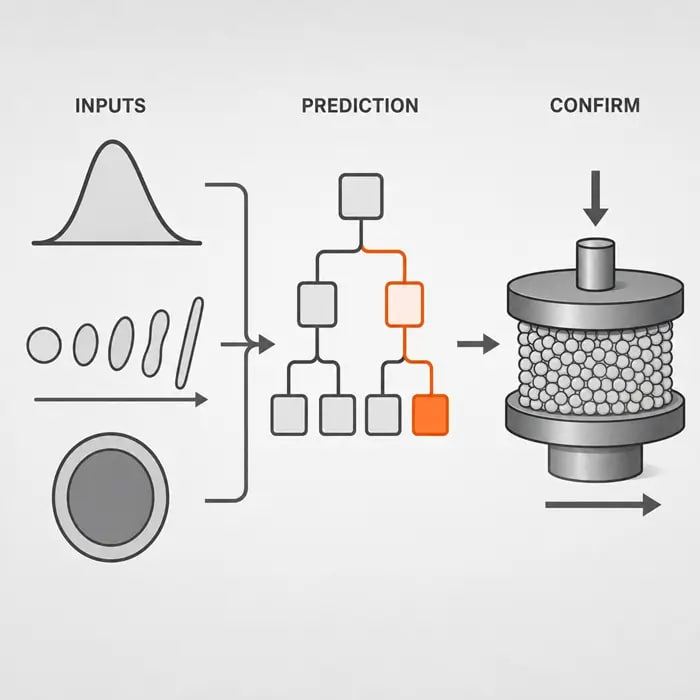
Machine Learning Flowability Prediction: What Constituent-Property Models Can and Can’t Replace
A Pharmaceutical Research study trained Random Forest and XGBoost classifiers on particle size, shape, surface energy, and silica dry-coating data to predict powder blend flowability category. The accuracy holds up as a screening tool and breaks down in specific, predictable places.
Insights
 22 August 2026
Triboelectric Separation: Using Charge Difference to Sort Plastics and Minerals Instead of Fighting It
Triboelectric separation turns contact electrification from a handling hazard into a deliberate sorting mechanism. This article covers how material pairs are selected by charge polarity, what feed moisture and particle size do to separation efficiency, and where the technique sits relative to density and optical sorting.
Feature Article
 15 August 2026
FDA’s Proposed Hub-and-Spoke Distributed Manufacturing Rule: What It Means for Blend Uniformity and Granulation Consistency
FDA's proposed hub-and-spoke registration rule treats geographically separate manufacturing units as one establishment. The registration paperwork is new; proving that blend uniformity, granulation endpoints, and moisture behavior actually match between sites is the older, harder problem.
Feature Article
 15 August 2026
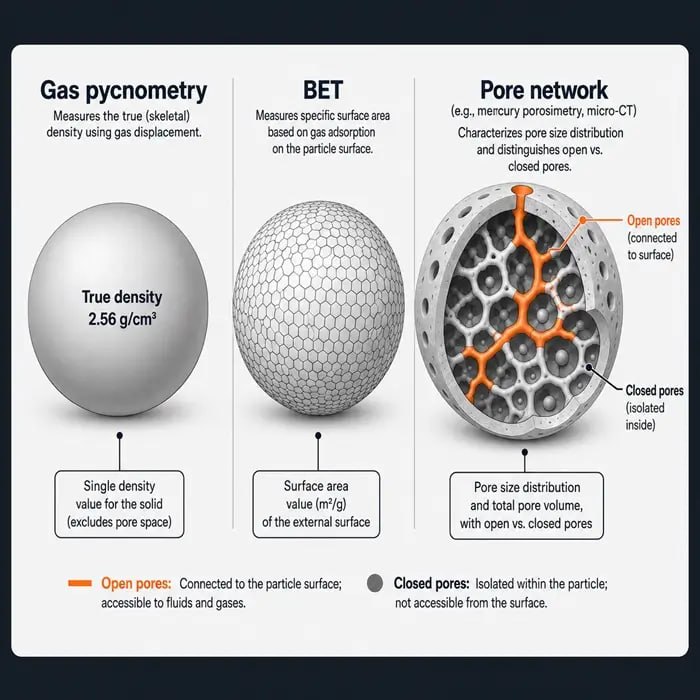
X-ray Micro-CT for Powder Pore Networks: What It Adds Beyond Gas Pycnometry and BET Surface Area
Gas pycnometry and BET surface area each report a single number. X-ray micro-CT builds a three-dimensional map of the pore network, showing connectivity, tortuosity, and closed porosity that single-value tests cannot resolve, within real resolution and sample-size limits.
Insights
 8 August 2026
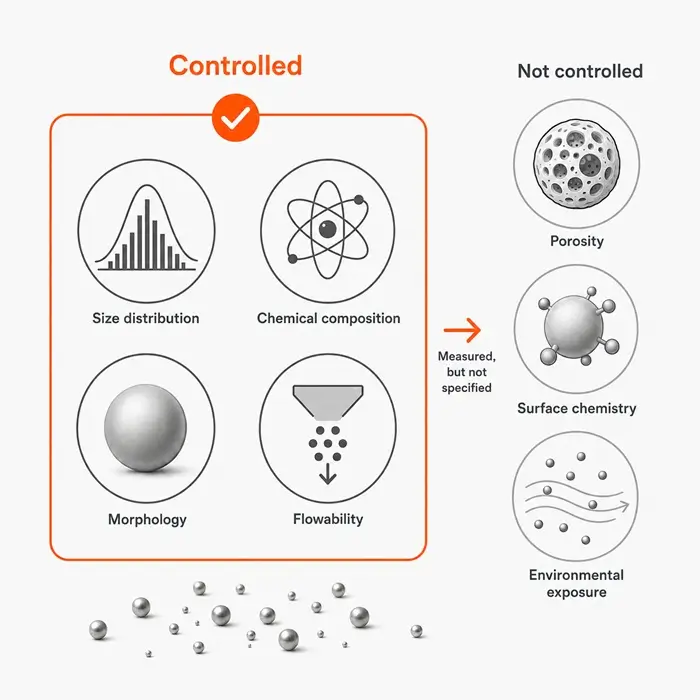
SAE AIR7359: Why Some Metal Powder Feedstock Properties Are Left Out of AM Specifications
AIR7359 explains why AMS-AM metal powder feedstock specifications leave certain properties uncontrolled, citing limited applicability and immature standardized inspection methods, and what that gap means for aerospace AM qualification programs.
Insights
 8 August 2026
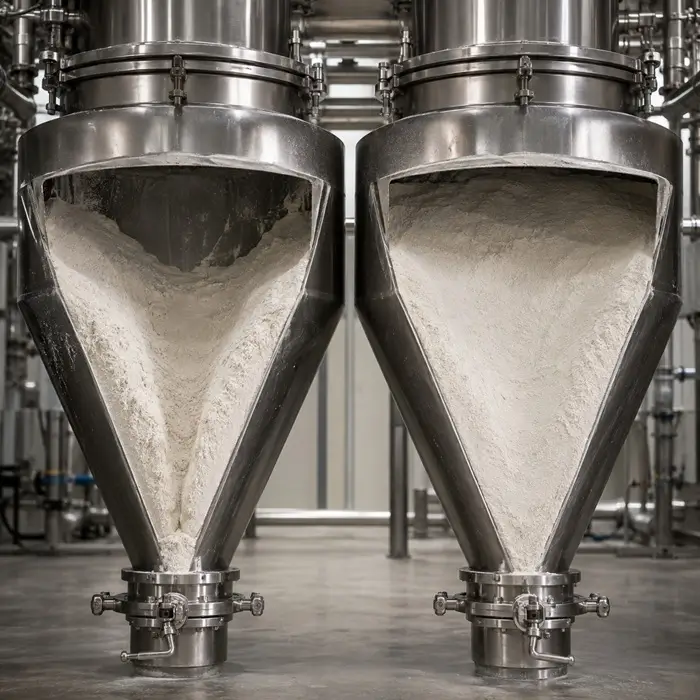
Powder Spreading in Powder Bed Fusion: What Recoater Interaction Reveals About Layer Defects
Powder spreading in powder bed fusion is a recoater-powder interaction shaped by cohesion, particle size distribution, and particle shape. This article maps streaking, short-feeding, and layer non-uniformity back to their underlying mechanisms and separates powder-driven causes from blade wear and spreading speed.
Feature Article
 1 August 2026
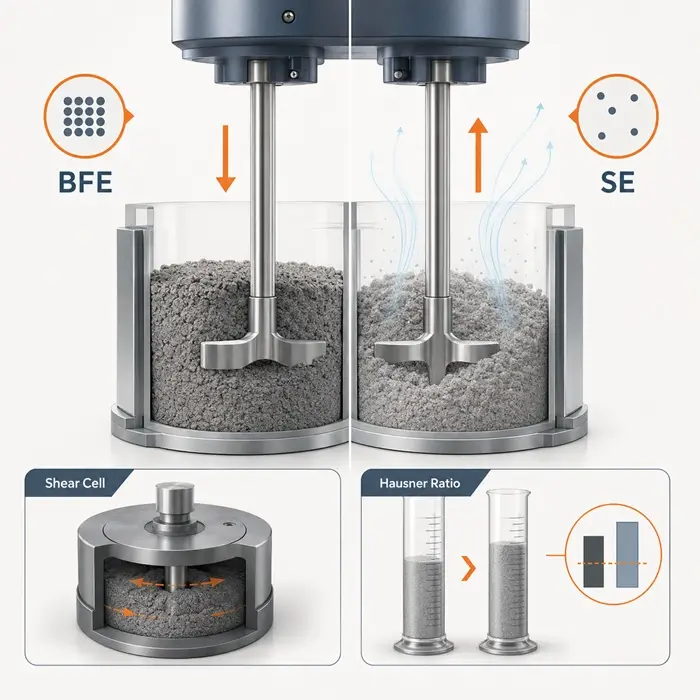
Dynamic and Aerated Powder Testing: What Flow Energy Adds Beyond the Shear Cell and Hausner Ratio
Dynamic and aerated powder testing measures basic flow energy and specific energy to fill the gap between shear cell consolidation data and Hausner ratio screening, particularly for fluidized processing and rapid-refill feeding.
Know How
 1 August 2026
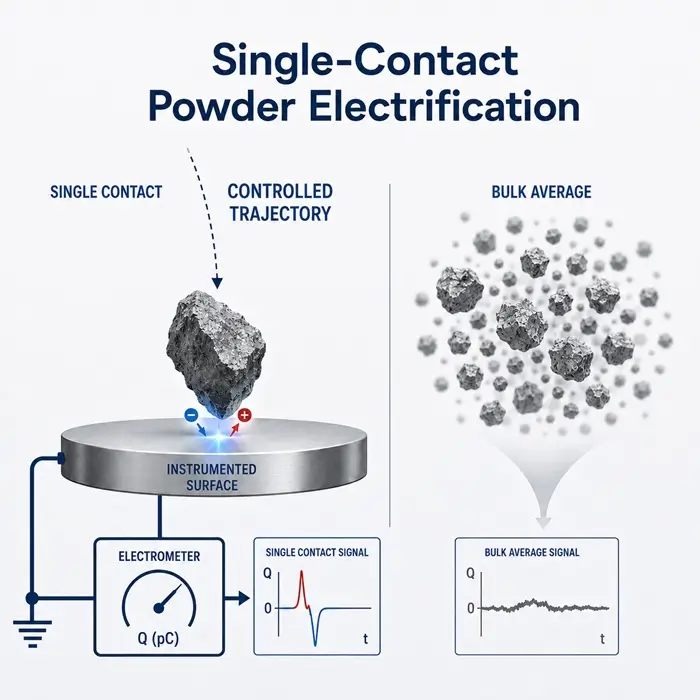
Single-Contact Electrification Testing: Isolating Charge Transfer Per Contact
Single-contact electrification apparatus measures charge transfer from one controlled particle-surface or particle-particle contact, isolating a variable that bulk triboelectric and charge decay measurements can only report as an average.
Insights
 25 July 2026
Roller Compaction Ribbon Solid Fraction: Why the Same Roll Force Can Produce Different Granules
Two lots that pass the same incoming flowability spec can still granulate differently after roller compaction. The reason usually traces to ribbon density, which responds to roll force, gap width, and feed screw speed as an interacting set, not to roll pressure in isolation.
Insights