How to tell whether humidity, storage load, or both are driving the problem
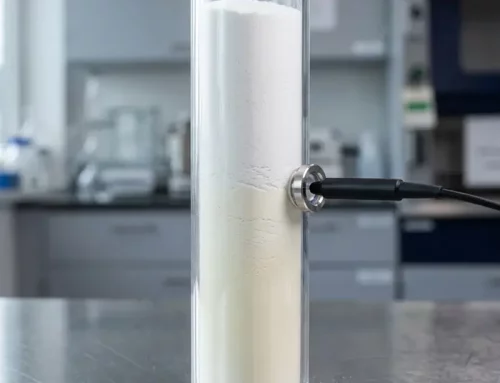
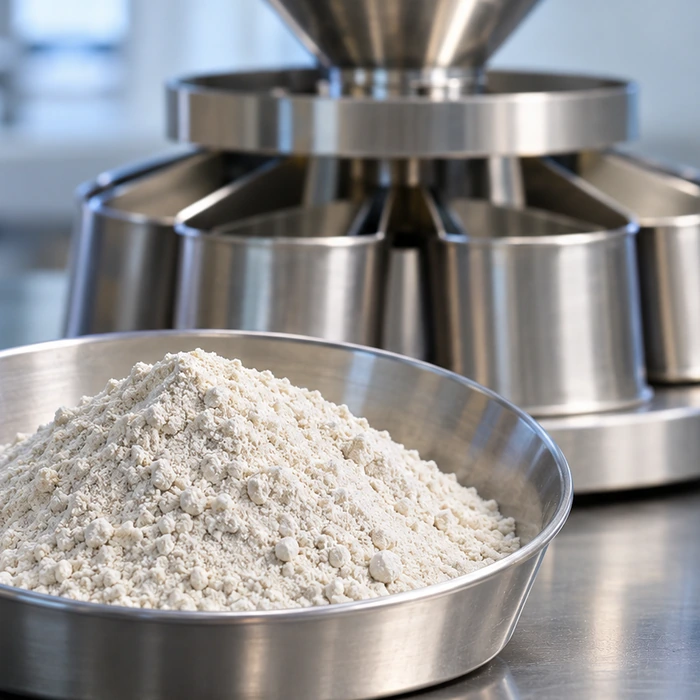
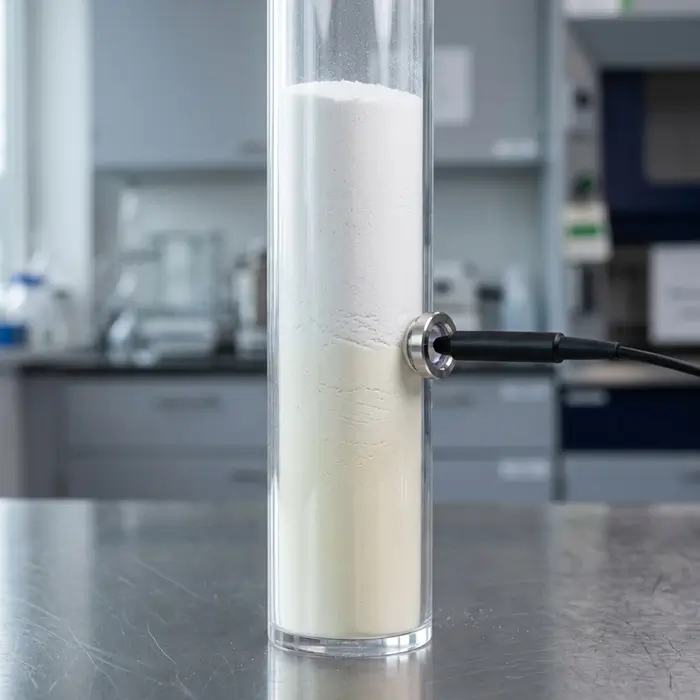
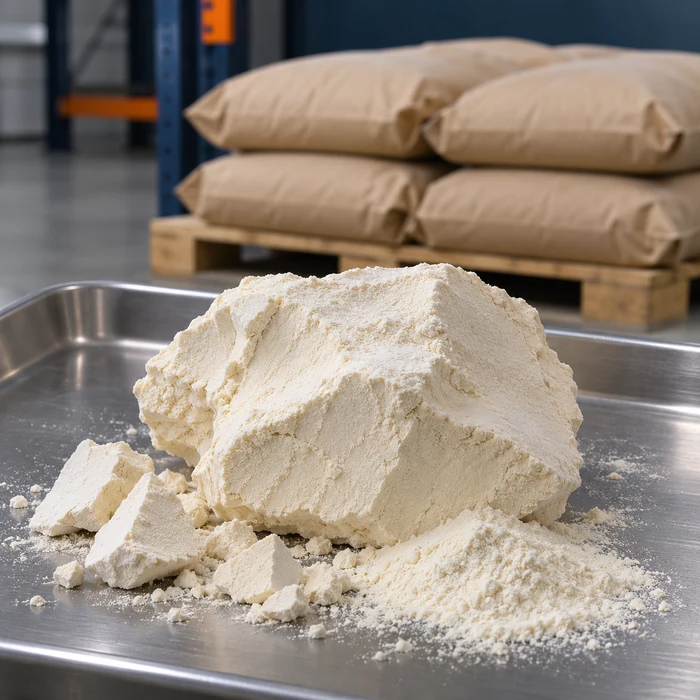
Caking of food powders during storage often becomes apparent at discharge. The powder flows freely into the bag, but a week later it comes out in lumps or barely discharges. If the hardest cakes are in the bottom bags, the weight of the stack is an obvious suspect. Temperature gradients can also redistribute moisture within a powder bed, raising local water activity even when the overall moisture content stays the same. To find out which condition drives the failure, vary storage load and humidity independently. [1]
How food powders gain strength during storage
Water lowers the glass transition temperature of amorphous ingredients
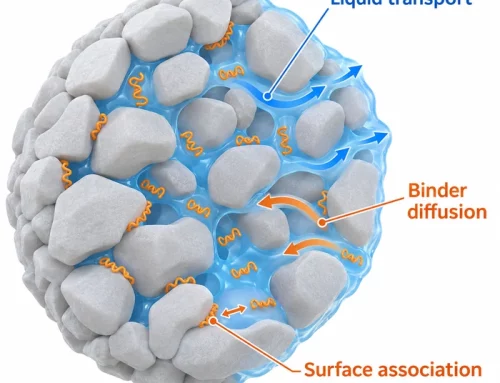
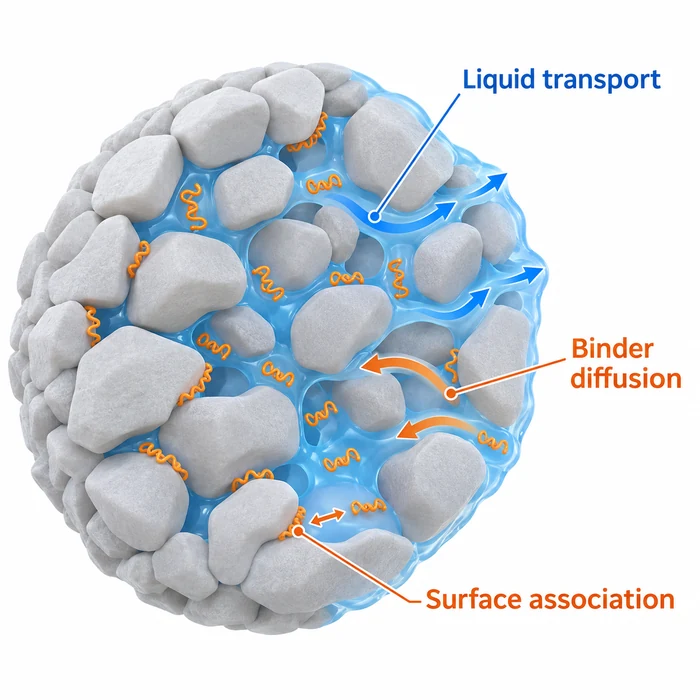
Water plasticizes amorphous ingredients such as maltodextrin and lowers their glass transition temperature, *Tg*. Above *Tg*, the material becomes more mobile. Particle surfaces deform more readily where they touch, and those contacts strengthen over time.
In a study of freeze-dried carbohydrate blends and food powders, researchers combined differential scanning calorimetry (DSC) with water sorption measurements to estimate the water activity at which *Tg* reached 25 °C. In the formulations studied, caking was negligible below that threshold and increased above it. [2]
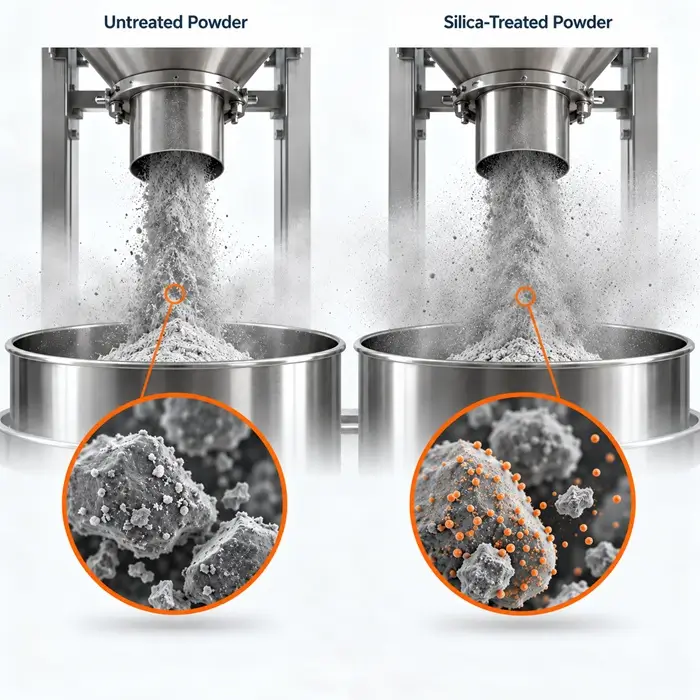
Adding cellulose reduced caking severity without measurably shifting the critical water activity. That matters when changing the packaging or warehouse conditions is difficult. An additive can weaken the cake even when the powder still encounters the conditions that initiate caking. Why can anti-caking agents increase dustiness?. [2]
Humidity cycles can leave solid bridges between particles
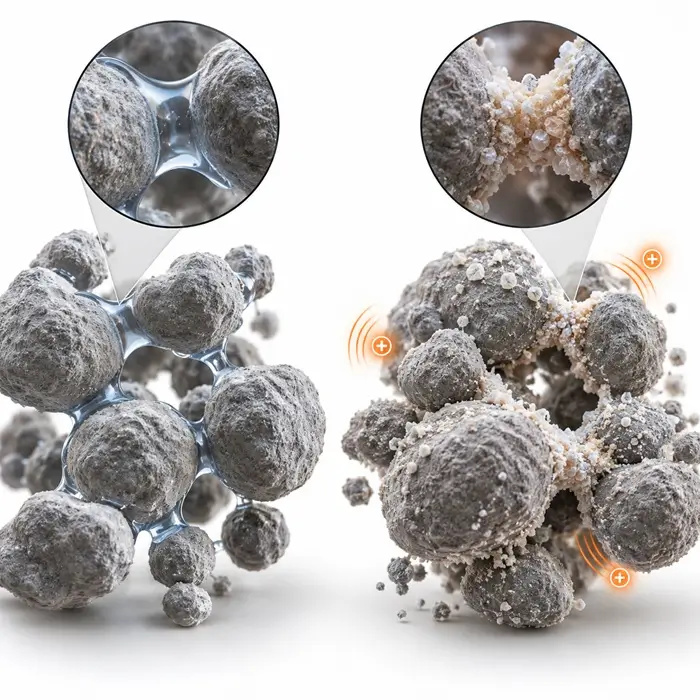
At **75.3% relative humidity (RH) at 25 °C**, solid sodium chloride is in equilibrium with its saturated solution. Above this RH, the salt takes up water and dissolves. When the surrounding air dries, dissolved salt recrystallizes. Where the solution spans particle contacts, recrystallization leaves solid bridges. The humidity measured when a cake is found may therefore miss the earlier exposure that formed it. [3, 4]
Fitzpatrick and colleagues found that sodium chloride, maltodextrin, and skim milk powder all took up substantial water during sustained high-humidity exposure, but produced cakes of different strengths. During the dry stage of a high–low–high humidity cycle, the maltodextrin cake weakened while the skim milk powder cake strengthened. The strength profile of the skim milk powder resembled that of sodium chloride. [4]
Dairy powders add another complication. Moisture lowers the glass transition temperature of amorphous lactose, and the lactose can subsequently crystallize. As the cycling study illustrates, a powder can lose water during drying while its cake grows stronger. Why does powder become more cohesive after drying?. [4]
A loaded powder bed can gain strength while it sits
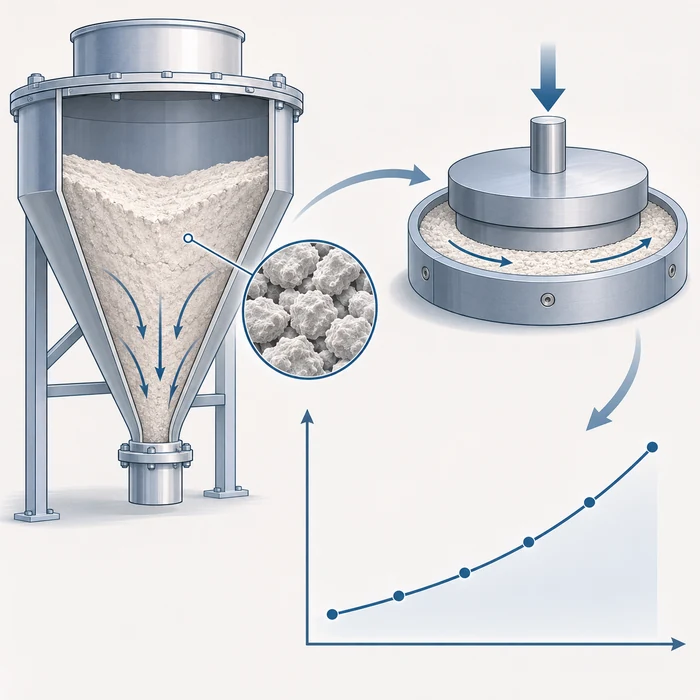
Powder held under compression can gain bulk strength over time. This behavior, known as **time consolidation**, helps explain why a powder that flowed freely during filling can resist discharge after a loaded standstill. A time-consolidation shear test measures the strength developed after storage under load. How preconsolidation stress changes a powder flow function. [5, 6]
Load also brings particles into closer contact, giving moisture-driven bridges more opportunities to form. A humidity test at low load and a load test at low humidity can both miss the condition that caused the failure. Include a condition that combines high humidity and high load.
Match the measurement to the failure
Surface crusting
Ball indentation measures how strongly the exposed powder surface resists penetration. Chen and colleagues used it to track surface hardening in pharmaceutical powders under controlled exposure conditions. [7]
Dividing indentation hardness by a suitable constraint factor gives an estimate of unconfined yield strength for a powder and test setup where that relationship has been established. The factor depends on the powder. In a crusted bed, the indentation still probes the surface layer. [8] If the powder fails to discharge, measure bulk strength directly after representative storage using a time-consolidation shear test. [5, 6]
A suspected moisture threshold
For an amorphous formulation, pair a water sorption isotherm with DSC to estimate where *Tg* reaches the storage temperature. Published thresholds illustrate how much the result depends on the product and method. A dynamic dewpoint isotherm study found a critical water activity of about 0.70 for the instant oatmeal muffin and chicken gravy premixes it tested. A DSC and sorption study on freeze-dried maca powder reported 0.258 at the onset of the glass transition and 0.480 at its completion. Use these values to scope testing on your own formulation. [9, 10]
Test the humidity and load the powder sees in storage
Suppose the bottom bags develop hard cakes after seven days. Take independent replicate portions from the same batch and test all four combinations of two humidity conditions and two loads. Keep temperature and dwell time constant. Compare unconfined yield strength after storage using a Schulze ring shear tester under ASTM D6773 or a Jenike shear tester under ASTM D6128. [5, 6]
- **Humidity.** If the product has a measured critical water activity, choose a low-RH condition below the corresponding equilibrium RH at the test temperature. Base the higher condition on the worst recorded warehouse excursion. Account for how long the excursion lasted and how much moisture reached the powder through the packaging. Use a humidity-controlled enclosure for ongoing exposure. If the test calls for a fixed starting moisture condition, equilibrate the specimens first and seal them during consolidation to limit moisture exchange. Reproduce the wetting and drying sequence when the incident involved a humidity cycle.
- **Load.** Compare a lightly loaded condition with the estimated stress on the bottom bag. Divide the weight carried above the bag by its effective loaded area. For a stack with a uniform footprint and evenly distributed load, the initial estimate is bulk density × height of powder above the bag × gravitational acceleration. Use actual bag weights and the loaded footprint when available.
| What the test shows | What to trial |
|---|---|
| Strength rises with load at both humidity levels | Lower the stacking load or shorten the loaded standstill. |
| Strength rises with humidity at both loads | Improve the moisture barrier or reduce the powder’s exposure to humid air. |
| Strength rises sharply only at high humidity and high load | Trial the less costly feasible change first. Verify discharge while the other condition remains high. |
| Neither change measurably affects strength | Check whether the test reproduced the incident. If it did, investigate temperature cycling, storage beyond the tested dwell time, or fat softening in a fat-containing formulation. |
Confirm the selected change in a storage and discharge trial. The laboratory comparison shows which conditions increased strength. The trial shows whether the change restores discharge.
Frequently Asked Questions
Technical Basis / Sources
- Bronlund, J. E., & Paterson, A. H. J. (2008). Mathematical modelling of temperature induced moisture migration in bulk powders. Chemical Engineering Science, 63, 2330–2340.
- Alvino Granados, A. E., & Kawai, K. (2021). Effect of cellulose powder content on the water sorption, glass transition, mechanical relaxation, and caking of freeze-dried carbohydrate blend and food powders. LWT, 148, 111798.
- Greenspan, L. (1977). Humidity fixed points of binary saturated aqueous solutions. Journal of Research of the National Bureau of Standards, Section A: Physics and Chemistry, 81A, 89–96.
- Fitzpatrick, J. J., Descamps, N., O’Meara, K., Jones, C., Walsh, D., & Spitere, M. (2010). Comparing the caking behaviours of skim milk powder, amorphous maltodextrin and crystalline common salt. Powder Technology, 204, 131–137.
- ASTM International. (2022). ASTM D6773-22, Standard Test Method for Bulk Solids Using Schulze Ring Shear Tester.
- ASTM International. (2022). ASTM D6128-22, Standard Test Method for Shear Testing of Bulk Solids Using the Jenike Shear Tester.
- Chen, Q., Zafar, U., Ghadiri, M., & Bi, J. (2017). Assessment of surface caking of powders using the ball indentation method. International Journal of Pharmaceutics, 521, 61–68.
- Zafar, U., Hare, C., Hassanpour, A., & Ghadiri, M. (2021). Assessing powder flowability at low stresses using ball indentation method: Evaluation of constraint factor. Powder Technology, 387, 287–294.
- Carter, B. P., Galloway, M. T., Campbell, G. S., & Carter, A. H. (2015). The critical water activity from dynamic dewpoint isotherms as an indicator of pre-mix powder stability. Journal of Food Measurement and Characterization, 9, 479–486.
- Alvino Granados, A. E., Fong-in, S., Hagura, Y., & Kawai, K. (2019). Continuously distributed glass transition of maca (Lepidium meyenii Walpers) powder and impact on caking properties. Food Biophysics, 14, 437–445.