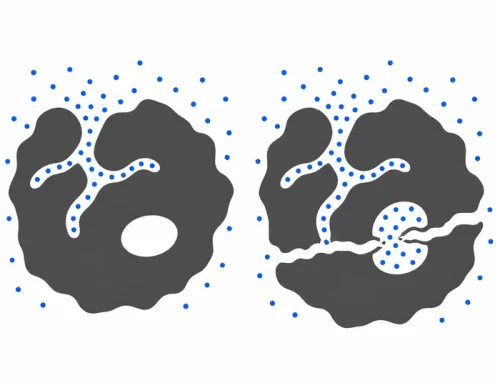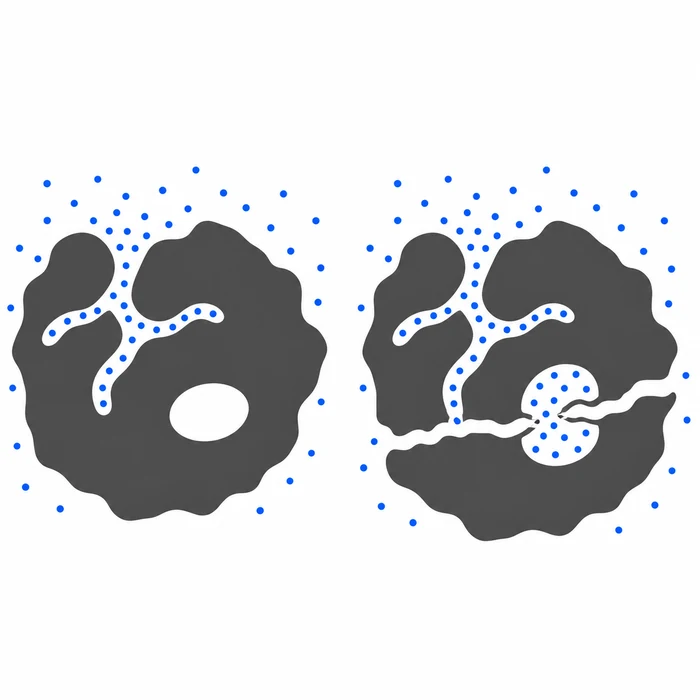
Bubbles and solid particles can both contribute to the optical signal. Their appearance in this schematic does not predict a particular size-distribution signature.
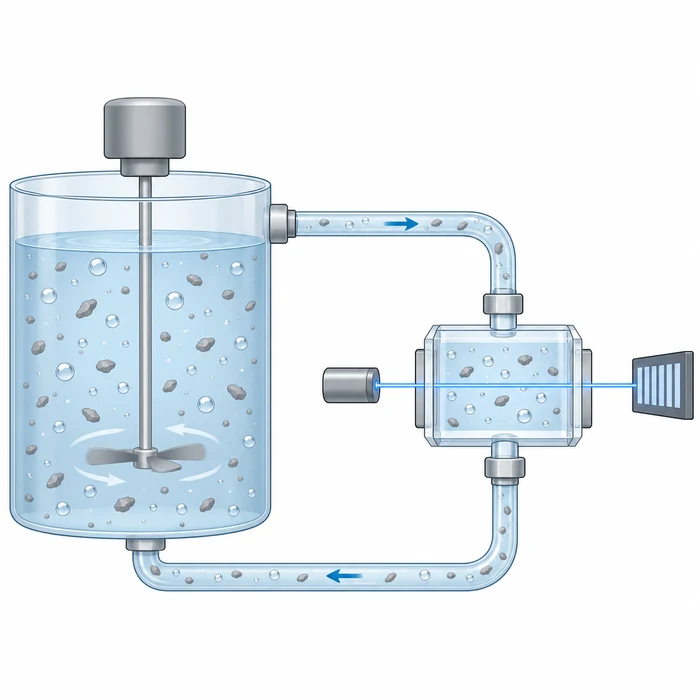
A coarse tail develops during wet laser-diffraction circulation, although preparation appeared unchanged. Before increasing dispersion energy or rejecting the material, decide whether the change represents particles, optical interference, or an unresolved combination.
Establish what changed
Start with representative aliquots from one homogenized sample, sharing storage, liquid composition, addition sequence, and initial dispersion history. Compare repeat measurements with the relevant baseline using the method’s established precision or uncertainty for the actual tail metric. Inspect the full distribution: a sparse coarse population may change without a useful shift in Dv90. No universal percentage difference identifies bubbles.
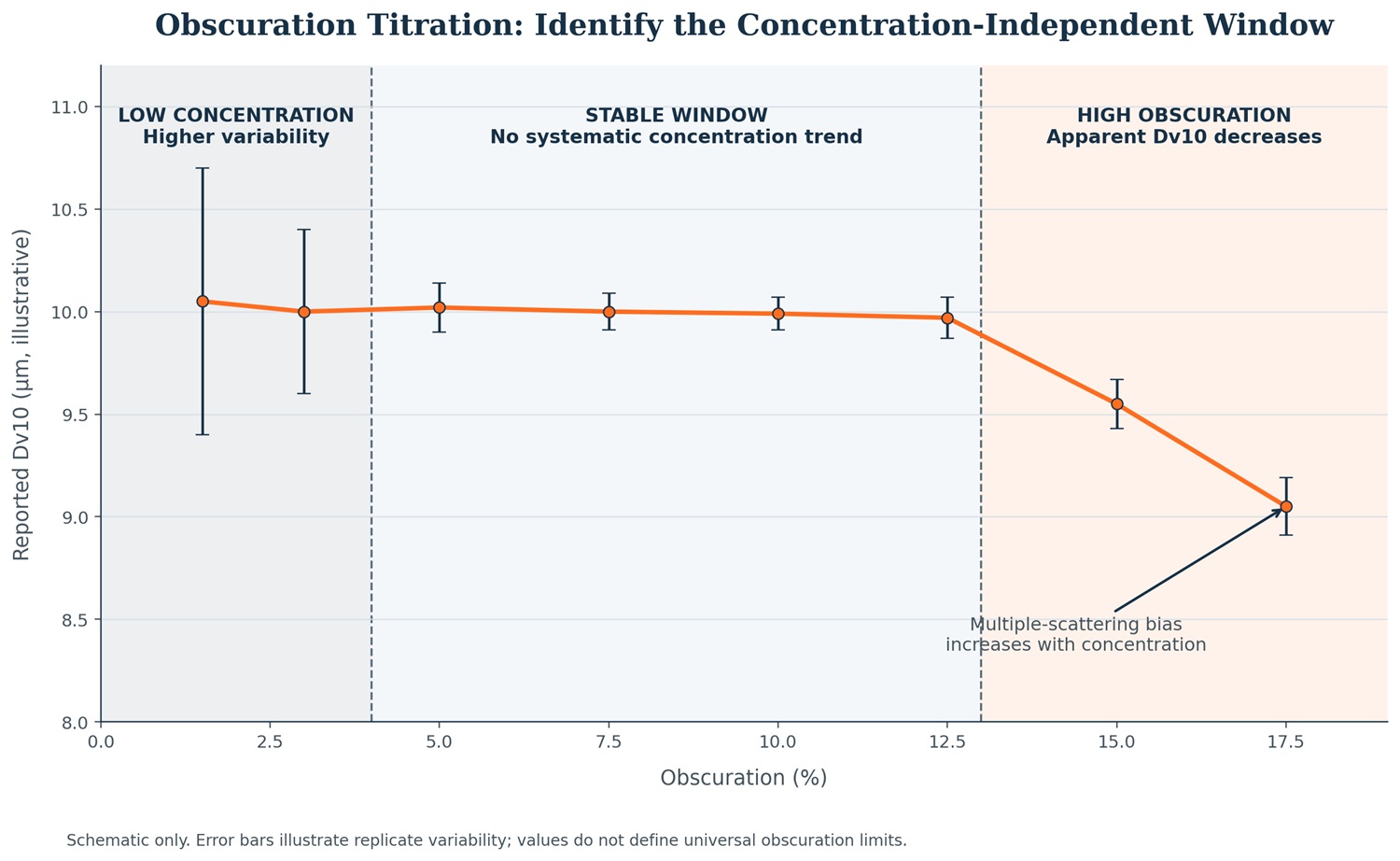
Review background records, optical settings, circulation, sonication, temperature, elapsed time, and obscuration before selecting a mechanism. Keep concentration within the established measurement window; the obscuration check explains why changing optical concentration can alter the reported distribution independently of dispersion. This prevents a concentration effect from becoming an additional uncontrolled variable.
Why bubbles are plausible
Laser diffraction infers size from scattered light, so a scattering contribution need not originate from solid particles. Malvern Panalytical’s wet-dispersion guidance states that excess surfactant can cause foaming and bubbles that may be interpreted as large particles [1]. This supports investigating bubbles under relevant wet-dispersion conditions; it does not establish a universal coarse-tail signature for every instrument or optical model.
Aggregation can also produce an abnormal coarse peak [3]. Circulation changes can alter which solids reach the cell: manufacturer guidance requires adequate suspension of large or dense particles [2]. The dispersion guide provides background on mixing and suspension stability when either explanation fits the preparation history.
Make two discriminating comparisons
First, run liquid and additives without solids through the relevant circulation sequence, following the instrument’s documented background-check procedure. Match composition, fill level, temperature, settings, and timing. Preserve abnormal background records rather than subtracting unexplained interference. An abnormal signal establishes interference without solids; contamination or optical problems still require consideration. Resolve that background before interpreting the sample. A clean check permits the sample comparison but cannot exclude air introduced during sample addition or sample-dependent foaming.
Second, compare sample portions receiving a documented, material-compatible air-removal treatment and matched untreated or sham handling. Match elapsed time, temperature, composition, solids loading, and subsequent measurement conditions. Record obscuration and full distributions, and obtain independent evidence that bubbles decreased, such as suitable direct observation. Check sediment, retained solids, and particle state because holding or treatment can also remove coarse particles from circulation or change the dispersion.
A reproducible tail reduction with fewer observed bubbles and preserved suspension strengthens the bubble explanation. Disappearance alone is insufficient: settling, particle loss, dissolution, or deagglomeration can produce a similar response. Reducing pump speed alone is especially ambiguous because it changes suspension conditions. If particle-state changes remain plausible, use the wetting and dispersion troubleshooting route to select the next discriminating observation.
Repeat before changing the method
Repeat preparation with the selected air-control condition and a matched control, preserving the established dispersion endpoint and acquisition sequence. Document the supported interpretation and control only if the response repeats with representative solids. If a coarse population persists, investigate it directly; bubbles and genuine coarse particles may coexist. Retain an inconclusive result when the comparisons cannot separate them.
Technical Basis / Sources
- Malvern Panalytical. “Wet or liquid dispersion method development for laser diffraction particle size distribution measurements.” Technical note, February 22, 2013.
- Hong, Myung-hee. “What is Dispersion? Developing Methods for Wet Dispersion Optimization – Part 2.” Malvern Panalytical, January 10, 2014.
- Malvern Panalytical. “Causes and Countermeasures for Strange Data in Laser Diffraction and Scattering Particle Size Analyzers.” May 1, 2023.