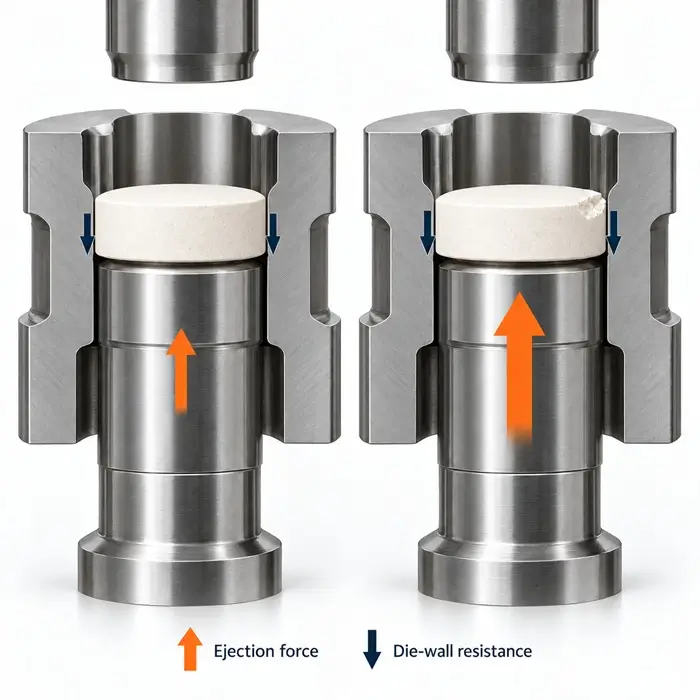
After compression, the tablet can continue pressing against the die wall as it unloads. This residual radial stress, combined with friction at the tablet–die interface, resists movement during ejection.
Why Can Ejection Force Rise?
Peak ejection force typically occurs when the tablet first moves and static friction is overcome. Kinetic friction governs the subsequent sliding stage. A higher peak does not necessarily mean the friction coefficient has increased, since residual wall pressure, tablet dimensions, and contact area also affect the measured force. Ejection speed can further change the frictional response, even when the formulation remains unchanged.
Why Doesn’t Hardness Reveal the Problem?
Routine tablet hardness generally refers to breaking force, not resistance to die-wall sliding. Tensile strength normalizes breaking force for tablet geometry, provided the tablet fails in a valid tensile fracture. Neither measurement directly captures the localized stresses experienced at the tablet edge during ejection.
A tablet can retain acceptable strength while developing sufficient local stress to chip as it leaves the die. Stable hardness therefore cannot rule out ejection-related damage.
What Did the 2024 Study Find?
Van der Haven and colleagues examined microcrystalline cellulose, dibasic calcium phosphate dihydrate (DCPD), and partially pregelatinized starch using a STYL’One Evolution compaction simulator with 11.28 mm flat-faced punches.
They varied ejection speed and compaction pressure across all three materials, and compared internal with external lubrication for the starch. The main experiments used 1 wt% magnesium stearate (MgSt) as an internal lubricant.
Increasing ejection speed consistently raised ejection forces and friction coefficients. However, only DCPD tablets developed chipping. At approximately 0.3 kN maximum ejection force, changing ejection speed shifted the outcome from no chipping to severe chipping, while tensile strength changed negligibly.
The authors point to the rate-dependent behavior of the MgSt film at the die interface as a possible explanation for the speed effect.
The 0.3 kN value describes the tested conditions. It is not a universal production limit.
What Should You Check?
-
- Confirm the trend. Compare ejection force at matched formulation, tablet geometry, compression conditions, and press settings. Check measurement consistency before interpreting small changes.
- Review lubrication. Examine lubricant concentration, distribution, blending history, and any external die-wall lubrication. MgSt behavior can influence speed-dependent friction, but adding more lubricant can reduce tablet strength or delay dissolution.
- Inspect tooling and defects. Check die-wall finish, deposits, punch alignment, tooling temperature during extended runs, and die-bore wear at the compression zone. Compare force profiles and inspect tablet edges for chipping.
- Test speed sensitivity. Where a compaction simulator is available, vary ejection speed under otherwise matched conditions and record force and edge damage. Changing turret speed on a rotary press also affects other process variables, including dwell time and die filling. Treat turret-speed trials as a combined test, not an isolated ejection-speed test.
For additional background, see PTI’s Compaction Behavior reference page.
When Should the Trend Trigger Action?
<p>A sustained increase relative to a validated baseline warrants investigation even when tablet weight, thickness, and hardness remain within specification.</p>
<p>Evaluate ejection-force trends alongside tooling condition and visible defects. Use product-specific acceptance criteria rather than adopting an absolute force limit from the literature.</p>
Technical Basis / Sources
-
- van der Haven, D. L. H., et al. (2024). Tablet ejection: A systematic comparison between force, static friction, and kinetic friction. International Journal of Pharmaceutics, 661, 124369. Ejection speed, friction, and tablet chipping.
-
- Uzondu, B., Leung, L. Y., Mao, C., & Yang, C.-Y. (2018). A mechanistic study on tablet ejection force and its sensitivity to lubrication for pharmaceutical powders. International Journal of Pharmaceutics, 543, 234–244. Die-wall stress, friction, and lubrication.
-
- Paul, S., & Sun, C. C. (2018). Systematic evaluation of common lubricants for optimal use in tablet formulation. European Journal of Pharmaceutical Sciences, 117, 118–127. Lubricant effectiveness and formulation trade-offs.
-
- USP General Chapter <1217>, Tablet Breaking Force. Tablet strength measurement.
-
- Higgins, T. (2015). Preventing Tablet Tooling Problems. Pharmaceutical Technology, 39(2), 58–59. Die-bore wear, tooling damage, and increased ejection forces.