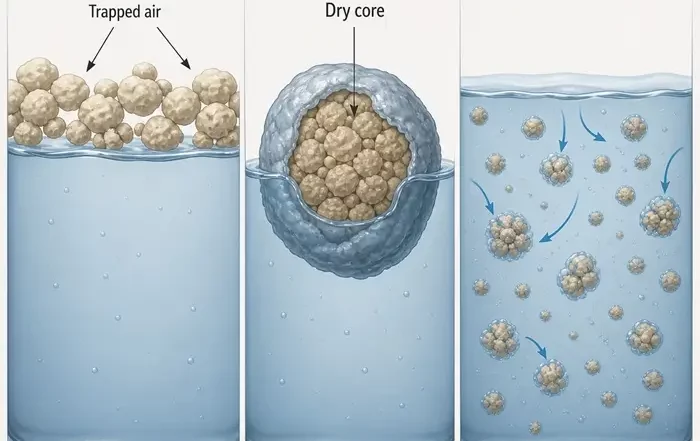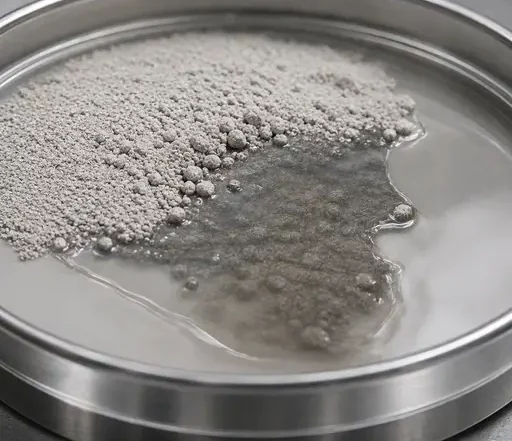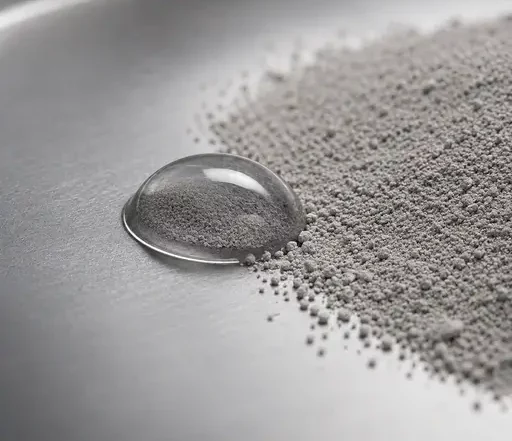
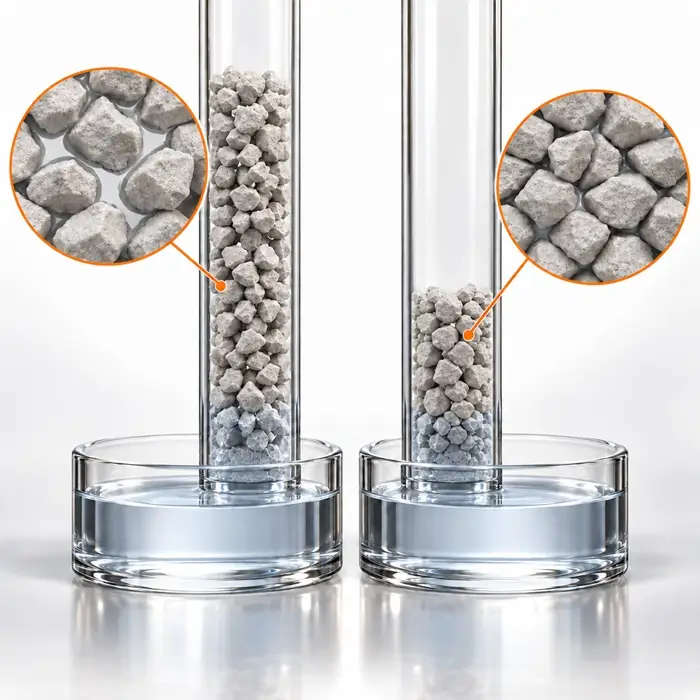
A coated powder measures 12° higher than its uncoated counterpart. The coated sample was tapped into a denser bed, while the uncoated sample was loosely filled. Both calculations used a structure parameter obtained from a loosely packed bed. Did the coating reduce wettability, or did packing inflate the coated result?
Why Does Packing Change the Calculation?
The Washburn capillary-rise method measures how quickly a liquid penetrates a packed powder column. In its idealized mass-uptake form:
Slope of m² versus t = C × (ρ²γ/η) × cosθ
Here, m is absorbed liquid mass, t is time, ρ is liquid density, γ is surface tension, η is viscosity, and θ is the apparent advancing contact angle.
The bed-structure parameter C represents pore geometry, not surface chemistry. For an ideal bundle of equivalent cylindrical capillaries:
C ≈ ε² × reff × A² / 2
Here, ε is bed porosity, reff is effective pore radius, and A is the tube’s cross-sectional area.
Denser packing reduces both porosity and effective pore radius, so C falls faster than ε² alone suggests. Reusing a larger C calibrated on a loose bed makes cosθ appear smaller and the calculated angle larger for wetting angles below 90°. Packing alone is enough to explain the direction of the opening discrepancy.
What Happens When Porosity Is Controlled?
Galet, Patry, and Dodds (2010) prepared reproducible powder beds using centrifugal packing and varied their porosity. Their experiments demonstrated that the Washburn-derived contact angle depends on bed porosity. They also determined the structure parameter from air permeability using a Kozeny-Carman relationship.
Conventional calibration uses a separate, nominally identical bed and a reference liquid assumed to wet the powder completely (θ = 0°). Applying that calibration to a differently packed test bed introduces systematic error.
Four Checks Before Crediting the Coating
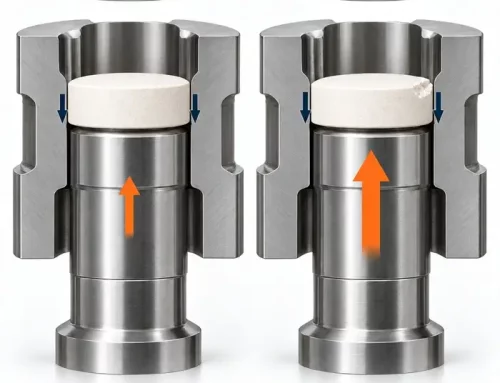
1. Reproduce Bed Preparation
Record powder mass, tube diameter, filling procedure, tapping or consolidation method, and final bed height. Calculate bulk density and estimate porosity:
ε = 1 − ρbulk/ρparticle
Use the appropriate particle density for each grade and compare packing conditions. Coatings can also change agglomeration and packing behavior independently of surface wettability.
2. Validate the Reference Liquid
Verify that the calibration liquid completely wets both grades. Low surface tension alone does not establish θ = 0°. Match calibration and test bed structures or determine C separately for each condition.
Tan et al. (2017) showed that the identical-bed assumption behind C rarely holds strictly and proposed data-driven reference-liquid selection. Kirdponpattara et al. (2013) found that Washburn overestimated advancing angles, with void structure and contact-angle hysteresis contributing.
3. Inspect the Uptake Curves
Compare the linear regions of mass squared versus time for replicate beds. Examine delayed penetration, changing slopes, and signs of swelling or bed rearrangement.
Report the fitted region and its R² alongside the calculated angle.
4. Test the Surface-Treatment Claim
Repeat coated and uncoated measurements using controlled packing conditions and appropriate calibration for each grade.
Washburn measures an apparent advancing angle through spontaneous liquid penetration. It cannot determine contact angles of 90° or greater because capillary-driven penetration ceases under the ideal model.
For strongly hydrophobic treatments, use an appropriate complementary method. Alghunaim et al. (2016) review alternatives, including sessile-drop and Wilhelmy techniques.
Decision rule: Match packing and calibration first. Only then interpret a persistent contact-angle difference as evidence of surface treatment.
Frequently Asked Questions
Technical Basis / Sources
- Galet, L., Patry, S., and Dodds, J. (2010). Determination of the wettability of powders by the Washburn capillary rise method with bed preparation by a centrifugal packing technique. Journal of Colloid and Interface Science, 346(2), 470–475.
- Kirdponpattara, S., Phisalaphong, M., and Zhang Newby, B. (2013). Applicability of Washburn capillary rise for determining contact angles of powders/porous materials. Journal of Colloid and Interface Science, 397, 169–176.
- Tan, G., Morton, D. A. V., and Larson, I. (2017). Strategies to analyse data obtained from liquid intrusion experiments of loose porous materials. Journal of Pharmaceutical and Biomedical Analysis, 145, 711–717.
- Alghunaim, A., Kirdponpattara, S., and Zhang Newby, B. (2016). Techniques for determining contact angle and wettability of powders. Powder Technology, 287, 201–215.