
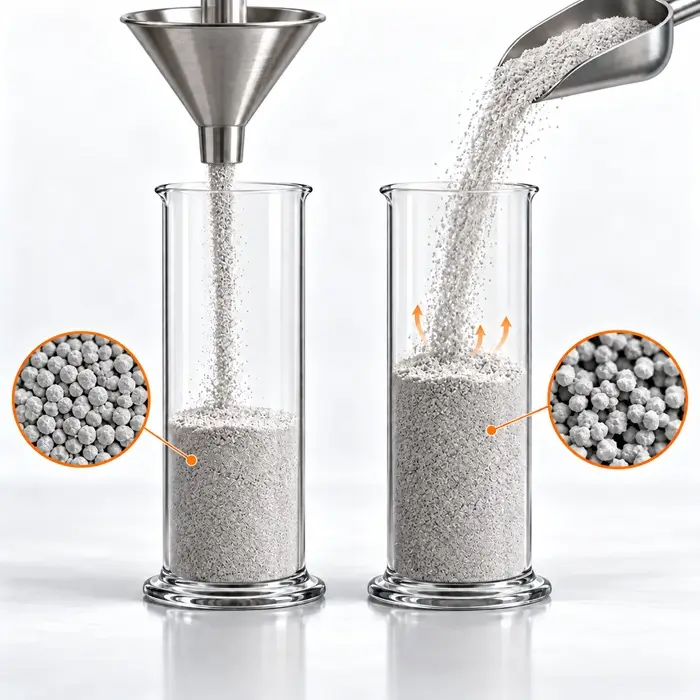
Two laboratories measure the loose bulk density of the same powder. Both use calibrated equipment, yet their results disagree. One fills the cylinder through a funnel; the other pours directly from a scoop. Neither has necessarily made a measurement error.
What Happens as Powder Fills a Container?
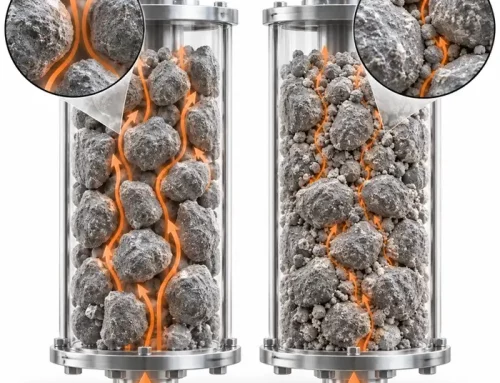
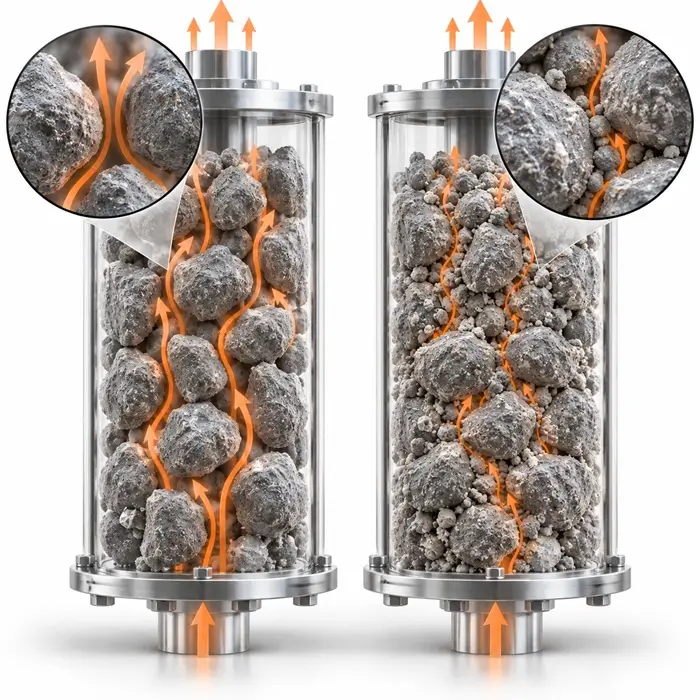
Loose bulk density is calculated from powder mass and occupied volume, including the spaces between particles. The calculation is straightforward. Producing a consistent packing structure is less so. As particles enter a cylinder, they collide, settle, and rearrange. Some air escapes; some remains trapped. Cohesive powders may form relatively open structures because interparticle forces resist settling. The resulting bed reflects how it was formed. Loose bulk density is therefore a property measured under specified conditions, not a fixed material constant.
Funnel or Scoop: Does It Matter?
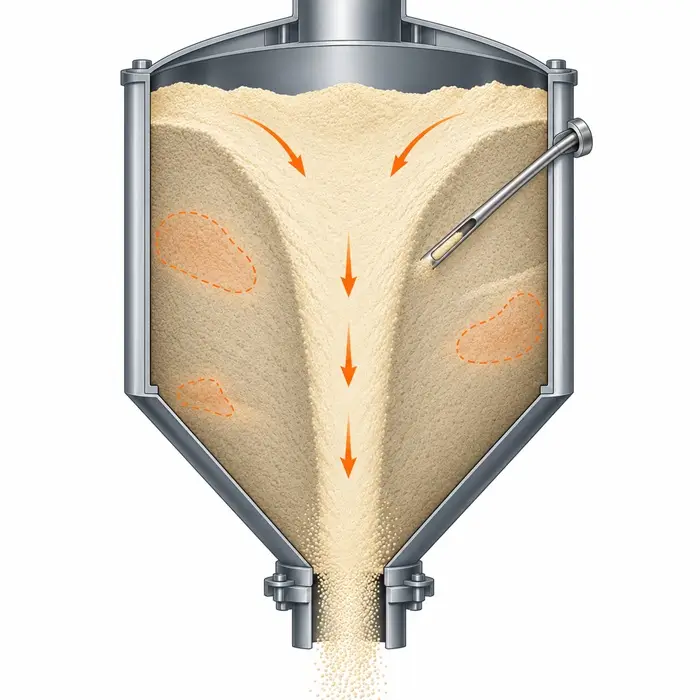
A funnel controls where powder enters the cylinder and, to some extent, how quickly it arrives. Outlet diameter and funnel geometry influence the discharge pattern. With a scoop, the operator determines the pouring angle, height, and speed. One person may produce a steady stream, while another releases powder in several portions. A funnel is not inherently better. Cohesive material may bridge at a narrow opening, and disturbing it to restart flow introduces another variable.
Drop Height, Filling Rate, and Trapped Air
<p>Pouring from greater height increases impact energy and can encourage particles to rearrange into denser packing.</p>
<p>But the falling stream also entrains air. In fine powders with low permeability, that air may escape slowly, leaving the bed temporarily expanded.</p>
<p>Filling rate affects the same balance. Rapid filling may trap more air, while slower filling gives the bed time to settle. Coarser, free-flowing particles can respond differently because impact-driven rearrangement becomes more important.</p>
<p>Neither greater height nor faster filling produces a predictable density change across all powders.</p>
The Sample Has a History
How powder was handled before testing can matter as much as how it enters the cylinder. Material taken directly from a fluidized process or pneumatic conveying line may remain aerated. Its volume can decrease as air escapes, without mechanical tapping. A sample transported, vibrated, or stored under load may already be partially consolidated. ASTM D7481-18 identifies initial dispersion, specimen height-to-diameter ratio, powder dryness, and other conditions as factors affecting loose bulk density.
Set the Procedure Before Comparing Results
Standard methods prescribe how powder is prepared and introduced into the measuring vessel. USP General Chapter <616> includes a cylinder method with provisions for breaking up storage agglomerates and a volumeter method. For metallic powders, ISO 3923-1 specifies funnel filling, while ISO 3923-2 describes the Scott volumeter method for powders that do not flow freely through the specified funnel.
These methods establish different filling conditions. Their results are not automatically interchangeable. For a useful comparison, record:
- Apparatus: Funnel or scoop arrangement, outlet dimensions, and cylinder geometry.
- Filling: Drop height, feed rate, pouring position, and stream continuity.
- Sample preparation: Previous handling, rest time, humidity, and any sieving.
- Volume reading: Time between filling and reading, and leveling without compaction.
- Repeatability: Independently prepared replicates and their spread.
What Does the Difference Mean?
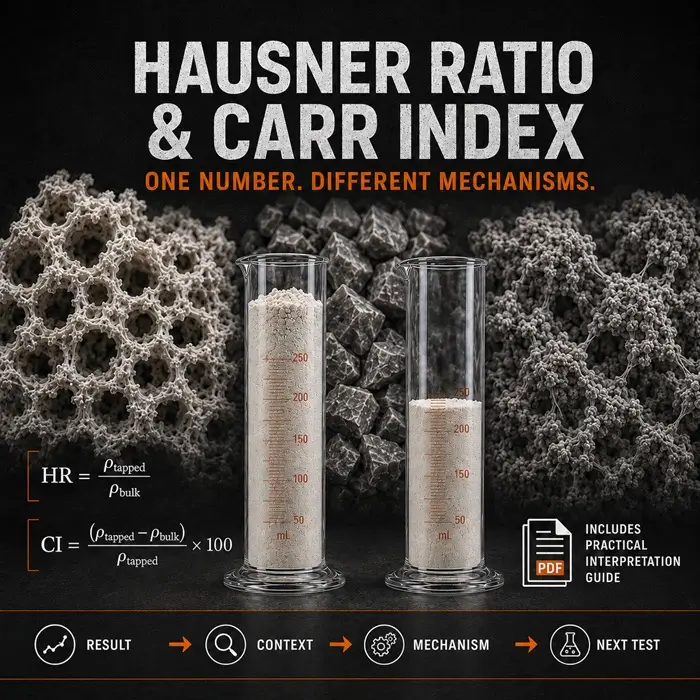
Both the Hausner ratio and Carr index use loose and tapped bulk density. If loose density changes while tapped density remains largely constant, both calculated indicators change. The powder may appear to have better or worse flow characteristics solely because of the filling procedure.
If the difference between laboratories exceeds the spread within each, repeat the test using identical preparation and filling procedures.
If the results converge, the procedure contributed to the discrepancy. If they remain apart, examine sample condition, equipment, and material variability.
Without a defined filling procedure, a loose bulk density result cannot be reproduced or meaningfully compared.
Technical Basis / Sources
- ASTM International. ASTM D7481-18: Standard Test Methods for Determining Loose and Tapped Bulk Densities of Powders Using a Graduated Cylinder.
- United States Pharmacopeia. USP General Chapter <616>: Bulk Density and Tapped Density of Powders. USP-NF.
- International Organization for Standardization. ISO 3923-1:2018: Metallic powders, Determination of apparent density, Part 1: Funnel method.
- International Organization for Standardization. ISO 3923-2:1981: Metallic powders, Determination of apparent density, Part 2: Scott volumeter method.