Powder property
Abrasion
Sliding and repeated contact remove material from particles, coatings, and equipment surfaces
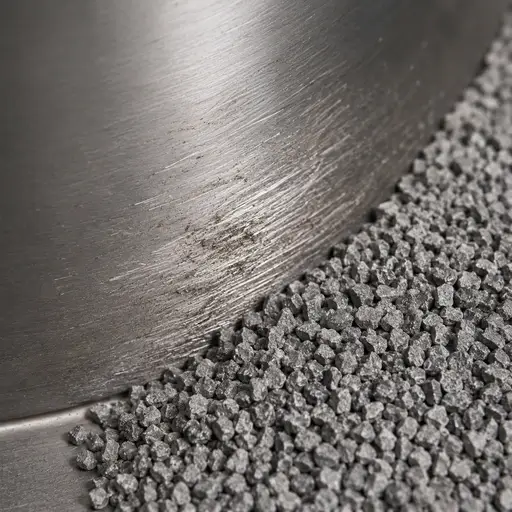
Abrasion is progressive surface wear caused by sliding, rubbing, rolling, or repeated contact between particles and equipment or between particles themselves. It can generate fines, round particles, remove functional coatings, erode equipment, and introduce wear debris into the product.
Powder property
Abrasion
Sliding and repeated contact remove material
from particles, coatings, and equipment surfaces
Abrasion is progressive surface wear caused by sliding, rubbing, rolling,
or repeated contact between particles and equipment or between particles themselves.
It can generate fines, round particles, remove functional coatings, erode equipment,
and introduce wear debris into the product.



Core concept
Abrasion is an interfacial wear mode within attrition
Abrasion removes material progressively from a surface. The worn surface may be the particle, a coating, a pipe, a valve, a liner, or another particle. Attrition describes the broader accumulation of particle damage and can include abrasion, chipping, fatigue, and fragmentation. Wear depends on both sides of the contact. A hard angular particle may erode a soft pipe, while a rough wall or hard contaminant can abrade a fragile product. Sliding distance, normal load, impact angle, velocity, and repeated cycles determine which surface loses material. Measure the origin and form of the debris, not only its quantity. Product fines and equipment wear particles can create very different quality, safety, and maintenance consequences.
What controls it
Six groups of variables govern abrasion
Abrasion rate reflects the mechanical contrast between contacting surfaces and the severity and repetition of their relative movement.
States and interpretation
Different wear modes create different surface signatures
Inspect the worn surfaces and debris to distinguish abrasion from impact fracture, adhesion, and corrosion.
| Wear mode | Typical signature | Dominant contact | Useful confirmation |
|---|---|---|---|
| Particle surface abrasion | Rounding, polishing, scratches, and gradual fine generation | Sliding or repeated glancing particle contacts | Microscopy, morphology, and fine-tail growth |
| Coating wear | Patchy exposure, thinning, or loss of functional performance | Rubbing, flexure, or weak coating-substrate bonding | Surface mapping and coating-specific analysis |
| Equipment erosion | Wall thinning, grooves, bend wear, and foreign debris | High-velocity particle-wall contact | Wear coupons, wall inspection, and debris composition |
| Three-body abrasion | Accelerated scratching by trapped hard debris or fines | Particles moving between two loaded surfaces | Debris identification and contact-surface inspection |
How to measure it
Choose an abrasion test by the contact pair
Reproduce the relevant surfaces, relative motion, loading, and environment before comparing wear resistance.
Where it matters
Abrasion becomes a product-quality and equipment-life constraint
Wear matters wherever particles slide, rub, circulate, or strike surfaces repeatedly during production and handling.
Go deeper
Three practical routes into abrasive wear
Explore powder tribology, product damage across transport methods, and the contamination created by pneumatic-line erosion.

Need the measurement, not just the guidance?
If the remaining uncertainty concerns particle abrasion, coating wear, pipeline erosion, tribological response, debris origin, or equipment-life comparison, select the measurement around the material state and process decision. PowderTechnology.info can help define the test sequence, sample conditions, and interpretation route. For laboratory support, explore our Delft Solids Solutions partner page or visit Delft Solids Solutions directly.