
Process & Equipment
AI & Digital Process Intelligence
Turning powder, sensor, image, and process data into better engineering decisions
AI in powder processing becomes useful when it links trustworthy measurements to a defined
operational question. Machine learning, soft sensors, computer vision, and digital twins can
detect patterns, estimate unmeasured states, and support decisions, but their output remains
bounded by the data, labels, operating window, and reference methods behind them.



Jump to
Jump to a specific engineering decision, or follow the sections from the operational question through data, validation, deployment, and verification.
Key Takeaway
AI adds an inference layer. It does not create evidence.
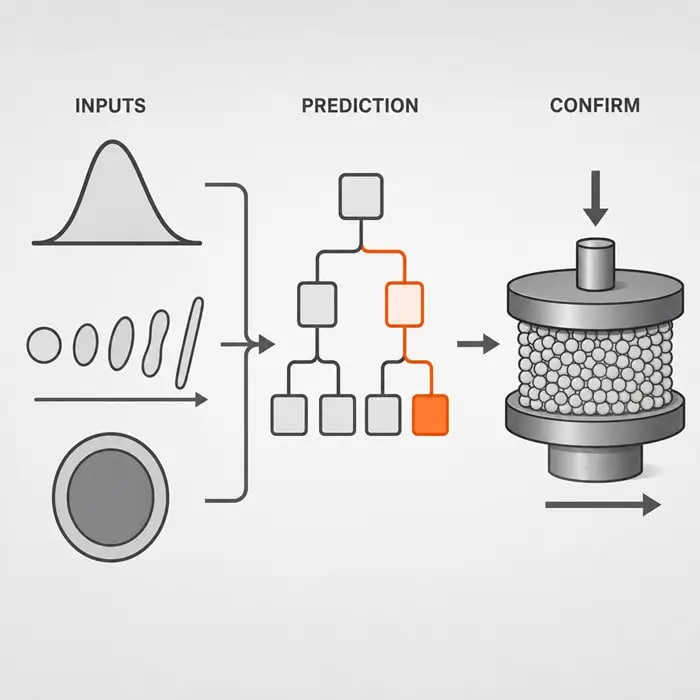
A model can connect many signals faster than an engineer can inspect them one by one, but it does not turn weak inputs into strong evidence. Its output reflects the measurements, labels, sampling, process states, and operating range used to train and validate it. Start with the engineering question: what state must be inferred, what decision will follow, and what physical measurement establishes whether the inference is correct?
Practical boundary: Treat model accuracy as conditional evidence. A high score inside a familiar dataset does not establish performance on a new formulation, material grade, equipment scale, season, or operating window. Keep the reference measurement visible, define when the model must be revalidated, and retain a route back to physical testing when the prediction becomes uncertain.
Start with the requirement
Define the decision before selecting the model
AI is not a process requirement by itself. Define the operational decision, target, response time, and consequence before choosing the model or data source.
Powder and process constraints
Define the states the model must survive
Digital models are conditional on the material, equipment, measurement system, and environment represented in their evidence base.
Choose by application question
Start with the unresolved digital decision
Match the digital method to the question and to the evidence required to verify the answer.
Data & signals
Six data layers can support digital process intelligence
Useful models combine signals that are relevant to the process state being inferred. More data is not automatically better data, and every input must remain traceable to how, where, and when it was generated.
Ground truth & labels
The model learns the target definition you give it
Reference data must be physically meaningful, traceable, and aligned with the process state represented by the model inputs.
What AI can do
Match the digital method to the decision
Different model types answer different questions. Select the capability around the decision and preserve the physical evidence needed to verify its output.
Validation boundary
A model is only valid inside the domain it has demonstrated
Validation should test the materials, process states, equipment conditions, and disturbances that matter to the decision, not only random rows from the same dataset.
| Validation question | Why it matters | Evidence to require | Warning sign |
|---|---|---|---|
| What is the ground truth? | The model learns the definition used for its target. | Traceable reference method, sampling plan, and label definition. | Labels mix different methods, operators, or conditions without control. |
| Does validation represent new material? | Random train/test splits can overstate transfer to genuinely new powders. | Held-out lots, formulations, grades, or campaigns where relevant. | Accuracy is reported only on rows drawn from the same material population. |
| Is the operating window covered? | Models interpolate more safely than they extrapolate. | Temperature, humidity, throughput, equipment state, and formulation ranges. | The process routinely operates outside the validated range. |
| How is drift detected? | Sensors, raw materials, equipment, and formulations change over time. | Monitoring limits, recalibration triggers, and revalidation ownership. | No defined action when input distributions or residuals shift. |
Process relevance
Digital intelligence becomes useful where a process decision repeats
The strongest applications connect a defined powder or equipment state to a repeatable decision. The model should narrow uncertainty or shorten response time without hiding which physical mechanism and measurement still define the problem.
Model lifecycle
Treat deployment as the start of evidence collection
A model that performs well at deployment can become unreliable when the process, measurement system, or material population changes.
Selection comparison
Choose the route around the engineering question
Compare the digital method by the decision it supports, the evidence needed to validate it, and the failure mode created when the model is wrong.
| Digital route | Typical engineering question | Minimum evidence | Main boundary |
|---|---|---|---|
| Classification | Which defined class or state does this sample belong to? | Stable labels, representative classes, independent test set, class-specific error rates. | Cannot safely assign genuinely new classes outside the training definition. |
| Anomaly detection | Is the process departing from its learned normal state? | Representative normal operation, disturbance examples where available, alert verification. | An anomaly score does not identify the physical cause by itself. |
| Soft sensor | What is the current value of a slow or difficult-to-measure property? | Traceable reference measurements aligned with process signals across the intended range. | Prediction inherits reference-method and domain limitations. |
| Computer vision | What particle, surface, defect, or process state is visible? | Controlled imaging, calibration, representative labels, independent review. | Lighting, optics, fouling, focus, or presentation changes can shift the result. |
| Predictive optimization or control | What action should be taken next? | Validated response model, decision constraints, timing, safeguards, fallback strategy. | Model error can propagate directly into process action. |
| Digital twin | What state is the process in, and what happens under another scenario? | Maintained process model, live data mapping, parameter verification, scenario validation. | Model fidelity depends on maintained assumptions and plant-state synchronization. |
Operating window
Publish the domain with the model
A digital model needs an operating window just as physical equipment does. Define where it is allowed to interpolate and what happens outside that boundary.
Data before design or deployment
Require evidence that matches the consequence of the decision
Model performance should be supported by evidence that represents the materials, disturbances, and consequences of the intended use.
Verification and acceptance
Accept the system, not just the algorithm
Acceptance should cover the complete measurement, data, model, software, and decision chain under representative operating conditions.
Integration
Connect the model to the real process without losing traceability
Digital intelligence becomes part of the process only when the data path, control interface, human role, fallback logic, and change-management responsibilities are explicit.
When a problem already occurs
Diagnose the process and the digital layer separately
If the installed process is already failing, start with the physical symptom in the Troubleshoot hub. In parallel, check sensor health, time alignment, missing data, out-of-domain conditions, preprocessing changes, model drift, and version history. A wrong prediction can come from a changed powder, a changed process, a changed measurement system, or the model itself.
Go Deeper
Three practical routes into digital process intelligence
These published technical articles cover prediction, process modeling, and real-time monitoring from three different engineering angles.


FAQ
AI and digital process intelligence questions
Use these boundaries when assessing models, digital tools, and deployment proposals.
Technical basis
Sources and scope
Use process measurements, model-validation evidence, and a defined operating domain together. The references below provide general PAT, chemometric, continuous-manufacturing, and AI-risk principles. They do not establish a universal powder-process model, acceptance limit, or control strategy.
- FDA, PAT: A Framework for Innovative Pharmaceutical Development, Manufacturing, and Quality Assurance: provides a PAT framework linking process measurement, process understanding, monitoring, and control. Its regulatory scope is pharmaceutical manufacturing.
- FDA, Development and Submission of Near Infrared Analytical Procedures: addresses development, validation, use, maintenance, and documentation of NIR analytical procedures using chemometric models.
- ICH Q13, Continuous Manufacturing of Drug Substances and Drug Products: provides scientific and regulatory considerations for development, implementation, operation, and lifecycle management of integrated continuous-manufacturing systems.
- NIST AI Risk Management Framework: provides a voluntary framework for managing AI risk and trustworthiness across design, development, deployment, use, and evaluation. It is a general AI framework, not a powder-processing standard.
For a specific process, define the ground truth, material and operating range, independent validation plan, uncertainty limits, monitoring strategy, fallback route, and ownership before using a digital prediction to support release, optimization, troubleshooting, or control.
Need reliable data before building the model?
AI and digital process intelligence depend on trustworthy reference measurements. If the decision requires physical characterization, method development, or a validation dataset, Delft Solids Solutions can help define the measurement plan and generate process-relevant evidence. Contact the laboratory with the application, available material, and the decision the data must support.
