An in-line near-infrared (NIR) sensor reports a moisture increase after a milling adjustment, but the dryer settings are unchanged. Has the powder gained water, or has its new particle size distribution altered the optical measurement?
How Particle Size Alters the NIR Signal
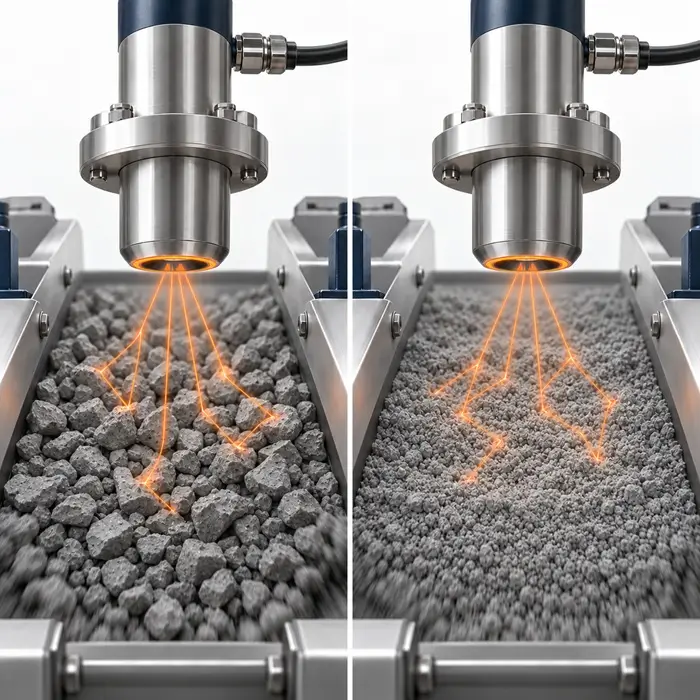
Water absorbs near-infrared light at characteristic wavelengths, including bands around 1450 and 1940 nm. In diffuse reflectance measurement, light also scatters repeatedly through the powder before reaching the detector. Particle size and morphology alter scattering, effective optical path length, and the apparent intensity of absorption features. After milling or classification, a shift in the fine fraction can therefore change the spectral baseline even when moisture remains constant. If that physical variation was poorly represented during calibration, the model may assign some of the spectral difference to water. Rantanen et al. (2000) observed particle-size-related baseline changes while studying in-line NIR moisture measurement during granulation. Pasikatan et al. (2001) reviewed the established dependence of powder NIR reflectance on particle size. The direction of the error is specific to the material and the model: a finer powder is not necessarily reported as wetter.
Four Checks Before Adjusting the Process
1. Check the Calibration Diagnostics
Inspect Q residuals and Hotelling’s T², where available, against validated model limits. High Q residuals indicate spectral variation not adequately described by the model; high T² indicates an unusual position within its modeled spectral space. Both flag samples for investigation; neither proves the moisture prediction is wrong. Instruments using only a few fixed wavelengths may not provide these diagnostics.
2. Compare the Raw Spectra
Overlay scans from before and after the particle size change, under comparable process and presentation conditions. A broad baseline offset or slope change suggests scattering or presentation effects; a change concentrated around water-sensitive bands supports a moisture-related explanation. This is triage, not confirmation, because scattering also affects absorption-band intensity.
3. Verify Moisture Independently
<a href=”https://powdertechnology.info/representative-powder-sampling/”>Collect time-matched, representative samples</a> and <a href=”https://powdertechnology.info/best-practices-for-moisture-content-analysis-in-powders/”>measure water using a validated reference method</a>. Karl Fischer titration is water-specific when suitable for the material; loss on drying can include other volatile components. Control sampling delays and exposure to ambient humidity. Compare differences against the methods’ normal uncertainty.
4. Check Particle Size and Sample Presentation
Compare full distributions, D10, D50, D90, and the relevant fine fraction, not D50 alone. Record agglomeration, bulk packing, probe window condition, and process temperature. Milling can raise product temperature, which shifts water band positions through changes in hydrogen bonding, independently of moisture content. Stable reference moisture alongside changed NIR predictions and particle size supports a size-related calibration bias; if the reference method confirms the NIR change, investigate the process. Until the reference result is available, follow the site’s approved verification procedure rather than adjusting dryer settings on the NIR value alone.
Making the Calibration More Robust
Build and validate calibrations across the particle size and moisture combinations expected in production. Include independent batches and test prediction errors across particle size ranges, rather than relying only on an overall accuracy figure. Where possible, vary moisture and size independently so the model cannot mistake one for the other. Standard normal variate (SNV), multiplicative scatter correction (MSC), and derivatives can reduce physical scattering effects, but they do not guarantee unbiased moisture predictions. Verify any preprocessing change against independent moisture measurements and the site’s acceptance limits. If the new material lies outside the validated calibration domain, investigate or extend the model before using its predictions to change process settings.
Frequently Asked Questions
Technical Basis / Sources
– Rantanen, J., et al. (2000). In-line moisture measurement during granulation with a four-wavelength near infrared sensor: an evaluation of particle size and binder effects. European Journal of Pharmaceutics and Biopharmaceutics, 50, 271–276. – Pasikatan, M. C., et al. (2001). Near infrared reflectance spectroscopy for online particle size analysis of powders and ground materials. Journal of Near Infrared Spectroscopy, 9, 153–164.